


In short ⚡
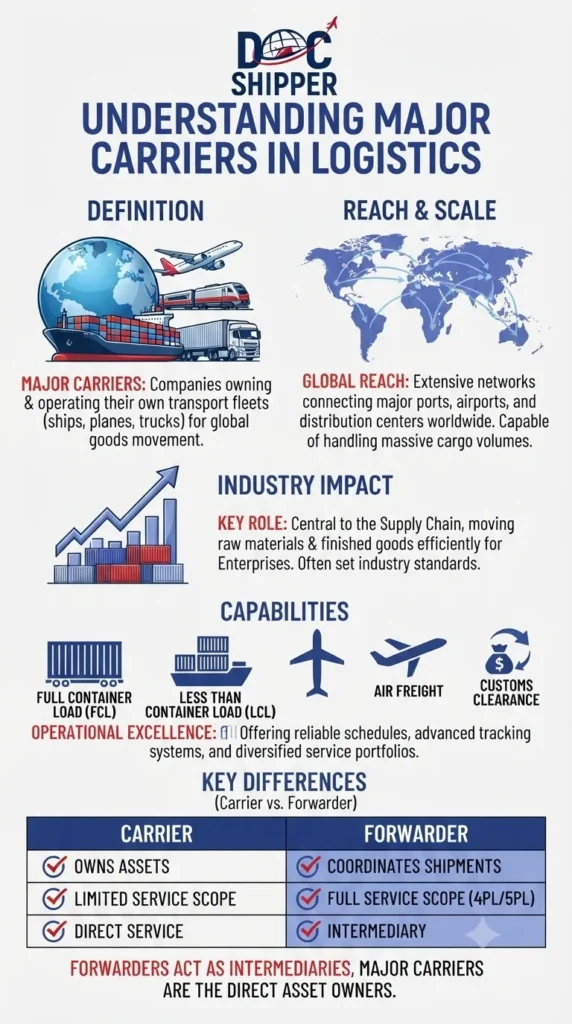
A Major Carrier is a large-scale shipping company operating extensive global networks for ocean freight, air cargo, or multimodal transport. These carriers handle high volumes of containerized goods, offer comprehensive service portfolios, and maintain strategic alliances with ports, terminals, and logistics hubs worldwide.
Introduction
Many importers struggle to differentiate between regional freight forwarders and true major carriers. This distinction directly impacts shipping reliability, pricing structures, and transit times. In international trade, major carriers control the infrastructure that moves 90% of global merchandise.
Understanding major carriers is essential because they set industry standards for containerization, capacity management, and route optimization. Their operational scale influences everything from freight rates during peak seasons to the availability of specialized equipment like reefer containers.
- Global fleet ownership: Major carriers operate or lease thousands of vessels and aircraft.
- Alliance participation: They form strategic partnerships to expand route coverage.
- Infrastructure control: Direct ownership or long-term leases of terminal facilities.
- Technology integration: Advanced tracking systems and digital booking platforms.
- Financial stability: Market capitalization enabling sustained service during economic downturns.
Operational Framework & Industry Dominance
Major carriers operate through vertically integrated models. They control vessel deployment, container leasing, port slot allocations, and increasingly, inland transportation networks. This integration allows end-to-end visibility and reduces dependency on third-party service providers.
The shipping alliance system defines carrier positioning. The three dominant ocean freight alliances—2M Alliance, Ocean Alliance, and THE Alliance—enable carriers to share vessel space, optimize routes, and maintain service frequency without individual capacity risks. This cooperation exists within strict antitrust regulations established by the U.S. Federal Maritime Commission.
Financial resilience separates major carriers from smaller operators. During the COVID-19 pandemic, rate volatility saw container prices increase 600% on certain routes. Major carriers absorbed market shocks through their capital reserves and diversified service portfolios, while many regional players consolidated or exited.
Fleet modernization remains a competitive differentiator. Major carriers invest billions in ultra-large container vessels (ULCVs) exceeding 24,000 TEU capacity. These vessels achieve economies of scale that reduce per-unit transportation costs, though they require specialized port infrastructure.
At DocShipper, we maintain direct contractual relationships with all major carriers. This ensures our clients access preferential rates, guaranteed space allocations during peak seasons, and priority handling for time-sensitive shipments. Our carrier management team monitors service performance metrics to optimize routing decisions continuously.
Market Position & Comparative Data
The global shipping industry concentrates around ten major carriers controlling approximately 85% of container capacity. Market share fluctuates based on fleet expansion, mergers, and alliance reconfigurations.
| Carrier | TEU Capacity (2024) | Alliance | Primary Routes |
|---|---|---|---|
| MSC | 4.9 million | 2M Alliance | Europe-Asia, Transpacific |
| Maersk | 4.3 million | 2M Alliance | Global coverage |
| COSCO | 3.1 million | Ocean Alliance | Asia-Europe, Intra-Asia |
| CMA CGM | 3.0 million | Ocean Alliance | Transpacific, Mediterranean |
| Hapag-Lloyd | 1.8 million | THE Alliance | Europe-Asia, Americas |
Use Case: An electronics importer shipping 40 containers monthly from Shenzhen to Rotterdam faces carrier selection. Choosing MSC provides weekly service frequency and terminal prioritization at Europe’s largest port. The 2M Alliance guarantees backup sailings if vessel delays occur.
Service differentiation extends beyond capacity. Major carriers offer specialized services: temperature-controlled logistics for pharmaceuticals, hazmat certification for chemical shipments, and oversized cargo handling for project freight. Their investment in digital platforms enables real-time container tracking through APIs integrated with enterprise resource planning systems.
Pricing structures reflect carrier positioning. Contract rates negotiated with major shippers provide volume discounts up to 40% below spot market prices. However, these contracts include minimum quantity commitments and penalty clauses for cargo rollovers.
Environmental regulations increasingly favor major carriers. The International Maritime Organization’s IMO 2050 decarbonization targets require substantial capital investment in alternative fuels and vessel retrofitting. Larger carriers access financing mechanisms unavailable to smaller operators, accelerating their transition to LNG-powered vessels and biofuel adoption.
Conclusion
Major carriers form the backbone of global supply chains through their operational scale, financial resources, and infrastructure control. Understanding their service capabilities and market positioning enables strategic shipping decisions that balance cost, reliability, and transit time requirements.
Need expert guidance on carrier selection for your import/export operations? Contact DocShipper for personalized logistics consultation.
📚 Quiz
Test Your Knowledge: Major Carrier
What is the primary defining characteristic of a Major Carrier in international shipping?
How do shipping alliances (2M Alliance, Ocean Alliance, THE Alliance) impact service reliability for customers of major carriers?
An electronics manufacturer ships 25 containers monthly from Shanghai to Los Angeles. What advantage would they gain by negotiating directly with a major carrier versus using a freight forwarder?
🎯 Your Result
📞 Free Quote in 24hFAQ | Major Carrier: Definition, Role & Concrete Examples in International Shipping
Major carriers own or lease transportation assets (vessels, aircraft, containers) and operate scheduled services. Freight forwarders act as intermediaries, booking cargo space with carriers but not operating transport equipment. Major carriers control capacity and routing decisions, while forwarders optimize logistics through carrier network aggregation.
Alliances enable carriers to share vessel space and coordinate schedules, increasing service frequency on key trade lanes. If one member's vessel experiences delays, alliance partners provide backup capacity. This redundancy improves schedule reliability by 15-20% compared to independent carrier operations, according to Drewry Maritime Research.
Not automatically. Major carriers provide volume discounts through annual contracts, but spot rates fluctuate based on supply-demand dynamics. Smaller niche carriers sometimes offer lower rates on specific routes where they concentrate capacity. Rate competitiveness depends on shipment volume, route, and seasonal demand patterns.
Major carriers maintain diverse container fleets: standard dry containers (20'/40'), high-cube variants, refrigerated containers (reefers), open-top containers, flat racks, and tank containers. Specialized equipment availability varies by carrier; some maintain dedicated reefer fleets exceeding 500,000 units for perishable goods transportation.
Carriers provide basic liability coverage under the Hague-Visby Rules, limiting compensation to approximately $500 per package. This rarely covers full cargo value. Shippers must purchase separate marine cargo insurance. Major carriers maintain claims departments but process disputes through their standard terms and conditions, which limit liability exposure.
Yes. Major carriers offer web portals and mobile applications with GPS-based container tracking. Advanced systems provide milestone notifications (gate-in, vessel departure, port arrival). However, tracking accuracy varies by carrier technology investment. Some offer API integration for automated supply chain visibility within enterprise systems.
Carrier bankruptcies disrupt supply chains significantly. Cargo in transit may be held at ports pending legal resolution. Major carrier bankruptcies are rare due to alliance support and government interventions. Recent industry consolidation (Hanjin collapse in 2016) led to stricter financial monitoring by regulatory authorities and increased alliance stability mechanisms.
Yes. Carriers prioritize high-value cargo, long-term contract customers, and shipments with premium service surcharges. During capacity constraints, spot-market bookings face higher rollover risks. Contract shippers with minimum quantity commitments receive guaranteed space allocations, even when vessel utilization exceeds 100% of nominal capacity.
Detention applies when containers remain with consignees beyond free time (typically 5-7 days). Demurrage charges accrue when containers aren't retrieved from port terminals within the free period. Major carriers set rates between $75-150 per container daily, escalating after initial grace periods. Charges vary by port, equipment type, and contract terms.
Major carriers invest in slow steaming (reduced vessel speeds to cut fuel consumption), LNG-powered vessels, biofuel testing, and shore power connectivity at terminals. Maersk committed to carbon-neutral operations by 2040, while CMA CGM operates dual-fuel vessels. Industry-wide initiatives include participation in the Sea Cargo Charter for emissions transparency.
Direct negotiation requires substantial annual shipping volumes, typically exceeding 1,000 TEUs. Smaller shippers access carrier capacity through freight forwarders who aggregate volumes. Named Account Customers receive dedicated account management, flexible credit terms, and priority equipment availability. Contract negotiations occur annually, with rates locked for 12-month periods.
Carriers implement omission strategies, skipping congested ports and rerouting vessels to alternative terminals. They charge port congestion surcharges (typically $500-1,500 per container) on affected trade lanes. Major carriers maintain buffer capacity in their schedules to absorb delays, but extended congestion leads to blank sailings (canceled voyages) to reset schedule reliability.
Need Help with
Logistics or Sourcing ?
First, we secure the right products from the right suppliers at the right price by managing the sourcing process from start to finish. Then, we simplify your shipping experience - from pickup to final delivery - ensuring any product, anywhere, is delivered at highly competitive prices.


Fill the Form
Prefer email? Send us your inquiry, and we’ll get back to you as soon as possible.
Contact us




