


In short ⚡
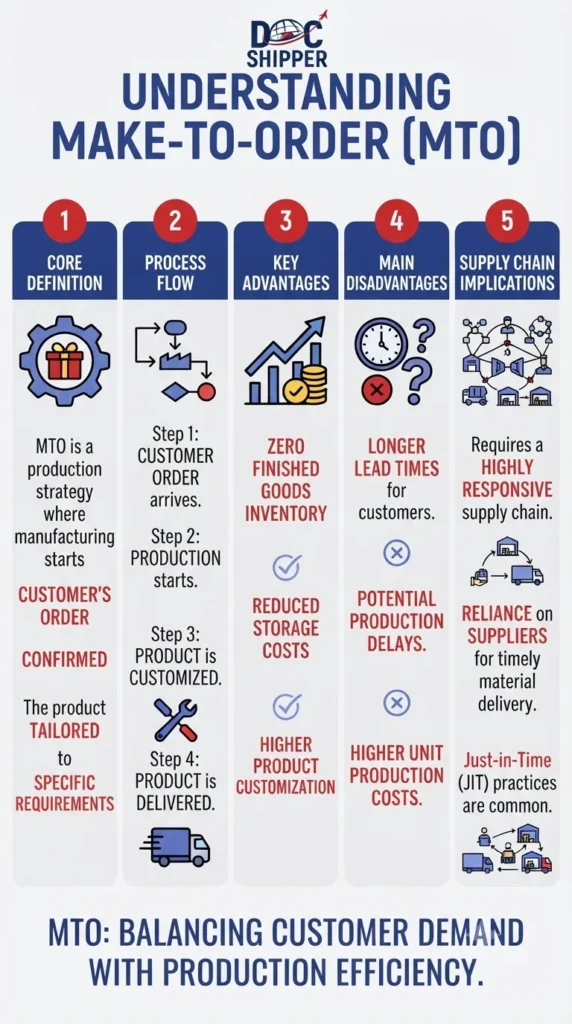
Make to Order (MTO) is a production strategy where manufacturing begins only after receiving a confirmed customer order. This approach minimizes inventory costs, reduces waste, and enables customization, making it ideal for specialized products, complex goods, or industries requiring tailored specifications. MTO contrasts with Make to Stock (MTS), where products are manufactured in advance based on demand forecasts.Introduction
Many businesses struggle with inventory management—holding excess stock ties up capital, while stockouts lead to lost sales. Make to Order eliminates this dilemma by synchronizing production precisely with customer demand. This strategy has become increasingly relevant as global supply chains shift toward customization and lean operations.
In international trade and logistics, MTO impacts lead times, supply chain coordination, and shipping schedules. Understanding when and how to implement this model is critical for businesses seeking operational efficiency without compromising customer satisfaction.
- Zero finished goods inventory: Products are manufactured only after order confirmation, reducing storage costs.
- High customization potential: Ideal for tailored products meeting specific customer requirements.
- Extended lead times: Production starts post-order, which may delay delivery compared to MTS models.
- Capital efficiency: Frees up working capital previously locked in unsold inventory.
- Supply chain complexity: Requires robust coordination with suppliers to ensure raw material availability.
MTO Implementation & Strategic Considerations
Adopting a Make to Order strategy requires careful planning across procurement, production, and logistics. The model works best when demand is unpredictable, products have high customization requirements, or inventory holding costs are prohibitive. However, it demands agile supply chains and reliable supplier networks.
From a regulatory standpoint, MTO operations must comply with country-specific manufacturing standards and customs regulations. For instance, the European Union’s CE marking requirements apply regardless of production method. Similarly, products destined for the U.S. market must meet Consumer Product Safety Commission (CPSC) standards before shipment.
Lead time management is the most critical factor in MTO success. Businesses must accurately communicate production timelines to customers while maintaining buffer capacity for supplier delays. Typical MTO lead times range from 2 to 12 weeks, depending on product complexity and raw material sourcing.
Raw material procurement becomes a strategic priority. Unlike MTS models where components are stocked, MTO requires just-in-time supplier coordination. Companies often negotiate long-term contracts with suppliers to ensure availability without holding excess inventory. This approach reduces risk but demands strong vendor relationships.
At DocShipper, we assist MTO businesses with supply chain orchestration, ensuring raw materials arrive precisely when production begins. Our logistics expertise minimizes delays, helping clients maintain competitive lead times while avoiding inventory buildup.
Production flexibility is another key consideration. MTO facilities must accommodate variable order sizes and specifications. This often requires modular production lines, cross-trained staff, and adaptable manufacturing systems. The trade-off is higher per-unit costs compared to mass production but lower overall inventory risk.
Concrete Examples & Industry Data
Make to Order is widely used across industries where customization or complexity makes pre-production impractical. Approximately 40% of manufacturing companies in the aerospace, heavy machinery, and custom furniture sectors operate primarily under MTO models, according to industry surveys.
Case Study: Custom Machinery Export
A European industrial equipment manufacturer receives an order for a specialized CNC machine destined for a Brazilian client. Production begins only after contract signing and 30% deposit payment. The manufacturing cycle lasts 8 weeks, followed by 2 weeks for quality testing and export documentation preparation.
- Order confirmation: Week 0 – Contract signed, production planning initiated.
- Material procurement: Weeks 1-2 – Components ordered from certified suppliers.
- Manufacturing: Weeks 3-10 – Assembly, calibration, and testing.
- Export preparation: Weeks 11-12 – Compliance verification, packing, customs clearance.
- Shipping: Week 13 – Maritime transport to Santos port (28-day transit).
This timeline demonstrates typical MTO coordination. The manufacturer avoids storing finished goods while the customer receives a product meeting exact specifications. DocShipper manages export documentation and freight forwarding, ensuring the machine arrives compliant and on schedule.
Industry Comparison: MTO vs. MTS Lead Times
| Industry Sector | MTO Lead Time | MTS Lead Time | Primary Driver |
|---|---|---|---|
| Aerospace Components | 12-16 weeks | Not applicable | Regulatory compliance, high value |
| Custom Furniture | 4-8 weeks | 1-2 weeks | Personalization requirements |
| Industrial Machinery | 8-12 weeks | Not applicable | Complex engineering, high cost |
| Automotive (Standard) | 6-10 weeks | Immediate | Dealer inventory preference |
| Consumer Electronics | 2-4 weeks | Same day | Mass market demand predictability |
Financial Impact
Implementing MTO can reduce inventory carrying costs by 60-80% while increasing per-unit production costs by approximately 15-25%. The net effect depends on product characteristics and demand volatility. High-value, low-volume products benefit most from this trade-off.
Conclusion
Make to Order offers a compelling solution for businesses seeking inventory optimization and product customization. While it requires sophisticated supply chain coordination and transparent customer communication, the financial and operational benefits often outweigh the challenges for suitable product categories.
Need support implementing or managing an MTO logistics strategy? Contact DocShipper for tailored supply chain solutions that align production with global shipping timelines.
📚 Quiz
Test Your Knowledge: Make to Order (MTO)
1. What is the fundamental defining characteristic of Make to Order production strategy?
2. A company claims MTO eliminates all inventory costs. Is this interpretation correct?
3. An aerospace manufacturer receives an order for specialized aircraft components. Which production approach should they choose?
🎯 Your Result
📞 Free Quote in 24hFAQ | Make to Order (MTO): Definition, Implementation & Real-World Examples
Make to Order (MTO) starts production only after receiving a customer order, while Make to Stock (MTS) manufactures products in advance based on demand forecasts. MTO minimizes inventory risk but extends delivery times, whereas MTS enables immediate fulfillment at the cost of potential overstock or obsolescence.
Industries with high customization requirements, expensive components, or low-volume specialized products benefit most. Examples include aerospace manufacturing, custom machinery, luxury furniture, industrial equipment, and specialized automotive modifications. These sectors prioritize personalization over rapid fulfillment.
MTO extends total order-to-delivery timelines by adding production duration before shipping begins. However, it allows precise shipping schedule coordination since production completion dates are known in advance. This predictability can actually improve logistics planning compared to MTS stockout scenarios requiring emergency airfreight.
Lead times vary significantly by industry and product complexity. Simple customized products may require 2-4 weeks, while complex machinery or aerospace components can take 12-16 weeks or longer. Accurate lead time communication is essential for customer satisfaction in MTO models.
Yes. MTO eliminates the need to finance finished goods inventory, freeing up capital that would otherwise be tied up in unsold stock. However, raw material procurement still requires working capital, though typically less than maintaining full finished goods inventory under an MTS model.
Primary risks include supplier delays causing production bottlenecks, longer customer wait times potentially reducing competitiveness, difficulty scaling for sudden demand increases, and higher sensitivity to raw material price fluctuations. Effective risk management requires strong supplier relationships and transparent customer communication.
Customs procedures remain identical to MTS products, but documentation timing differs. MTO products are classified, valued, and documented after manufacturing completion. This allows for accurate HS code classification and precise commercial invoice preparation based on actual specifications rather than forecasted product features.
It depends on product type and customer expectations. E-commerce typically demands rapid fulfillment, making MTO challenging for mass-market products. However, it works well for customized goods, luxury items, or niche products where customers accept longer lead times in exchange for personalization or exclusivity.
Flexible manufacturing systems, modular production lines, advanced ERP software with real-time inventory tracking, and additive manufacturing (3D printing) technologies support MTO effectively. These tools enable rapid production reconfiguration and efficient handling of variable order specifications without extensive downtime.
Transition requires analyzing demand predictability, negotiating just-in-time supplier agreements, implementing flexible production systems, training staff for variable workflows, and gradually shifting product lines based on customization potential. Pilot programs with select product categories help validate the approach before full-scale implementation.
MTO does not inherently change quality standards or warranty obligations. However, the made-to-specification nature often allows for more rigorous quality control during production since each unit is individually monitored. Warranty terms remain governed by applicable consumer protection laws and contractual agreements regardless of production method.
Deposits protect manufacturers from order cancellations after production begins. Typical deposits range from 30-50% of total order value, paid upon contract signing before manufacturing starts. This financial commitment reduces buyer-side risk for the manufacturer while demonstrating customer seriousness, enabling confident material procurement.
Need Help with
Logistics or Sourcing ?
First, we secure the right products from the right suppliers at the right price by managing the sourcing process from start to finish. Then, we simplify your shipping experience - from pickup to final delivery - ensuring any product, anywhere, is delivered at highly competitive prices.


Fill the Form
Prefer email? Send us your inquiry, and we’ll get back to you as soon as possible.
Contact us




:%20Definition,%20Implementation%20&%20Real-World%20Examples)