


In short ⚡
Management of All Logistics encompasses the comprehensive coordination, planning, and execution of all supply chain activities—from procurement and warehousing to transportation and distribution. This holistic approach ensures seamless product flow, cost optimization, and customer satisfaction across international and domestic operations.
Introduction
Many businesses struggle with fragmented logistics operations. Different teams manage procurement, inventory, shipping, and delivery independently. This creates communication gaps, redundant costs, and delivery delays.
Management of All Logistics offers a unified solution. It integrates every logistics function under a single strategic framework. This approach is critical for companies operating in complex international markets where regulatory compliance, multi-modal transport, and real-time visibility determine competitive advantage.
Key characteristics of comprehensive logistics management include:
- End-to-end visibility: Real-time tracking from factory gate to final delivery point
- Integrated planning: Synchronized inventory, transportation, and warehousing decisions
- Multi-modal coordination: Seamless transitions between sea, air, road, and rail transport
- Risk mitigation: Proactive identification and management of supply chain disruptions
- Cost optimization: Consolidated operations reduce redundancies and leverage economies of scale
This integrated approach transforms logistics from a cost center into a strategic enabler of business growth and customer satisfaction.
Deepening & Expertise
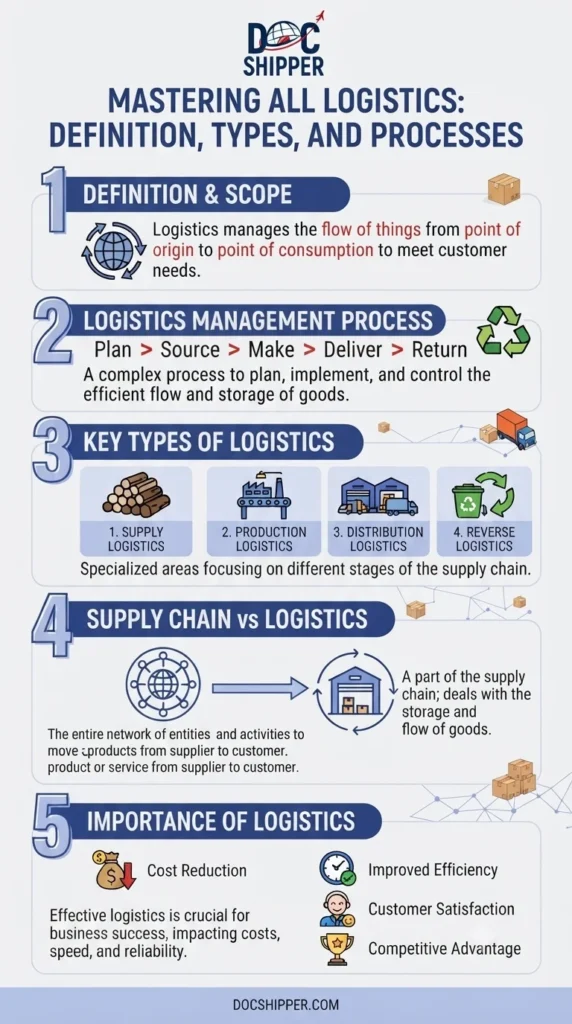
Management of All Logistics operates on five interconnected pillars that create a resilient supply chain ecosystem.
The first pillar is strategic procurement management. This involves supplier selection, contract negotiation, and quality assurance. Companies must balance cost efficiency with supply reliability. At DocShipper, we conduct thorough supplier audits to ensure manufacturing standards meet international requirements before initiating any shipment.
Second comes inventory optimization. Holding too much stock ties up capital. Too little creates stockouts and lost sales. Advanced demand forecasting combines historical data, market trends, and seasonal patterns. The optimal inventory level typically follows the Economic Order Quantity (EOQ) model, minimizing combined ordering and holding costs.
The third element is transportation network design. This determines optimal routing, carrier selection, and mode choice. International shipments require understanding Incoterms—the standardized trade terms published by the International Chamber of Commerce. These define responsibility transfer points between buyer and seller.
Warehousing and distribution form the fourth pillar. Strategic warehouse placement reduces last-mile delivery costs. Modern facilities employ cross-docking to minimize storage time. Products move directly from receiving to shipping, reducing handling and storage expenses by up to 30%.
Finally, technology integration ties everything together. Transportation Management Systems (TMS), Warehouse Management Systems (WMS), and Enterprise Resource Planning (ERP) platforms enable data-driven decision-making. Real-time dashboards provide visibility into shipment status, inventory levels, and performance metrics.
Legal compliance adds another layer of complexity. International shipments must navigate customs regulations, export controls, and documentation requirements that vary by country. The European Union’s Union Customs Code, for instance, mandates specific electronic declarations for all imports. DocShipper systematically verifies all required documents—from commercial invoices to certificates of origin—preventing costly customs delays.
Concrete Examples & Data
Let’s examine how integrated logistics management delivers measurable results through real-world scenarios and comparative data.
Comparative Cost Analysis: Fragmented vs. Integrated Logistics
| Cost Category | Fragmented Approach | Integrated Management | Savings |
|---|---|---|---|
| Transportation Costs | $850,000/year | $680,000/year | 20% |
| Inventory Holding | $420,000/year | $315,000/year | 25% |
| Warehousing | $290,000/year | $232,000/year | 20% |
| Administrative Overhead | $180,000/year | $108,000/year | 40% |
| Total Annual Costs | $1,740,000 | $1,335,000 | 23.3% |
This comparison demonstrates that integrated management reduces total logistics costs by nearly one-quarter through consolidated operations and strategic planning.
Use Case: Electronics Manufacturer Importing to Europe
A mid-size electronics company imports components from three Asian suppliers. Previously, each supplier arranged separate shipments, resulting in:
- Twelve separate ocean freight containers monthly
- Fragmented customs clearance procedures
- Three different warehouse locations across Europe
- Average delivery time: 42 days door-to-door
After implementing comprehensive logistics management:
- Consolidation strategy: Combined shipments reduced containers to eight monthly
- Single customs broker: Streamlined clearance through one authorized agent
- Centralized distribution: One strategically located European hub
- Optimized routing: Reduced delivery time to 28 days
- Cost reduction: $247,000 annual savings on a $1.1M logistics budget
The company also achieved better inventory turnover. By synchronizing procurement with demand forecasts, they reduced safety stock levels by 35% without increasing stockout risk.
Key Performance Indicators (KPIs) for Logistics Management
Successful implementation requires measuring five critical metrics:
- Order Accuracy Rate: Target ≥99.5% (orders delivered complete and correct)
- On-Time Delivery: Industry benchmark 95-98% within promised window
- Logistics Cost as % of Sales: Optimal range 8-12% depending on industry
- Inventory Turnover Ratio: Higher ratios indicate efficient stock management
- Cash-to-Cash Cycle Time: Days between paying suppliers and receiving customer payment
Companies implementing integrated management typically see a 15-30% improvement across these KPIs within the first 18 months.
Conclusion
Management of All Logistics transforms fragmented operations into a cohesive competitive advantage. By integrating procurement, transportation, warehousing, and distribution under unified strategic oversight, companies achieve significant cost reductions and service improvements.
Need support optimizing your international logistics operations? Contact DocShipper for expert guidance tailored to your supply chain requirements.
📚 Quiz
Test Your Knowledge: Management of All Logistics
What is the primary defining characteristic of Management of All Logistics?
A common misconception is that Management of All Logistics is the same as basic transportation management. Which statement correctly distinguishes them?
Your electronics company imports components from multiple Asian suppliers. Which approach best demonstrates Management of All Logistics principles?
🎯 Your Result
📞 Free Personalized QuoteFAQ | Management of All Logistics: Definition, Strategies & Concrete Examples
Logistics management focuses specifically on the movement and storage of goods—transportation, warehousing, inventory control, and order fulfillment. Supply chain management is broader, encompassing the entire network from raw material sourcing through manufacturing to end customer delivery, including supplier relationships, demand planning, and product development. Logistics is a critical component within the larger supply chain framework.
Modern logistics technology provides real-time visibility, predictive analytics, and automation. Transportation Management Systems optimize routing and carrier selection. Warehouse Management Systems automate picking and packing. IoT sensors track shipment conditions. AI-powered forecasting improves demand planning accuracy. These tools collectively reduce manual errors, accelerate processing times, and enable data-driven decision-making that cuts costs by 15-25%.
International operations face multiple complexities: varying customs regulations across jurisdictions, documentation requirements for cross-border shipments, currency fluctuations affecting costs, longer transit times increasing inventory carrying expenses, and coordination across multiple time zones. Political instability, port congestion, and trade policy changes add further uncertainty requiring proactive risk management strategies.
Costs vary significantly based on shipment volume, geographic scope, and service requirements. Small businesses might spend $50,000-150,000 annually for third-party logistics management. Mid-size companies typically invest $200,000-800,000. Large enterprises with global operations may exceed $5 million yearly. However, integrated management typically reduces total logistics expenses by 18-28% compared to fragmented approaches, delivering positive ROI within 12-18 months.
3PL providers offer outsourced logistics services including warehousing, transportation, freight forwarding, and customs brokerage. They leverage specialized expertise, established carrier relationships, and technology infrastructure that individual companies would find costly to develop internally. Quality 3PLs provide scalability, allowing businesses to expand operations without capital investment in facilities or vehicles, while maintaining focus on core competencies.
Incoterms define precisely when responsibility and risk transfer from seller to buyer during international shipments. They determine who pays for transportation, insurance, and customs duties at each stage. Choosing the appropriate Incoterm impacts total landed costs, liability exposure, and operational control. For example, DDP (Delivered Duty Paid) places maximum responsibility on the seller, while EXW (Ex Works) transfers responsibility immediately upon pickup.
EOQ calculates the optimal order quantity that minimizes total inventory costs—combining ordering expenses and holding costs. The formula is: EOQ = √(2DS/H), where D represents annual demand, S is ordering cost per order, and H is annual holding cost per unit. This model helps determine how much to order and when, balancing the cost of placing frequent small orders against the expense of storing large quantities.
Last-mile delivery represents 28-35% of total logistics costs. Reduction strategies include: strategic warehouse placement near population centers, route optimization software to minimize distance traveled, delivery time windows to consolidate stops, alternative delivery points like lockers or pickup stations, and leveraging local courier partnerships. Some companies reduce costs by 20-40% through multi-carrier shipping platforms that automatically select the most cost-effective option.
Essential documents include: commercial invoice detailing goods and values, packing list describing shipment contents, bill of lading or air waybill as transport contract, certificate of origin proving manufacturing location, customs declarations for import clearance, and insurance certificates if applicable. Specialized products may require additional permits—phytosanitary certificates for agricultural goods, safety data sheets for hazardous materials, or conformity certificates for regulated products.
Customs clearance involves submitting required documentation to government authorities, paying applicable duties and taxes, and obtaining release authorization. Efficient clearance requires accurate product classification using HS codes, proper valuation declarations, and compliance with import regulations. Licensed customs brokers expedite this process through established relationships and electronic submission systems. Delays typically occur due to incomplete documentation or classification disputes.
Cross-docking transfers incoming goods directly from receiving docks to outbound shipping, bypassing warehouse storage. Products spend less than 24 hours in the facility. This strategy works best for: fast-moving consumer goods with predictable demand, time-sensitive products like fresh produce, consolidated shipments requiring rapid redistribution, and high-volume operations with reliable supplier schedules. Cross-docking reduces handling costs by 30-50% and accelerates delivery times.
Resilient logistics management requires: maintaining diversified supplier and carrier networks to avoid single points of failure, building strategic safety stock for critical items, implementing real-time tracking for rapid problem identification, establishing clear contingency protocols for common disruptions, maintaining strong relationships with logistics partners for priority support, and regularly stress-testing supply chains through scenario planning. Companies with formal risk management programs experience 40% shorter recovery times from disruptions.
Need Help with
Logistics or Sourcing ?
First, we secure the right products from the right suppliers at the right price by managing the sourcing process from start to finish. Then, we simplify your shipping experience - from pickup to final delivery - ensuring any product, anywhere, is delivered at highly competitive prices.


Fill the Form
Prefer email? Send us your inquiry, and we’ll get back to you as soon as possible.
Contact us




