


In short ⚡
Manufacturing Lead Time is the total duration required to transform raw materials into finished goods ready for shipment, from order placement to production completion. It encompasses pre-production preparation, actual manufacturing processes, quality control, and final packaging stages—a critical metric for supply chain planning and customer delivery commitments.
Introduction
Many importers confuse manufacturing lead time with total delivery time, leading to costly inventory shortages or rushed air freight expenses. This distinction becomes critical when coordinating international purchase orders with seasonal demand peaks or contractual delivery deadlines.
In global supply chains, manufacturing lead time directly impacts cash flow cycles, warehouse space optimization, and customer satisfaction rates. Miscalculating this variable creates a domino effect—delayed production means missed shipping windows, demurrage fees at ports, and potential loss of market opportunities.
Understanding this metric allows businesses to:
- Establish realistic order placement schedules aligned with market demands
- Negotiate favorable payment terms based on production timelines
- Optimize inventory turnover by synchronizing production with sales velocity
- Mitigate risks through accurate contingency planning and supplier diversification
- Enhance competitiveness through faster time-to-market strategies
Technical Components & Strategic Implications
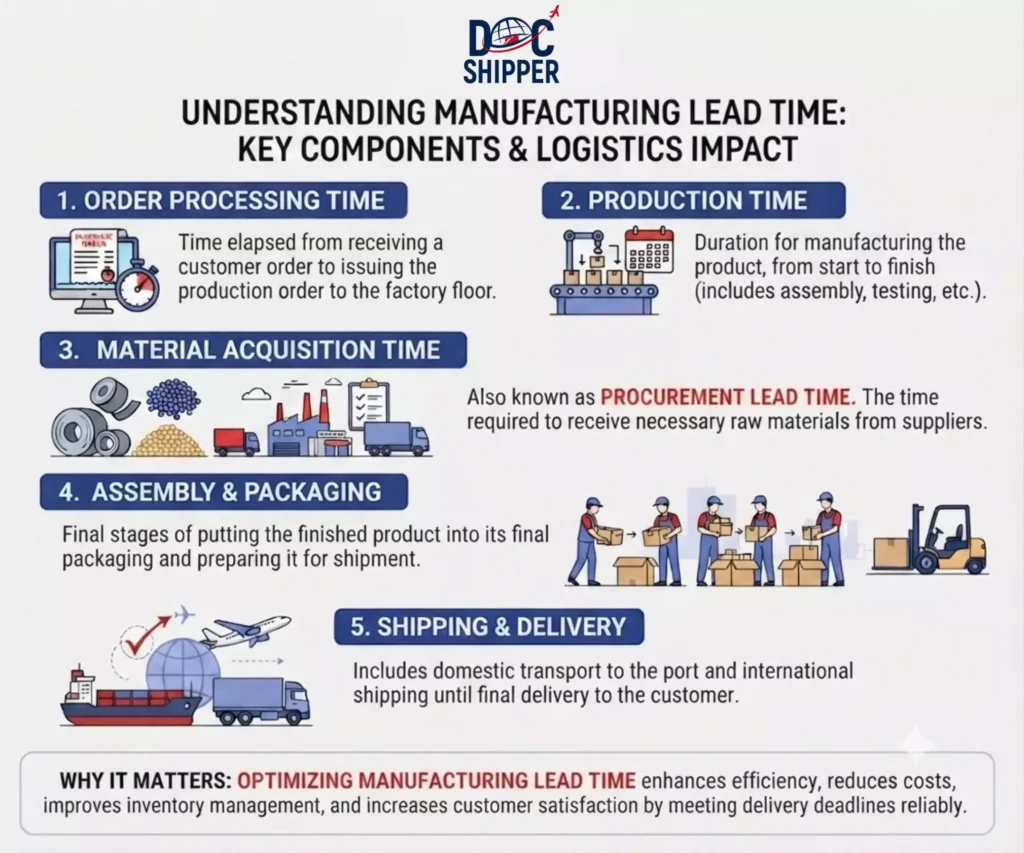
Manufacturing lead time comprises several interconnected phases that vary significantly across industries and production methodologies. The pre-production phase includes material sourcing, design finalization, tooling preparation, and workforce allocation—often consuming 20-40% of total lead time in custom manufacturing scenarios.
The production cycle itself depends on manufacturing complexity, batch sizes, and equipment availability. High-mix low-volume operations typically require longer setup times between product changes, while continuous production lines optimize throughput at the expense of flexibility. Quality control checkpoints extend timelines but reduce costly post-shipment defects that jeopardize client relationships.
A critical yet frequently overlooked component is resource availability. Raw material stockouts, skilled labor shortages, or machine downtime can double projected lead times. Seasonal fluctuations in manufacturing capacity—particularly in Asian production hubs during Lunar New Year or Golden Week—require advance planning to avoid production bottlenecks.
The post-production phase includes final inspections, packaging customization, and preparation for shipment. Export-oriented manufacturers must factor in compliance documentation, labeling requirements per destination country regulations, and consolidation timelines if combining multiple SKUs into a single shipment.
According to the International Trade Administration, optimizing manufacturing lead time has become a competitive differentiator, with companies achieving 15-25% reductions through digital production planning tools and supplier collaboration platforms.
At DocShipper, we systematically monitor manufacturing milestones for our clients, providing real-time production updates and intervening proactively when delays threaten delivery commitments—ensuring seamless coordination between factory floors and destination warehouses.
Calculation Methods & Real-World Scenarios
Manufacturing lead time calculation follows this fundamental formula:
MLT = Pre-Production Time + Processing Time + Post-Production Time + Buffer Time
Consider a practical scenario: A European retailer orders 5,000 units of custom textiles from a Vietnamese manufacturer. The breakdown illustrates typical timeline variables:
| Production Phase | Duration | Critical Factors |
|---|---|---|
| Material Procurement | 7-10 days | Fabric availability, dye lot matching |
| Pattern Creation & Sampling | 5-7 days | Client approval cycles, design complexity |
| Cutting & Stitching | 12-15 days | Order quantity, production line allocation |
| Quality Inspection & Packaging | 3-4 days | QC standards, packaging specifications |
| Buffer (Contingency) | 3-5 days | Unforeseen delays, rework requirements |
| Total Manufacturing Lead Time | 30-41 days | — |
Industry benchmarks reveal significant variation by sector. Electronics manufacturing typically requires 45-90 days due to component lead times and testing protocols. Conversely, standardized injection molding operations may complete orders in 15-25 days when tooling exists and materials are stocked.
A comparative analysis of manufacturing strategies shows:
- Made-to-Stock (MTS): Minimal lead time (3-7 days) since products are pre-manufactured, but carries inventory holding costs and obsolescence risks
- Made-to-Order (MTO): Moderate lead time (20-40 days) balancing customization with production efficiency
- Engineer-to-Order (ETO): Extended lead time (60-120 days) for highly customized products requiring design engineering
- Assemble-to-Order (ATO): Shortened lead time (10-20 days) by pre-manufacturing components and final assembly upon order confirmation
Advanced manufacturers implement concurrent engineering techniques to compress timelines—overlapping design, procurement, and production phases rather than executing sequentially. This approach can reduce total lead time by 25-35% but requires sophisticated project management and supplier coordination.
Conclusion
Manufacturing lead time remains a fundamental metric that shapes inventory strategies, pricing competitiveness, and customer relationships in international trade. Mastering its calculation and management transforms reactive logistics into proactive supply chain orchestration.
Need expert guidance on optimizing your manufacturing timelines and logistics coordination? Contact DocShipper for tailored solutions that synchronize production schedules with global shipping requirements.
📚 Quiz
Test Your Knowledge: Manufacturing Lead Time
Manufacturing lead time encompasses which complete production scope?
Which statement accurately reflects how customization level affects manufacturing timelines?
An electronics importer needs products delivered by November 15 for holiday sales. When should they place the order, considering typical manufacturing lead times and ocean freight transit?
🎯 Your Result
📞 Free Quote in 24hFAQ | Manufacturing Lead Time: Definition, Calculation & Practical Examples
Manufacturing lead time measures only the production phase—from raw material processing to finished goods completion. Total order lead time encompasses the entire cycle including order processing, manufacturing, quality inspections, international shipping, customs clearance, and final delivery. For international shipments, total lead time typically exceeds manufacturing time by 15-45 days depending on transportation mode and destination customs efficiency.
Raw material shortages top the list, particularly for specialized components with limited suppliers. Equipment breakdowns, workforce shortages during peak seasons, design revision requests mid-production, and quality control failures requiring rework also frequently add 7-21 days. External factors like power outages in manufacturing regions or regulatory changes affecting production permits can cause unpredictable delays requiring contingency planning.
Yes, through strategic interventions: pre-ordering long-lead materials, implementing parallel production processes, optimizing machine changeover times, and establishing preferred supplier agreements with guaranteed capacity allocation. Advanced manufacturing techniques like 3D printing for prototypes and modular production systems can compress timelines by 20-40% while maintaining quality standards through automated inspection technologies.
Importers should backdate from target delivery dates, adding manufacturing lead time plus international transit (typically 30-45 days for ocean freight). For seasonal peaks like holiday retail, orders should be placed 4-6 months in advance, factoring potential delays. Splitting orders across multiple manufacturers reduces dependency risks, while maintaining buffer stock covers unexpected production slowdowns during high-demand periods.
Effective contracts include penalty clauses for late delivery (typically 0.5-2% of order value per week delayed), milestone-based payment schedules linking funds release to production progress, and force majeure definitions limiting excusable delays. Inspection rights at various production stages and clear acceptance criteria prevent disputes. Including alternative supplier provisions allows order transfer if delays exceed defined thresholds, protecting buyer interests.
Premium suppliers often deliver 15-30% faster through dedicated production lines, priority access to quality materials, and experienced workforces reducing error rates. Low-cost suppliers may extend timelines due to capacity sharing across multiple clients, reliance on cheaper but slower material sources, and higher rejection rates requiring rework. However, some cost-competitive manufacturers achieve comparable speeds through automation investments and efficient process management.
Higher MOQs typically justify dedicated production runs, reducing per-unit lead time by eliminating line changeover delays. Orders below MOQ thresholds often face extended timelines as manufacturers batch small orders together. Strategic buyers negotiate MOQ reductions by committing to annual volume targets or accepting slightly longer lead times. Understanding this relationship allows optimized order sizing that balances inventory costs against production efficiency.
Cloud-based production management systems provide real-time milestone tracking, alerting stakeholders to delays immediately. IoT sensors on manufacturing equipment predict maintenance needs before breakdowns occur. AI-powered demand forecasting helps manufacturers pre-position materials, reducing procurement delays. Blockchain integration creates transparent, immutable production records that streamline quality verification and reduce inspection times by 20-35%.
Factory audits reveal capacity utilization rates, equipment condition, workforce stability, and material inventory levels—critical indicators of lead time reliability. Observing production workflows identifies bottlenecks not apparent in supplier quotations. Third-party inspection services provide objective assessments for importers unable to visit personally. Annual audits for strategic suppliers ensure continued capability as production volumes scale, preventing surprises during peak order periods.
Standard products leverage existing tooling and proven processes, minimizing lead time to 15-30 days. Minor customizations (color changes, logo placement) add 5-10 days for setup and sampling. Moderate modifications requiring new molds or patterns extend timelines to 35-50 days. Fully custom designs necessitate 60-90+ days for engineering, prototyping, and production refinement. Buyers should balance customization benefits against inventory velocity requirements when specifying product features.
Apparel and textiles typically require 30-45 days for standard items, 60-90 days for fully customized fashion. Electronics span 45-120 days depending on component sourcing complexity. Furniture ranges from 40-70 days based on materials and finishing requirements. Promotional products average 25-40 days with established suppliers. Machinery and industrial equipment extend to 90-180 days due to engineering specifications and testing protocols. These benchmarks serve as negotiation baselines when evaluating supplier quotations.
Trade policy changes can redirect material sourcing, adding 10-20 days as suppliers qualify new vendors. Tariff uncertainties may prompt manufacturers to delay production pending regulatory clarity. Regional conflicts disrupt logistics networks, extending lead times by 15-45 days through rerouted shipments. Currency fluctuations affect material affordability, causing suppliers to seek alternative sources mid-production. Diversifying manufacturing across multiple countries mitigates these risks, though coordination complexity increases project management demands.
Need Help with
Logistics or Sourcing ?
First, we secure the right products from the right suppliers at the right price by managing the sourcing process from start to finish. Then, we simplify your shipping experience - from pickup to final delivery - ensuring any product, anywhere, is delivered at highly competitive prices.


Fill the Form
Prefer email? Send us your inquiry, and we’ll get back to you as soon as possible.
Contact us




