


In short ⚡
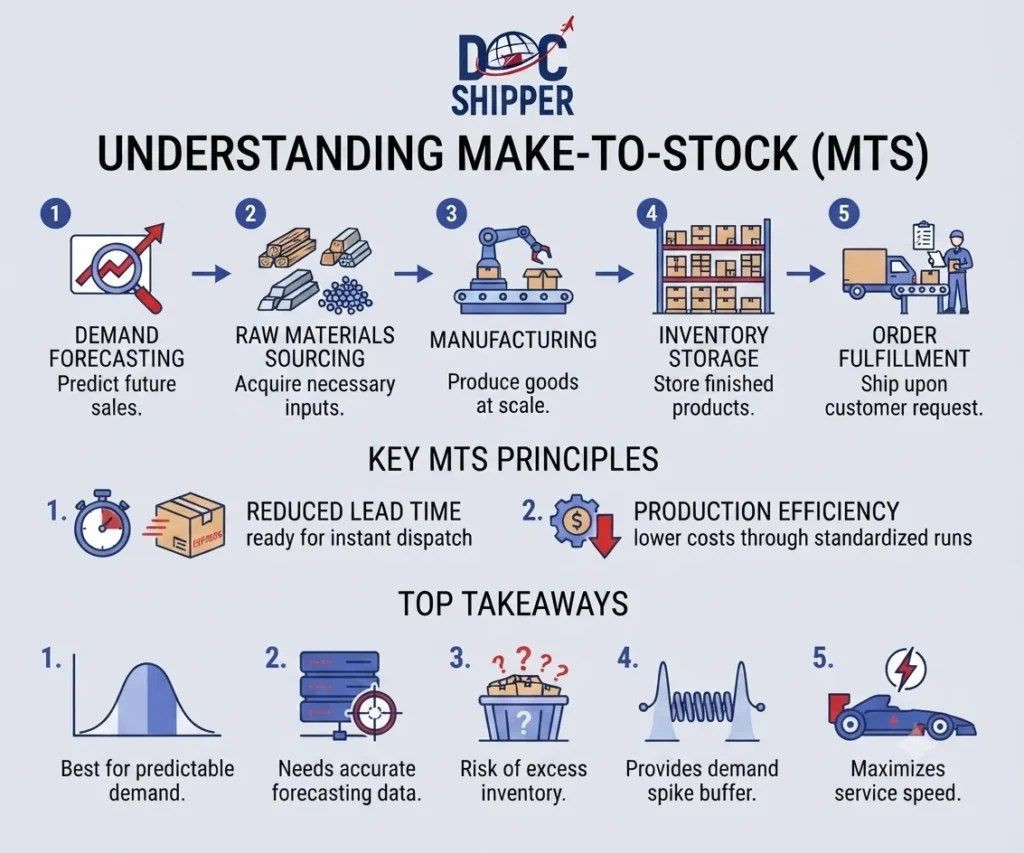
Make to Stock (MTS) is a production strategy where manufacturers produce goods in advance based on demand forecasts, storing finished products in inventory before customer orders arrive. This approach enables immediate order fulfillment but requires accurate demand prediction to minimize excess inventory costs and stockout risks.
Introduction
Many importers struggle with the dilemma: should you manufacture products before orders arrive, or wait for confirmed demand? This decision fundamentally shapes your entire supply chain, affecting cash flow, delivery times, and customer satisfaction.
Make to Stock represents a proactive manufacturing philosophy where production precedes sales. Unlike Make to Order strategies, MTS prioritizes speed and availability over customization, making it essential for standardized products in competitive markets.
This production model dominates industries where:
- Product standardization allows mass production without customization
- Demand predictability enables accurate forecasting and planning
- Fast fulfillment creates competitive advantage in the marketplace
- Economies of scale reduce per-unit costs through batch production
- Shelf stability permits extended storage without product degradation
MTS Mechanisms & Strategic Implementation
The Make to Stock approach operates on a forecast-driven production cycle. Manufacturers analyze historical sales data, market trends, and seasonal patterns to determine optimal production volumes. This forecast becomes the blueprint for production scheduling, material procurement, and inventory management.
Production begins weeks or months before anticipated demand. Raw materials are ordered, manufacturing lines operate continuously, and finished goods accumulate in warehouses. This proactive stance eliminates production lead time from the customer experience, enabling same-day or next-day shipping—a critical advantage in e-commerce and retail sectors.
However, MTS introduces significant inventory holding costs. Warehousing expenses, insurance, obsolescence risk, and tied-up capital create financial pressure. Companies must balance these costs against the revenue benefits of immediate availability. According to Investopedia’s analysis, inventory carrying costs typically range from 20% to 30% of inventory value annually.
The strategy requires sophisticated demand forecasting systems. Statistical models, machine learning algorithms, and collaborative planning with retailers improve accuracy. Forecast errors create two opposite problems: stockouts lose immediate sales and damage customer relationships, while overproduction generates dead stock that may require discounting or disposal.
Safety stock calculations become critical in MTS environments. This buffer inventory protects against demand variability and supply disruptions. The safety stock level depends on service level targets, demand volatility, and replenishment lead times. At DocShipper, we help clients optimize these calculations to balance availability against inventory costs throughout international supply chains.
MTS particularly suits products with stable demand patterns and low customization requirements. Consumer packaged goods, basic electronics, standard industrial components, and commodity products thrive under this model. Conversely, highly customized, expensive, or rapidly obsolescent products typically require alternative approaches like Make to Order or Assemble to Order strategies.
Concrete Examples & Performance Data
The practical implications of Make to Stock become clear through industry examples and comparative data. Different sectors implement MTS with varying degrees of success based on their specific characteristics.
Industry Application Comparison
| Industry | MTS Suitability | Key Success Factor | Typical Inventory Turnover |
|---|---|---|---|
| Consumer Electronics | Medium-High | Rapid obsolescence management | 8-12 times/year |
| Food & Beverage | Very High | Accurate seasonal forecasting | 15-20 times/year |
| Automotive Parts | High | SKU rationalization | 6-8 times/year |
| Pharmaceuticals | Medium | Regulatory compliance & expiry tracking | 4-6 times/year |
| Industrial Machinery | Low | High customization needs | 2-3 times/year |
Real-World Case Study: Consumer Goods Manufacturer
A European home appliance company implemented MTS for their standard product line of 120 SKUs. Their previous hybrid approach created inconsistent delivery times and frequent stockouts during peak seasons.
After transitioning to pure MTS with improved forecasting:
- Order fulfillment speed improved from 7-10 days to 24-48 hours
- Stockout frequency decreased by 68% during Q4 holiday season
- Production efficiency increased through longer, uninterrupted manufacturing runs
- Overall inventory levels rose by 22%, but sales growth of 31% justified the investment
- Customer satisfaction scores improved from 78% to 91% due to reliable availability
However, the company maintained Make to Order production for 35 premium SKUs with lower volumes and higher customization requirements, demonstrating that hybrid strategies often optimize overall performance.
MTS Performance Metrics
Successful Make to Stock operations monitor five critical indicators:
- Forecast Accuracy: Industry leaders achieve 85-95% accuracy for high-volume products, while 70-80% is typical for mid-tier performers
- Inventory Turnover Ratio: Higher turnover indicates efficient capital use; target ranges vary by industry from 4× to 20× annually
- Fill Rate: Percentage of orders fulfilled immediately from stock; world-class operations exceed 98%
- Days of Inventory: Stock duration measured in days; optimal levels balance availability against holding costs
- Obsolescence Rate: Percentage of inventory written off or heavily discounted; should remain below 2-3% for stable products
At DocShipper, we analyze these metrics across our clients’ international supply chains, identifying optimization opportunities that reduce costs while maintaining service levels through strategic inventory positioning and multi-country warehousing solutions.
Conclusion
Make to Stock remains the dominant production strategy for standardized products where speed and availability create competitive advantage. Success requires sophisticated forecasting, disciplined inventory management, and continuous optimization of the balance between service level and holding costs.
Need expert guidance on production strategy and international inventory management? Contact DocShipper for customized supply chain solutions.
📚 Quiz
Test Your Knowledge: Make to Stock (MTS)
1. What is the fundamental characteristic that defines Make to Stock production strategy?
2. A manufacturer consistently experiences forecast accuracy of 65% and obsolescence rates of 7% for a product line. What does this indicate?
3. Your company imports consumer electronics and customers demand next-day delivery. Which production approach best supports this requirement?
🎯 Your Result
📞 Free Personalized QuoteFAQ | Make to Stock (MTS): Definition, Strategy & Concrete Examples
Make to Stock produces goods before receiving customer orders based on demand forecasts, storing finished inventory for immediate shipment. Make to Order only begins production after receiving confirmed customer orders, eliminating inventory holding costs but extending delivery times. MTS prioritizes speed and availability; MTO prioritizes customization and capital efficiency.
Consumer packaged goods, food and beverage, basic electronics, automotive replacement parts, and commodity products benefit most from MTS. These industries share characteristics of high demand predictability, standardized products, price-sensitive customers, and competitive pressure for fast delivery. Industries with high customization or expensive products typically avoid pure MTS approaches.
Optimal inventory combines cycle stock (average demand during replenishment lead time) plus safety stock (buffer against variability). The calculation considers demand forecast, forecast error, desired service level, lead time variability, and holding costs. Advanced systems use statistical models incorporating seasonal patterns, promotional impacts, and supply chain disruptions to dynamically adjust targets.
Primary risks include inventory obsolescence from forecast errors, high carrying costs from excessive stock levels, cash flow constraints from capital tied in inventory, markdowns required to clear excess inventory, and storage capacity limitations. Additionally, product design changes or market shifts can instantly obsolete existing stock, creating significant write-offs for manufacturers.
Yes, hybrid approaches are common and often optimal. Companies typically use MTS for high-volume, standardized products with predictable demand, while applying MTO to low-volume, customized, or expensive items. This segmentation allows optimizing each product category according to its specific demand characteristics, profitability, and customer expectations, maximizing overall supply chain efficiency.
MTS enables strategic pre-positioning of inventory in target markets, reducing international shipping lead times from weeks to days. Companies can consolidate full container loads for ocean freight economies, then distribute from regional warehouses. However, this requires forecasting demand by geography and managing multi-country inventory, customs compliance, and potential parallel import issues across markets.
Modern MTS operations utilize ERP systems integrating sales history, demand planning software with statistical forecasting algorithms, machine learning platforms detecting pattern changes, collaborative planning tools connecting suppliers and retailers, and inventory optimization systems balancing stock levels across multiple locations. Cloud-based solutions increasingly provide real-time visibility and automated replenishment recommendations.
Seasonal products require advanced production planning, building inventory months before peak seasons. Manufacturers must balance production capacity smoothing against holding costs from early production. Successful seasonal MTS operations use historical data to identify demand patterns, adjust safety stock levels seasonally, plan promotional inventory separately, and implement markdown strategies for post-season excess inventory clearance.
MTS and lean manufacturing create inherent tension. Lean principles minimize inventory as waste, while MTS requires maintaining finished goods stock. However, companies reconcile these by applying lean to production processes (reducing work-in-process inventory and cycle times) while strategically maintaining finished goods inventory. The goal becomes producing forecast quantities efficiently rather than eliminating all inventory.
Transition requires implementing demand forecasting systems, establishing safety stock policies, securing additional warehouse capacity, training staff on inventory management, and gradually building initial stock levels. Companies typically pilot MTS with high-volume products first, validating forecast accuracy before expanding. Financial planning must account for increased working capital requirements from inventory investment during the transition period.
Warning signs include forecast accuracy consistently below 70%, obsolescence rates exceeding 5%, inventory turnover dropping below industry norms, frequent markdowns to clear excess stock, and declining demand trends. Products showing increasing customization requests, shortening lifecycle curves, or declining sales volumes may benefit from transitioning to Make to Order or discontinuation rather than continued MTS production.
MTS enables longer-term supply contracts with volume commitments, improving supplier pricing and priority treatment. Manufacturers can consolidate raw material purchases for economies of scale and negotiate better payment terms. However, forecast errors create bullwhip effects upstream, potentially straining supplier relationships. Successful MTS operations share forecast data with key suppliers, enabling collaborative planning and synchronized production scheduling.
Need Help with
Logistics or Sourcing ?
First, we secure the right products from the right suppliers at the right price by managing the sourcing process from start to finish. Then, we simplify your shipping experience - from pickup to final delivery - ensuring any product, anywhere, is delivered at highly competitive prices.


Fill the Form
Prefer email? Send us your inquiry, and we’ll get back to you as soon as possible.
Contact us




:%20Definition,%20Strategy%20&%20Concrete%20Examples)