


In short ⚡
The ABC Model is an inventory classification method that categorizes products into three groups (A, B, C) based on their value and importance. Category A represents high-value items requiring tight control, B covers moderate-value goods, while C includes low-value but high-volume products. This approach optimizes resource allocation in supply chain management.
Introduction
Many logistics managers struggle with inventory management, wasting resources on low-impact items while critical stock runs out. The ABC Model solves this by applying the Pareto Principle to inventory control.
In international trade and warehousing, this classification system directly impacts cash flow, storage costs, and customer satisfaction. Companies using ABC analysis reduce carrying costs by 15-30% on average.
Key characteristics of the ABC Model include:
- Value-based segmentation: Products ranked by annual consumption value (unit cost × annual volume)
- 80/20 rule application: Typically 20% of items (Category A) represent 80% of inventory value
- Differentiated control strategies: Each category receives specific management protocols
- Dynamic reassessment: Regular reclassification based on demand fluctuations
- Resource optimization: Focus intensive monitoring on high-impact inventory
In-Depth Analysis & Classification Methodology
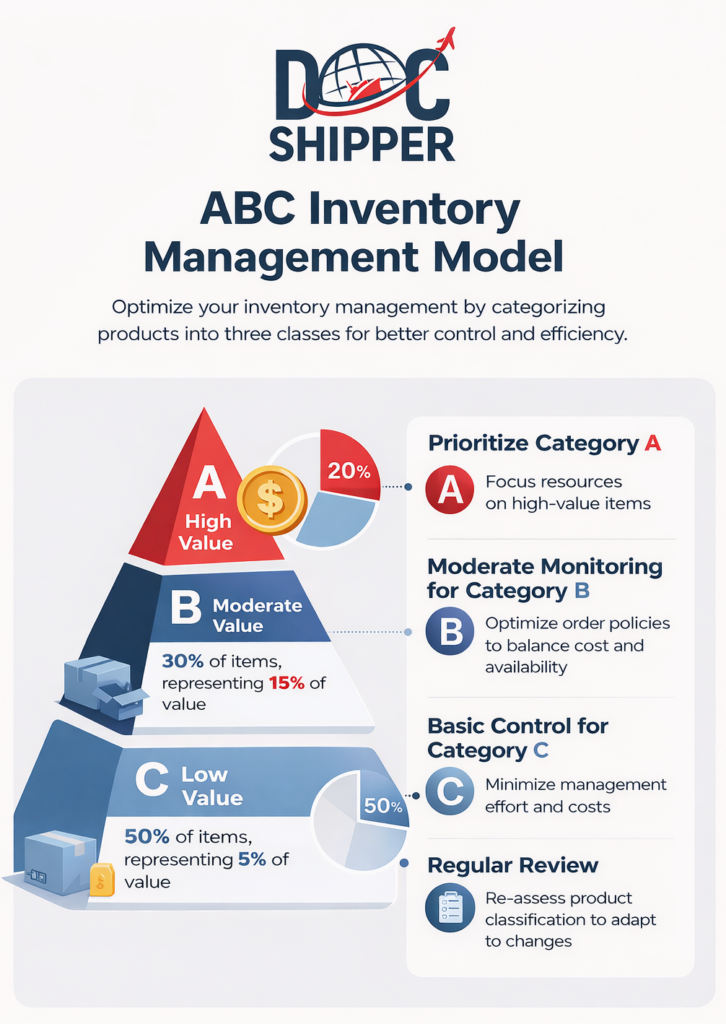
The ABC Model operates on a mathematical foundation rooted in the Pareto Principle. Category A items typically comprise 10-20% of total SKUs but account for 70-80% of annual consumption value. These require daily cycle counts, sophisticated forecasting, and multiple supplier relationships.
Category B items represent the middle ground—approximately 30% of inventory items generating 15-25% of value. These products receive monthly reviews and moderate safety stock levels. The classification boundary between A and B typically occurs at the 80th percentile of cumulative value.
Category C encompasses the remaining 50-60% of SKUs contributing only 5-10% of total value. These low-cost items often receive annual reviews and simple reorder point systems. Despite their minimal financial impact, mismanagement can still disrupt operations.
The calculation methodology follows these steps: (1) Calculate annual consumption value for each item, (2) Sort items in descending order by value, (3) Calculate cumulative percentage, (4) Apply classification thresholds. According to ISO 9001 quality management standards, this process should be documented and reviewed quarterly.
At DocShipper, we implement ABC analysis across our clients’ supply chains, integrating classification data with customs documentation and freight forwarding priorities. This ensures that high-value shipments receive expedited clearance while optimizing container loading for mixed-category cargo.
Advanced variations include the ABC-XYZ Model, which adds demand variability analysis, and weighted ABC systems that incorporate factors like lead time, obsolescence risk, and supplier reliability beyond pure monetary value.
Practical Examples & Data-Driven Insights
Consider an electronics importer managing 500 SKUs with $5 million annual inventory value. After ABC classification, they discover 75 items (15%) account for $3.8 million (76%) in value—their Category A products requiring weekly monitoring.
| Category | % of Items | % of Value | Review Frequency | Safety Stock |
|---|---|---|---|---|
| A | 15% | 76% | Weekly | Low (JIT preferred) |
| B | 30% | 19% | Monthly | Moderate |
| C | 55% | 5% | Quarterly | High (bulk orders) |
Use Case – Automotive Parts Distributor: A company importing spare parts from Asia implemented ABC analysis and reduced inventory holding costs by $420,000 annually. They shifted Category A items to air freight with 7-day lead times, while consolidating Category C products into quarterly ocean shipments, optimizing both speed and cost.
Key implementation insights include:
- Threshold flexibility: Adjust classification percentages based on industry—pharmaceuticals often use tighter A-category definitions (5-10% of items)
- Seasonal adjustments: Reclassify items quarterly to capture demand shifts (e.g., holiday products moving from C to A temporarily)
- Multi-criteria scoring: Combine value with criticality—a $50 component halting a $50,000 production line warrants A-level treatment
- Technology integration: Modern WMS systems automate ABC calculations using real-time sales data and predictive analytics
- Cross-functional alignment: Share classifications with procurement, finance, and sales teams for coordinated decision-making
Research from supply chain consultancies shows companies applying ABC Model principles achieve 22% faster inventory turnover and 18% reduction in stockouts for critical items compared to uniform inventory management approaches.
DocShipper Platform
Cut logistics costs. Not corners.
See exactly where your logistics costs are bleeding — and how to fix it. Book your expert demo.

Conclusion
The ABC Model transforms inventory management from reactive guesswork into strategic resource allocation. By focusing attention where it matters most, businesses optimize working capital while maintaining service levels.
Need expert guidance implementing ABC analysis across your international supply chain? Contact DocShipper for customized logistics solutions that align inventory classification with freight forwarding strategies.
📚 Quizz
Test Your Knowledge: ABC Model
Q1 – What is the primary basis for classifying items in the ABC Model?
Q2 – A logistics manager argues that Category C items can be completely ignored since they only represent 5–10% of total inventory value. Is this correct?
Q3 – An automotive parts distributor imports a $50 component that, if out of stock, halts a $50,000 production line. According to ABC Model best practices, how should this item be classified?
🎯 Your Result
📞 Free Quote 24hFAQ | ABC Model: Definition, Classification & Practical Examples
Category A usually represents 10-20% of total SKUs, though this varies by industry. Luxury goods retailers may see only 5% in Category A, while industrial distributors might classify 25% of items as high-value.
Most organizations review classifications quarterly, with monthly updates for fast-moving consumer goods. Seasonal businesses may require more frequent adjustments during peak periods to reflect demand fluctuations.
Service organizations apply ABC principles to client accounts, project portfolios, or service offerings. A consulting firm might classify clients by revenue contribution, allocating senior resources to Category A accounts.
ABC classification determines which items warrant detailed analysis, while Economic Order Quantity (EOQ) calculates optimal order sizes. ABC identifies priorities; EOQ optimizes ordering decisions for those priorities.
JIT principles work best with Category A items where frequent small deliveries minimize holding costs. Category C products often use traditional batch ordering since their low value doesn't justify JIT logistics expenses.
Yes. Category A items typically maintain lower safety stock due to tighter monitoring and faster replenishment. Category C products carry higher safety stock since their low cost makes buffer inventory economical.
Most modern ERP systems (SAP, Oracle, Microsoft Dynamics) include ABC analysis modules. Specialized WMS platforms like Manhattan Associates and Blue Yonder offer advanced multi-criteria classification algorithms with predictive capabilities.
High-duty items may warrant A-category treatment regardless of volume due to cash flow impact. Importers should factor total landed cost including duties, not just product purchase price, when calculating classification values.
Yes. Consolidating Category C shipments into less frequent bulk orders reduces transportation frequency. Meanwhile, optimizing Category A logistics through air freight for critical items balances speed with overall emissions reduction.
Frequent errors include using static classifications without regular updates, ignoring non-financial factors like criticality, applying uniform thresholds across diverse product lines, and failing to communicate classifications to procurement teams.
E-commerce operations use ABC to position inventory within warehouses—Category A items near packing stations for faster picking. Drop-shipping often handles Category C products to minimize warehouse space requirements.
Not necessarily. New products with uncertain demand may start in Category B with closer monitoring. Promote to Category A only after sales data confirms high-value contribution to avoid over-investing in unproven SKUs.
Need Help with
Logistics or Sourcing ?
First, we secure the right products from the right suppliers at the right price by managing the sourcing process from start to finish. Then, we simplify your shipping experience - from pickup to final delivery - ensuring any product, anywhere, is delivered at highly competitive prices.


Fill the Form
Prefer email? Send us your inquiry, and we’ll get back to you as soon as possible.
Contact us




