In short ⚡
To find suppliers in China with social media, focus on platforms that reveal both real factory activity and export capability.
Use Chinese networks for production proof and negotiation, and Western networks for introductions, then cross‑check licenses, export experience, packaging discipline, and Incoterms understanding before you commit to samples or deposits.
We hope you’ll find this article genuinely useful, but remember, if you ever feel lost at any step, whether it’s finding a supplier, validating quality, managing international shipping or customs, DocShipper can handle it all for you!
Understand how Chinese and Western social media help you reach the right suppliers

If you’re trying to find suppliers in China with social media, you’re not “scrolling for fun”, you’re building a sourcing pipeline that can feed your procurement, protect your margins, and reduce ugly surprises at customs clearance.
Here’s the thing, social platforms reveal how a factory behaves before you wire a deposit, long before a bill of lading exists, and way before your consignee gets hit with delays, rework, or unexpected duty and compliance issues.
We’ve seen this play out in real life, a US buyer found a “manufacturer” on a Western network, negotiated fast, and only discovered after the first shipment that the seller was a trading company outsourcing production to three different workshops.
The result was inconsistent palletization, shifting lead time, and a freight rate that kept changing because carton sizes never matched the booking.
Quick checklist, what social media should help you validate
- Whether the supplier looks like a real factory or a reseller, production videos, equipment, staff, QA lab.
- Whether their export documentation talk sounds solid, packing list, commercial invoice, HS code awareness.
- Whether they understand Incoterms and routing, especially FOB vs EXW impact on trucking, port handling, and customs brokerage.
- Whether they can hit stable lead time and inventory management basics, not just “fast delivery bro”.

DocShipper Alert
We audit factories, confirm exporter status, and secure your Incoterms to protect margins and avoid costly freight surprises.
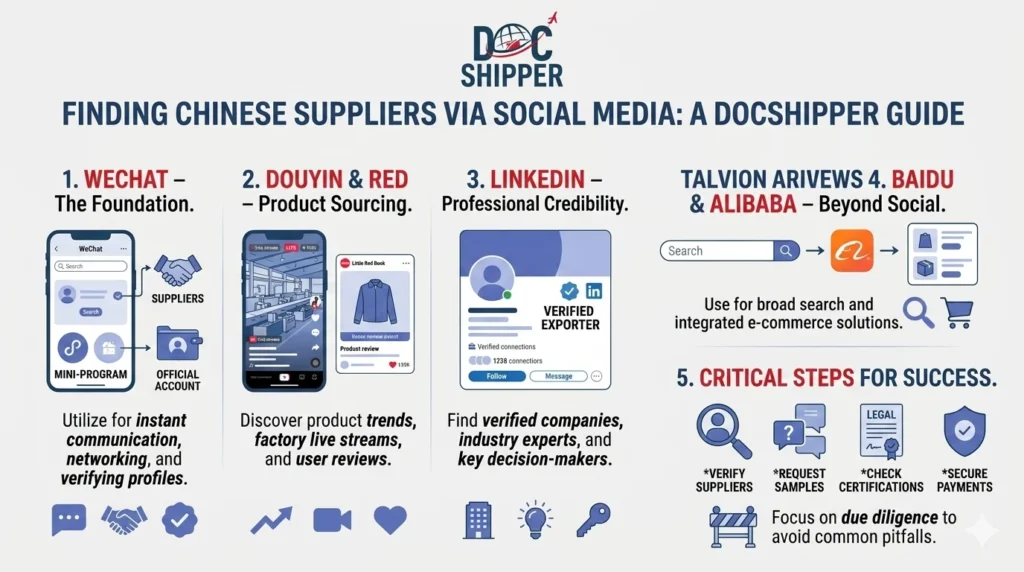
Key differences between Chinese platforms (WeChat, Weibo, Douyin) and Western networks
To find suppliers in China with social media efficiently, you need to accept one big reality, Chinese platforms don’t behave like Western networks, and suppliers use them like a hybrid of CRM, catalog, and deal room.
You’ll notice fast that what looks like “content” is often a live sales floor, and the good stuff sits behind private chats and mini-sites.
WeChat is where business actually closes.
Factories use it to send quotes, spec sheets, production updates, tracking screenshots, and sometimes even packaging approval pics before containerization.
Douyin (China’s TikTok) is where you verify reality.
Short videos show machines running, packaging lines, warehouse aisles, load planning, and sometimes the actual export cartons being taped.
Weibo sits closer to brand signaling and public reach.
It can help you spot who’s active, who attends trade fairs, and who’s pushing new product lines, but it’s rarely where negotiation ends.
Meanwhile, Western networks like LinkedIn, Facebook groups, and even YouTube can still help you find suppliers in China with social media, but you’re more likely to meet sales reps, distributors, or “global sourcing agencies” than the person who controls production scheduling.
Micro-story from experience: we once helped a buyer who found a “factory” through a polished Western page.
On Douyin, the same company posted videos that clearly showed someone else’s facility logo in the background, and that one detail saved the buyer from a messy transshipment scenario and weeks of order fulfillment delays.
Mini comparison table you can use while sourcing
| Platform | Best for | What to watch out for |
| Fast quotes, sample coordination, negotiation, production follow-up, documentation checks | Harder to verify identity, you must validate business license and exporter record | |
| Douyin | Factory reality check, process visibility, packaging and warehousing signals | Staged videos, reposted content, misleading “manufacturer” claims |
| Brand presence, announcements, trade fair activity | Less direct access to decision-makers | |
| LinkedIn / Facebook groups | Introductions, referrals, initial trust signals for export-facing suppliers | Middlemen, generic profiles, copied certifications |
One authoritative reference worth keeping in mind is the China Council for the Promotion of International Trade (CCPIT), suppliers that show consistent trade activity and verifiable export posture tend to align better with real-world import and export requirements.
When to use social media instead of Alibaba or traditional sourcing channels
You’ll find suppliers in China with social media faster than you think when Alibaba feels saturated, overpriced, or filled with listings that all look the same.
Social shines when you need nuance, a specific process, a specific finish, or a supplier who can talk packaging, compliance, and shipping constraints like an adult.
Use social media when you need:
- Direct factory access, especially for custom products, private label, or tooling.
- Process proof, you can see production steps, QA checks, and how they handle warehousing and inventory buffers.
- Faster back-and-forth, specs, MOQ, lead time, freight quote assumptions, and carton optimization.
- Better negotiation leverage, you can benchmark suppliers in the same niche by watching their content and customer comments.
Traditional sourcing still wins when you need heavy due diligence from day one, regulated goods, complex compliance, or when you’re planning multi-SKU consolidation in a distribution center flow.
But for discovery and early filtering, social media can be your unfair advantage.
Micro-story: a buyer came to us after choosing a supplier purely from a marketplace listing.
On WeChat, the supplier later admitted they couldn’t provide consistent export cartons, which triggered re-measurements at booking, re-quotes from the carrier, and a last-minute switch from ocean freight to air freight to protect launch dates.
Simple workflow, decide your channel in 60 seconds
1) If your product is commodity and specs are standard, start with marketplaces, then validate on social.
2) If your product is custom, start with social to find real workshops, then formalize with audits and contracts.
3) If compliance is strict, combine both, and bake in inspection, lab testing, and documentation review before any shipment.
Checklist, use social media first if these are true
- You need customization, packaging engineering, or carton sizing to lower freight rate per unit.
- You care about stable lead time more than the cheapest unit price.
- You plan containerization or consolidation and you need suppliers who can follow load planning instructions.
- You want to pre-qualify communication quality before you pay for samples.
DocShipper Info
We validate suppliers, documentation, and export readiness before you commit, reducing delays and unexpected logistics costs.
Step‑by‑step roadmap to find Chinese suppliers with social media
Let’s get tactical, if you want to find suppliers in China with social media and actually import to the American market without chaos, you need a repeatable roadmap.
Think like supply chain, not like browsing, your goal is to protect your procurement, your routing, and your documentation trail all the way to last-mile delivery.
We’ve watched importers get stuck at the same moment, they get excited by a great video, rush to pay, then realize nobody agreed on Incoterms, labeling, or who is the shipper of record.
That’s how “cheap sourcing” turns into expensive logistics outsourcing and emergency fixes.
Checklist, your roadmap foundations
- Your product spec is written and measurable, materials, tolerances, labeling, packaging, compliance marks.
- Your target Incoterms are clear, EXW vs FOB vs DDP, and you understand what changes for trucking, export clearance, and import duty.
- Your logistics plan exists, ocean freight vs air freight, target lead time, safety stock, and warehousing needs.
- Your inspection plan is defined, pre-production sample, during-production check, pre-shipment inspection.
Looking for a Reliable Shipping & Sourcing Partner?
Define your sourcing brief and buyer profile before you start searching
If you skip this, you’ll still find suppliers in China with social media, but you’ll waste weeks chatting with the wrong factories, or worse, you’ll get a quote that collapses once you add packaging, compliance, and transportation reality.
Start with a sourcing brief that reads like an order fulfillment playbook.
Your brief should include:
- Product and quality specs, drawings, reference samples, acceptable defect rate.
- Commercial targets, MOQ, target unit price, payment terms, tooling ownership.
- Logistics constraints, carton dimensions, master carton weight limits, palletization rules for US distribution centers.
- Trade and compliance, HS code candidate, labeling, tariff exposure, required documentation.
Micro-story: we supported a buyer sourcing a fragile household item for the US.
The supplier’s quote looked perfect until we added ISTA-style packaging expectations and realized the inner pack needed redesign, that changed carton count, changed container load planning, and instantly changed the freight quote.
Step-by-step workflow, build your brief in 30 minutes
1) Write the “non-negotiables”, material, size, function, compliance marks.
2) Define your target Incoterms and who handles export clearance and customs brokerage.
3) Set packaging and carton limits to protect freight rates and avoid carrier surcharges.
4) Decide inspection points and acceptance criteria before any deposit.
5) Prepare a short intro message you’ll paste into WeChat or DMs, clear, polite, and specific.
For a reliable baseline on trade terms, you’ll see many serious exporters reference ICC Incoterms in their export discussions, if a supplier can’t explain FOB versus EXW clearly, that’s a signal you shouldn’t ignore.
DocShipper Advice
Let our team review your specs, packaging, and Incoterms before negotiation to protect freight rates and compliance.
Use advanced search, hashtags, and groups to build a qualified supplier shortlist
This is where you actually find suppliers in China with social media at scale, not one by one.
You’re not hunting for a “best supplier”, you’re building a shortlist you can pressure-test with samples, inspections, and shipping scenarios.
Use these practical search angles:
- Douyin keywords combining product + process, “factory”, “workshop”, “OEM”, “custom”, “packaging”.
- WeChat discovery via introductions, QR codes from videos, and supplier catalogs inside mini-programs.
- Western group sourcing using niche communities where buyers share real lead time and quality experiences.
- Hashtag stacking for export intent, look for signals like “US market”, “FDA”, “CPSIA”, “ASTM” when relevant.
Micro-story: a buyer once shortlisted 12 “manufacturers” from social within two days.
After we requested a simple packing list mockup and asked who would be listed as shipper on the bill of lading, only 4 could answer cleanly, and those 4 became the real negotiation pool.
Quick shortlist scoring table
| Signal | What you check on social | Why it matters for logistics |
| Factory proof | Production videos, equipment, staff, consistent location cues | Stable lead time, fewer last-minute outsourcing surprises |
| Export fluency | Talk about documents, packaging, HS codes, shipping terms | Fewer customs clearance delays and documentation errors |
| Packaging discipline | Carton labels, pallets, warehouse handling | Lower damage rates, smoother trucking and distribution center receiving |
| Responsiveness | Speed and clarity in DM/WeChat replies | Faster booking, fewer missed cutoffs, better tracking coordination |
Checklist, your “qualified shortlist” is ready when
- You have 5 to 8 suppliers with consistent factory evidence, not just glossy posts.
- Each one confirmed MOQ, lead time, and Incoterms in writing.
- Each one accepted an inspection plan and can share packaging specs for freight planning.
- You’ve captured full company name in Chinese, address, and a clear point of contact for documentation.
If you want, we can plug into this exact process at DocShipper, we help you validate suppliers, run inspections, and then handle freight forwarding end-to-end, from pickup and export clearance to ocean freight or air freight, customs brokerage, and delivery to your warehouse or distribution center.
DocShipper Info
We pressure-test suppliers through documentation checks, inspections, and freight simulations before you scale volume.
Best social platforms and tactics to connect with Chinese manufacturers

You need to choose the right platform based on your product category, target price, and sourcing strategy. Not all social networks will help you find suppliers in China with social media efficiently.
Each platform has a specific role in your sourcing funnel. You should combine visibility, verification, and direct communication tools.
| Platform | Best For | How You Should Use It | Risk Level |
| Direct factory contact | Add sales reps, request catalogs, schedule video audits | Medium | |
| Douyin | Factory production videos | Check real production lines and equipment | Medium |
| Brand visibility | Verify company activity and engagement | High | |
| Export-oriented suppliers | Connect with export managers and verify experience | Low | |
| Facebook Groups | Trading companies and agents | Ask for referrals and feedback | High |
You should always cross-check the same supplier on at least two platforms. A real manufacturer leaves digital footprints.
If a supplier refuses video calls or avoids sharing business licenses, you should immediately slow down. Transparency is non-negotiable.
- Request a live factory tour via WeChat video
- Ask for their Chinese business license and export license
- Check if the bank account matches the registered company name
- Verify consistency between social content and actual product range
- Confirm MOQ, lead time, and Incoterm in writing
At DocShipper, we often start conversations on social media, then move quickly to structured supplier evaluation. Social media opens the door, but due diligence closes the deal.

DocShipper Advice
We conduct factory audits, license checks, and live video verifications to confirm you are dealing with a real manufacturer.
Vet, negotiate, and manage risk with suppliers you meet on social media
Finding a supplier is easy. Managing risk is where most importers fail.
When you find suppliers in China with social media, you bypass traditional filters. That means you must build your own verification process.
| Verification Step | What You Should Do | Why It Matters for US Importers |
| Company Registration Check | Verify business scope and capital | Avoid trading companies posing as factories |
| Factory Audit | On-site or third-party inspection | Confirm production capacity |
| Sample Validation | Test quality before mass production | Reduce defect risk |
| Contract & Incoterms | Define FOB, CIF, or DDP clearly | Control landed cost |
| Pre-shipment Inspection | Quality control before balance payment | Avoid costly returns |
You should negotiate with data, not emotion. Show target pricing benchmarks and expected US compliance standards.
Always split payments. A common structure is 30 percent deposit, 70 percent after inspection.
Never pay 100 percent upfront, even if the supplier pressures you with “limited capacity” arguments. Scarcity tactics are common.
- Use formal purchase orders with clear specifications
- Lock packaging requirements for the American market
- Clarify labeling compliance, especially FDA or FCC if applicable
- Define penalty clauses for delays
- Secure backup suppliers before scaling volume
We manage these steps daily at DocShipper. You can use social media to identify factories, then let us handle audits, negotiation, quality control, and international freight.
DocShipper Alert
We manage audits, contracts, inspections, and freight so you avoid costly mistakes and protect your landed cost.
Conclusion
You now understand how to strategically find suppliers in China with social media without exposing your business to unnecessary risk. Social platforms are tools, not shortcuts.
- Choose the right platform based on your sourcing objective
- Cross-check supplier credibility across multiple networks
- Always verify licenses, capacity, and ownership
- Negotiate payment terms and Incoterms clearly
- Conduct inspections before shipping to the US
- Use professional sourcing support when scaling volume
If you want to secure reliable Chinese manufacturers while protecting your margins, we can support you end-to-end. From supplier validation to final delivery in the United States, DocShipper controls every critical step of your supply chain.
FAQ | How to find reliable suppliers in China with social media and grow your margins
- Start on-platform: begin with DMs or WeChat, but never rush to pay after the first conversation.
- Ask for documents: Chinese company business license, export license, full legal name in Chinese, address, website.
- Cross-check:
- Search the legal name in Chinese business registries or directories
- Compare product range and branding across WeChat, Douyin, LinkedIn, and any marketplace listings
- Request a video call: a quick WeChat video walk-through of the office or factory is a strong filter.
- Check payment details: the beneficiary name on bank details must match the registered company, not a private person.
- Start small: place a small, controlled first order with inspection before shipment to limit risk.
Look out for combinations of these signals rather than a single one:
- Content issues
- Only generic product photos, no real factory or production videos
- Reused images from other brands or obviously stock imagery
- Inconsistent logos or branding across posts and platforms
- Company identity gaps
- Refuses to share the Chinese company name or business license
- Bank account is under an individual’s name, not a company
- No clear address or “we have many factories” but no specifics
- Export and logistics gaps
- Can’t explain Incoterms (FOB/EXW/DDP) in simple, concrete terms
- Avoids questions about HS codes, packing lists, or export documents
- Changes lead time or MOQ every time you ask for details
- Communication style
- Pushy about “pay fast, production start now”
- Refuses video call or says “factory too busy to show” repeatedly
Focus your questions and checks on export experience:
- Direct questions to ask
- “Which countries do you export to most often?”
- “Do you have current customers in the US or EU?”
- “What US or EU standards have your products passed (e.g., FDA, FCC, CPSIA, ASTM, CE)?”
- Documents and samples
- Request recent test reports from recognized labs for your product category
- Ask for a sample with US-style labeling, barcodes, and packaging to see if they understand requirements
- Request a draft packing list and commercial invoice as if a shipment were leaving for the US
- Operational signals
- Can they give carton sizes and weights adapted to US carriers and distribution centers?
- Do they mention experience with US ports, customs brokers, or Amazon FBA (if relevant)?
- Do they accept third-party inspections before shipment?
Suppliers who handle these points confidently are far more likely to fit US import expectations.
Use the same structured data for each supplier so you’re not comparing “vibes”:
- Step 1 – Create a comparison sheet
- Company name (Chinese & English), contact person, platforms where you found them
- Product match, MOQ, unit price, tooling fees
- Lead time, payment terms, Incoterms offered
- Step 2 – Add logistics and quality criteria
- Carton dimensions & weight
- Willingness to follow your packaging rules
- Acceptance of pre-shipment inspection and third-party lab testing
- Step 3 – Score soft factors
- Communication speed and clarity
- Technical understanding of your specs
- Transparency (licenses, factory photos/video, documents)
- Step 4 – Shortlist
- Keep 3–5 suppliers that score well across price, capacity, export fluency, and transparency
- Request samples and run the same evaluation process for each before you commit to volume
Treat them like any other supplier—social media is just the entry point:
- Contract basics
- Use a written purchase agreement or detailed purchase orders
- Include product specs, packaging requirements, labeling rules, and quality standards
- Clearly define Incoterms (FOB, CIF, DDP, etc.) and who handles export & import formalities
- Payment structure
- Typical: 30% deposit, 70% after passed pre-shipment inspection
- Use bank transfer to the registered company, avoid Western Union/PayPal to private accounts for bulk orders
- Link final payment explicitly to inspection results and document delivery (invoice, packing list, BL draft)
- Risk control
- Cap the first order value until the supplier proves reliability
- Add delivery time expectations and penalties for major delays if your volume is significant
- Keep a backup supplier in the same category in case performance drops
In practice, combining channels is usually safer and more efficient:
- When social media works best
- You need to see real production (videos, live calls) and verify factory reality
- You’re sourcing customized products, private label, or packaging-heavy items
- You want faster communication with factory sales or export managers
- When marketplaces/agents still add value
- Highly regulated products with complex compliance
- Multi-SKU consolidation and long-term, high-volume programs
- You need systematic factory audits, lab testing, and shipping coordination
- Smart approach
- Use social media for discovery, reality checks, and early qualification
- Use marketplaces, third-party inspections, or professional sourcing/logistics partners to formalize, audit, and ship
- Continuously cross-check information between channels to catch inconsistencies early
You won’t get 100% protection, but you can reduce the risk significantly:
- Before sharing details
- Share only what’s necessary to get a ballpark quote at first
- Use generic descriptions until you’ve checked company identity and export track record
- Legal and contractual tools
- Use an NNN agreement (Non-disclosure, Non-use, Non-circumvention) tailored for Chinese jurisdiction when possible
- Clarify ownership of tooling, molds, and designs in writing
- Specify that your brand, packaging design, and artwork are exclusive to you
- Operational tactics
- Avoid giving one supplier the full picture of your supply chain when not needed
- Separate critical components or final packaging, if your model allows it
- Monitor social media and marketplaces periodically to spot copies early
Combining legal safeguards with careful supplier selection and ongoing monitoring is far more effective than relying on a contract alone.
Need Help with
Logistics or Sourcing ?
First, we secure the right products from the right suppliers at the right price by managing the sourcing process from start to finish. Then, we simplify your shipping experience - from pickup to final delivery - ensuring any product, anywhere, is delivered at highly competitive prices.
Fill the Form
Prefer email? Send us your inquiry, and we’ll get back to you as soon as possible.
Contact us