


In short ⚡
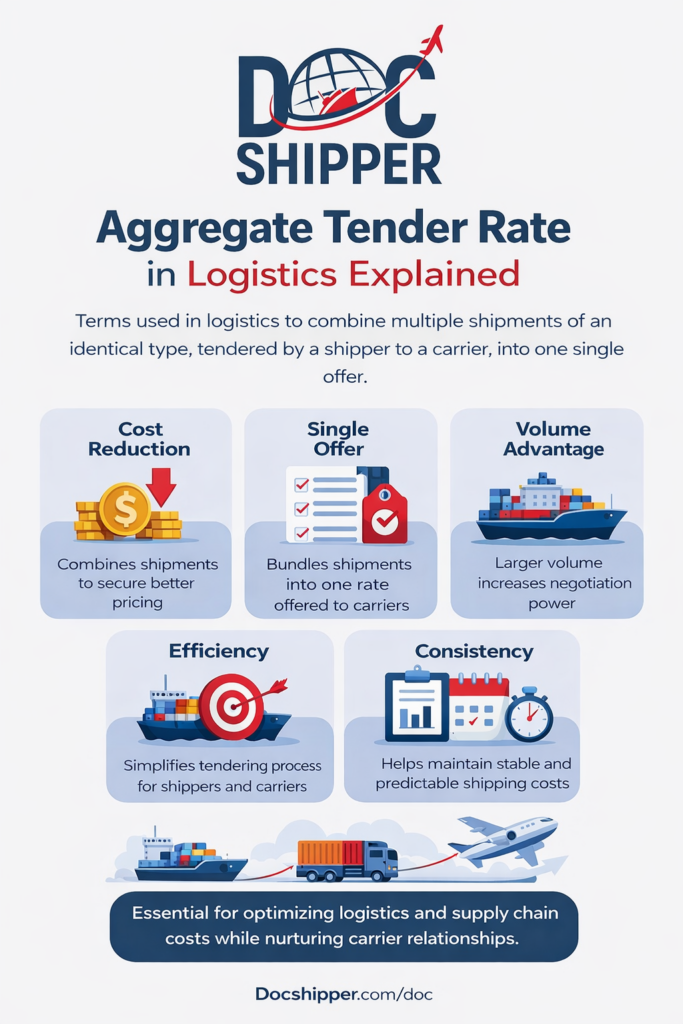
The Aggregate Tender Rate is a weighted average metric representing the combined transportation costs across multiple shipment lanes or service providers. It consolidates individual tender rates into a single performance indicator, enabling logistics managers to assess overall freight spending efficiency and negotiate better contracts with carriers based on volume commitments.
Introduction
Many shippers struggle to understand their true transportation costs when managing multiple carriers and routes simultaneously. Individual freight quotes provide limited visibility into overall spending patterns.
The Aggregate Tender Rate addresses this challenge by providing a consolidated view of transportation expenses. This metric is critical for budget forecasting, carrier performance evaluation, and strategic sourcing decisions in international trade.
- Consolidates multiple freight rates into one actionable metric
- Enables volume-based negotiations with carriers
- Supports accurate cost forecasting across shipping lanes
- Facilitates comparative analysis between service providers
- Optimizes freight spend allocation across supply chain networks
Understanding Mechanisms & Strategic Importance
The Aggregate Tender Rate functions as a weighted average calculation that accounts for shipment volume, distance, and mode variations. Unlike simple averages, it reflects the actual distribution of freight activity across your logistics network.
Calculation methodology requires three core components: individual tender rates (quoted or contracted prices per shipment), shipment volumes (number of loads or weight per lane), and weighting factors (typically based on freight value or frequency).
In procurement contexts, this metric serves as the foundation for Request for Proposal (RFP) evaluations. Carriers submit rates across multiple lanes, and procurement teams calculate aggregate rates to identify the most cost-effective provider while maintaining service quality standards.
The European Union Customs Code recognizes aggregated cost metrics for customs valuation purposes, particularly when determining transaction values that include transportation costs. Accurate aggregate rate documentation supports compliance during customs audits.
From a contract management perspective, aggregate rates enable performance-based incentives. Shippers can structure agreements where carriers receive volume discounts when maintaining service levels across all contracted lanes, rather than negotiating each route independently.
At DocShipper, we systematically calculate aggregate tender rates during our procurement process to ensure clients receive the most competitive freight pricing while maintaining transparency across all transportation modes and routes.
Calculation Methods & Real-World Examples
The standard formula for Aggregate Tender Rate is: (Sum of [Rate × Volume]) ÷ Total Volume. This weighted approach ensures high-volume lanes have proportional influence on the final metric.
| Shipping Lane | Rate per Unit | Monthly Volume | Weighted Cost |
|---|---|---|---|
| Shanghai-Rotterdam | $1,200 | 50 TEU | $60,000 |
| Shenzhen-Hamburg | $1,350 | 30 TEU | $40,500 |
| Ningbo-Antwerp | $1,180 | 20 TEU | $23,600 |
| Total | — | 100 TEU | $124,100 |
Aggregate Tender Rate = $124,100 ÷ 100 TEU = $1,241 per TEU
This calculation reveals the true average cost across all lanes. A simple arithmetic mean would yield $1,243, but the weighted approach accurately reflects the shipper’s actual spending pattern based on volume distribution.
Use Case: Carrier Selection Scenario
A European importer receives bids from three carriers for 200 annual shipments across five Asia-Europe lanes. Carrier A offers the lowest rates on high-volume routes but higher prices on secondary lanes. Carrier B provides consistent mid-range pricing. Carrier C has premium rates with guaranteed transit times.
- Carrier A Aggregate Rate: $1,215/TEU (optimized for volume lanes)
- Carrier B Aggregate Rate: $1,260/TEU (balanced approach)
- Carrier C Aggregate Rate: $1,340/TEU (premium service)
By calculating aggregate rates rather than comparing individual lane quotes, the importer identifies a potential annual savings of $9,000 with Carrier A ($45 difference × 200 TEU), while maintaining service requirements across all routes.
Industry benchmarking data shows aggregate tender rates for Asia-Europe ocean freight typically range between $1,100-$1,400 per TEU for standard 20-foot containers, with variations based on contract duration, volume commitments, and fuel adjustment clauses.
DocShipper Platform
One platform. Your entire supply chain
Sourcing, freight, customs & documents — all centralised, all visible, 24/7.
Conclusion
The Aggregate Tender Rate transforms fragmented freight data into strategic intelligence, enabling data-driven procurement decisions and optimized carrier relationships. Mastering this metric is essential for competitive supply chain management.
Need expert guidance on freight rate analysis and carrier negotiations? Contact DocShipper for customized logistics solutions tailored to your shipping requirements.
📚 Quiz
Test Your Knowledge: Aggregate Tender Rate
Q1 — What does the Aggregate Tender Rate represent?
Q2 — Why is a weighted average used instead of a simple arithmetic mean when calculating the Aggregate Tender Rate?
Q3 — A European importer compares three carriers across five Asia-Europe lanes. Carrier A has an aggregate rate of $1,215/TEU and Carrier B has $1,260/TEU for 200 annual TEUs. What is the correct conclusion?
🎯 Your Result
📞 Free Quote in 24hFAQ | Aggregate Tender Rate: Definition, Calculation & Practical Examples
Aggregate Tender Rate represents contracted, volume-weighted averages across multiple lanes, while spot rates are one-time market prices for individual shipments without long-term commitments.
Most organizations calculate quarterly or annual aggregate rates to smooth seasonal fluctuations and provide meaningful benchmarks for contract renewals and budget planning.
Yes, but each transportation mode should be calculated separately before combining into an overall logistics cost metric, as ocean, air, and ground rates have different pricing structures.
Best practice recommends monthly monitoring for operational adjustments and quarterly formal recalculations to capture market trends and support strategic sourcing decisions.
Primary drivers include fuel price changes, capacity constraints, seasonal demand variations, currency exchange rates, and geopolitical events affecting specific shipping lanes.
Yes, comprehensive aggregate rates should include detention fees, fuel surcharges, and documentation costs to reflect total landed cost rather than base transportation rates alone.
Carriers typically offer 5-15% discounts for guaranteed annual volumes, which directly reduces aggregate rates when shippers meet minimum shipment thresholds across contracted lanes.
Absolutely. Even with limited volumes, calculating aggregate rates helps identify consolidation opportunities and strengthens negotiation positions when approaching freight forwarders or third-party logistics providers.
Historical shipment records should include exact weights, dimensions, origin-destination pairs, and all charges. A minimum of 50 shipments per lane provides statistically meaningful averages.
20-foot, 40-foot, and high-cube containers have different rate structures. Aggregate calculations should normalize to a standard unit (typically TEU) or calculate separate aggregates per container type.
While not directly used for duty calculations, documented aggregate rates support transaction value declarations when transportation costs must be included in customs valuations under CIF terms.
Transportation Management Systems (TMS), procurement platforms, and specialized freight audit tools automate data collection and calculation, providing real-time dashboards for rate monitoring and carrier performance analysis.
Need Help with
Logistics or Sourcing ?
First, we secure the right products from the right suppliers at the right price by managing the sourcing process from start to finish. Then, we simplify your shipping experience - from pickup to final delivery - ensuring any product, anywhere, is delivered at highly competitive prices.


Fill the Form
Prefer email? Send us your inquiry, and we’ll get back to you as soon as possible.
Contact us




