


In short ⚡
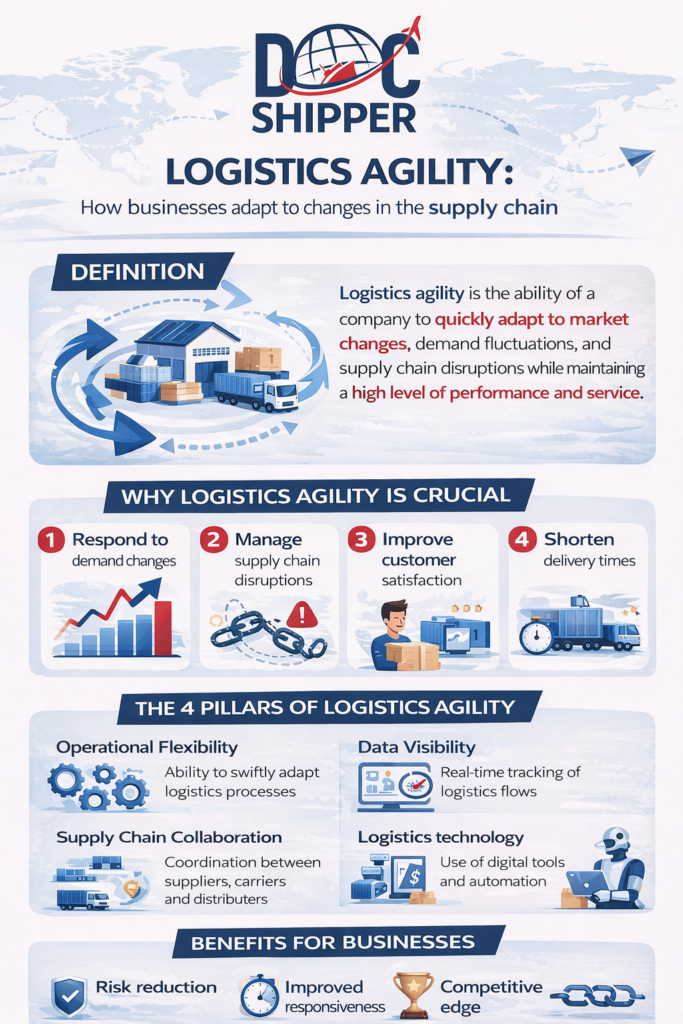
Agility in logistics refers to the ability of a supply chain to rapidly adapt to market fluctuations, customer demands, and unforeseen disruptions while maintaining operational efficiency. This strategic capability enables companies to respond quickly to changes in volume, routes, or requirements without compromising service quality or cost-effectiveness.
Introduction
In today’s volatile global trade environment, companies face a critical challenge: how to maintain supply chain continuity when disruptions occur weekly. Port congestions, regulatory changes, and sudden demand spikes can paralyze rigid logistics systems overnight.
Agility has become the cornerstone of resilient international shipping operations. Unlike traditional linear supply chains, agile logistics systems incorporate flexibility at every node—from sourcing to final delivery.
Key characteristics of agile logistics include:
- Real-time visibility across all transportation modes and inventory locations
- Flexible carrier networks with pre-negotiated alternative routing options
- Modular warehousing allowing rapid scaling of storage capacity
- Dynamic inventory management adjusting stock levels based on predictive analytics
- Cross-functional collaboration enabling quick decision-making during disruptions
The concept extends beyond speed—it encompasses the strategic capacity to pivot operations without incurring prohibitive costs or service degradation.
Deep Dive & Expertise
Implementing agility requires fundamental shifts in how logistics operations are structured. Traditional efficiency-focused models optimize for cost reduction through standardization, while agile frameworks prioritize responsiveness and adaptability.
The foundation rests on three operational pillars. First, information integration connects disparate systems—customs platforms, carrier APIs, warehouse management systems—into unified dashboards. This eliminates information silos that slow response times during crises.
Second, network redundancy establishes backup options for every critical supply chain function. Rather than single-sourcing transportation or warehousing, agile operators maintain relationships with multiple service providers across different geographic zones.
Third, process modularity breaks complex operations into independent components that can be reconfigured quickly. For instance, separating order fulfillment from inventory storage allows companies to shift between distribution centers without disrupting customer deliveries.
From a regulatory perspective, agile logistics demands proactive compliance management. The World Customs Organization emphasizes Authorized Economic Operator (AEO) programs that expedite clearances for pre-vetted companies—a critical advantage when rerouting shipments through alternative ports.
Technology enablers include control tower platforms that aggregate real-time data from IoT sensors, GPS trackers, and customs databases. These systems use machine learning to flag potential delays 48-72 hours before they impact delivery schedules.
At DocShipper, we implement agility through our multi-modal network spanning air, sea, and road freight. When a client’s container faces unexpected port congestion, our operations team automatically evaluates alternative routing options and presents cost-impact scenarios within hours—not days.
Concrete Examples & Data
The value of agility becomes quantifiable when examining real-world scenarios. Consider the 2021 Suez Canal blockage—a six-day disruption that delayed 369 vessels carrying $9.6 billion in daily trade.
Use Case: Electronics Importer Response
A European electronics retailer faced a critical situation when their containerized shipment from Shenzhen became trapped in the Suez backlog. With product launch deadlines approaching, traditional logistics would have meant waiting 12-15 days for canal clearance.
Their agile response included:
- Immediate air freight arrangement for 30% of high-priority SKUs (laptops, smartphones)
- Rerouting remaining cargo via Cape of Good Hope with expedited customs pre-clearance
- Temporary inventory reallocation from their Istanbul warehouse to cover Northern European demand
- Customer communication strategy explaining delays with alternative product suggestions
The outcome: 85% of original delivery commitments met, versus the industry average of 34% during the crisis period. The additional cost was $47,000—significantly less than the projected $280,000 in lost sales and contractual penalties.
Comparative Analysis: Agile vs. Traditional Response Times
| Disruption Type | Traditional Response | Agile Response | Time Saved |
|---|---|---|---|
| Port Congestion | 7-10 days (wait for clearance) | 2-3 days (reroute to alternate port) | 5-7 days |
| Customs Documentation Error | 4-6 days (resubmit and wait) | 8-12 hours (pre-clearance system) | 3-5 days |
| Carrier Capacity Shortage | 5-8 days (negotiate new booking) | 1-2 days (backup carrier activation) | 4-6 days |
| Regulatory Change | 10-14 days (compliance adjustment) | 2-4 days (pre-vetted alternatives) | 8-10 days |
Industry data from the Council of Supply Chain Management Professionals shows that companies with high agility scores (measured by response time, cost flexibility, and service continuity) maintain 92% on-time delivery rates during disruption periods, compared to 67% for traditional operators.
Investment in agility infrastructure typically ranges from 3-7% of total logistics spend but delivers ROI through reduced emergency freight costs, lower inventory carrying expenses, and improved customer retention. A 2023 MIT study found that agile supply chains reduce total disruption costs by 40-60% annually.
DocShipper Platform
Cut logistics costs. Not corners.
See exactly where your logistics costs are bleeding — and how to fix it. Book your expert demo.

Conclusion
Agility transforms logistics from a reactive cost center into a strategic competitive advantage. Companies that embed flexibility into their supply chain architecture consistently outperform competitors during both stable and volatile market conditions.
Need guidance on building agility into your international shipping operations? Contact DocShipper for a customized assessment of your supply chain responsiveness capabilities.
📚 Quiz
Test Your Knowledge: Agility in Logistics
Q1 — What does "agility" in logistics primarily refer to?
Q2 — A common misconception is that agility and flexibility mean the same thing in logistics. What is the correct distinction?
Q3 — During the 2021 Suez Canal blockage, a European electronics retailer used an agile logistics response. Which of the following best describes that approach?
🎯 Your Result
📞 Free Quote in 24hFAQ | Agility in Logistics: Definition, Implementation & Concrete Examples
Agility refers to the speed of response to changes, while flexibility describes the range of options available. An agile system responds quickly; a flexible system has multiple response pathways. Optimal logistics combines both attributes.
Initial investment typically ranges from 3-7% of annual logistics spend, covering technology platforms, network redundancy, and training. Most companies achieve positive ROI within 18-24 months through reduced disruption costs and improved service levels.
Yes. Small importers can leverage third-party logistics providers like DocShipper that offer agile infrastructure without requiring internal investment. Shared warehouse networks and multi-carrier platforms provide scalable agility options for businesses of all sizes.
Core technologies include transportation management systems (TMS), real-time tracking platforms, customs automation tools, and control tower dashboards. Cloud-based solutions reduce implementation barriers and enable rapid scaling during demand surges.
Agile systems use pre-clearance protocols and AEO certifications to reduce clearance times by 40-70%. Automated documentation systems flag potential issues before shipment arrival, enabling proactive resolution rather than reactive problem-solving at borders.
Fashion, electronics, automotive, and perishable goods sectors gain maximum advantage due to short product lifecycles and time-sensitive delivery requirements. However, any industry facing demand volatility or supply disruption risks benefits from agile logistics capabilities.
Key metrics include response time to disruptions, percentage of on-time deliveries during crisis periods, number of alternative routing options, inventory turnover rates, and cost variance between planned and actual logistics spend during volatile periods.
Short-term operational costs may increase 5-12% due to network redundancy and technology investments. However, total cost of ownership decreases by 15-30% over 3-5 years through reduced emergency freight, lower safety stock requirements, and improved asset utilization.
Agile warehousing uses distributed micro-fulfillment centers instead of centralized mega-warehouses. This geographic dispersion reduces last-mile delivery times and provides backup inventory locations during regional disruptions, improving overall supply chain resilience.
Agile routing optimization reduces empty miles and fuel consumption by 12-18%. Real-time capacity matching improves load consolidation, while flexible modal choices allow selection of lower-emission transportation options when time constraints permit.
Yes. Ocean agility includes maintaining bookings with multiple carriers, using alternative ports, and combining ocean-air hybrid solutions. Container tracking systems provide early warning of delays, enabling proactive rerouting decisions 5-7 days before port arrival.
Organizational resistance to change represents the primary obstacle. Agile logistics requires cross-functional collaboration and decentralized decision-making authority—cultural shifts that challenge traditional hierarchical structures. Technology and cost barriers are secondary compared to change management challenges.
Need Help with
Logistics or Sourcing ?
First, we secure the right products from the right suppliers at the right price by managing the sourcing process from start to finish. Then, we simplify your shipping experience - from pickup to final delivery - ensuring any product, anywhere, is delivered at highly competitive prices.


Fill the Form
Prefer email? Send us your inquiry, and we’ll get back to you as soon as possible.
Contact us




