In short ⚡
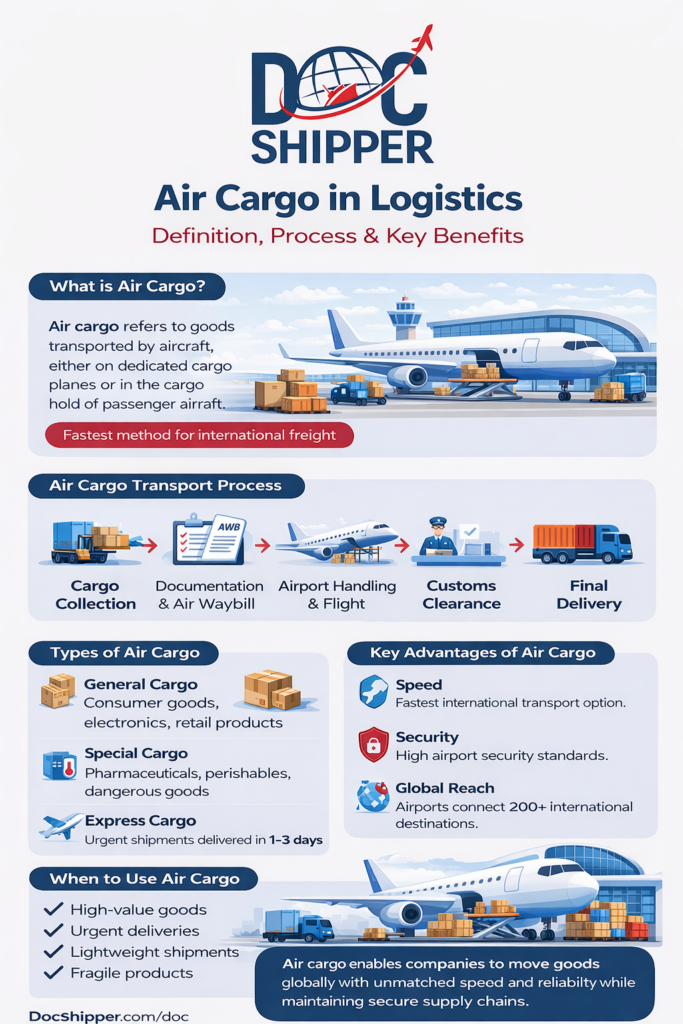
Air cargo refers to goods transported by aircraft, either in dedicated freighter planes or in the belly holds of passenger flights. This logistics mode enables fast international delivery, making it essential for time-sensitive, high-value, or perishable shipments across global supply chains.
Introduction
Many importers struggle to choose between sea and air freight. The confusion often stems from cost versus speed trade-offs. Air cargo solves this dilemma for businesses requiring rapid delivery despite higher rates.
In international trade, air transport represents approximately 35% of global trade value while accounting for less than 1% of volume. This disparity highlights its role in moving high-priority goods.
Key characteristics of air cargo include:
- Speed: Delivery times of 1-7 days versus 20-45 days by sea
- Reliability: Fewer delays compared to ocean freight
- Security: Reduced theft and damage risks due to shorter transit
- Temperature control: Specialized handling for pharmaceuticals and perishables
- Documentation: Streamlined customs clearance processes
Understanding air cargo mechanics is crucial for optimizing supply chain efficiency and meeting customer expectations in today’s fast-paced market.
In-Depth Operations & Expertise
Air cargo operates through a complex network of airlines, freight forwarders, ground handlers, and customs authorities. The process begins with booking cargo space, either through dedicated freighters or passenger aircraft belly holds.
Unit Load Devices (ULDs) are standardized containers designed to fit aircraft cargo holds efficiently. These aluminum or composite structures protect goods while maximizing space utilization. Common ULD types include pallets (LD3, LD7) and containers (LD2, LD9).
The Air Waybill (AWB) serves as the primary transport document. Unlike ocean Bills of Lading, AWBs are non-negotiable and act as receipts rather than title documents. Each AWB contains an 11-digit reference number tracking the shipment from origin to destination.
Dimensional weight pricing applies when cargo volume exceeds actual weight. Airlines calculate this by multiplying length × width × height (in cm) and dividing by 6,000. Shippers pay for whichever is greater: actual weight or dimensional weight.
Regulatory compliance is critical. The IATA Dangerous Goods Regulations govern hazardous material transport by air. Items like lithium batteries, chemicals, and compressed gases require special packaging, labeling, and documentation.
Security screening has intensified since 2001. All cargo undergoes X-ray or physical inspection. Known Shipper programs and Regulated Agent certifications expedite this process for trusted parties.
At DocShipper, we manage the entire air cargo process—from AWB preparation to customs clearance—ensuring compliance with international aviation regulations and minimizing delays.
Practical Examples & Data
To illustrate air cargo applications, consider these real-world scenarios and comparative data:
Cost Comparison: Air vs. Sea Freight
| Route | Air Freight (100kg) | Sea Freight (1 CBM) | Transit Time (Air) | Transit Time (Sea) |
|---|---|---|---|---|
| Shanghai → New York | $450-$650 | $200-$350 | 3-5 days | 28-35 days |
| Frankfurt → Dubai | $280-$420 | $150-$250 | 2-3 days | 18-22 days |
| Los Angeles → Sydney | $520-$720 | $180-$320 | 4-6 days | 20-28 days |
Use Case: Pharmaceutical Cold Chain
A European pharmaceutical company needed to ship 500kg of temperature-sensitive vaccines to Africa. Requirements included maintaining 2-8°C throughout transit.
Solution: Active temperature-controlled containers (RKN type) on a direct freighter flight. Total cost: €8,500 including ground handling and monitoring.
Result: 48-hour door-to-door delivery with continuous temperature logging. Sea freight would have risked product degradation over 25+ days.
Key Industry Statistics
- Global volume: 61.2 million tonnes transported annually (2023 data)
- Average rate: $2.50-$5.00 per kilogram depending on route and season
- Peak season surcharge: 20-40% increase during Q4 (October-December)
- Carbon footprint: 500g CO₂ per tonne-kilometer (vs. 10-40g for sea freight)
- E-commerce share: 25% of air cargo now consists of cross-border online purchases
These figures demonstrate why businesses select air cargo for urgent, valuable, or perishable goods despite higher costs.
Conclusion
Air cargo remains indispensable for global trade requiring speed, security, and reliability. Mastering its operational nuances—from dimensional weight calculations to regulatory compliance—directly impacts supply chain performance.
Need expert guidance on your air freight shipments? Contact DocShipper for tailored logistics solutions.
📚 Quiz
Test Your Knowledge: Air Cargo
Q1 — What best defines "air cargo" in international logistics?
Q2 — An Air Waybill (AWB) is a negotiable title document, just like an ocean Bill of Lading. Is this statement correct?
Q3 — A shipment measures 80cm × 60cm × 50cm and weighs 18kg. Using the dimensional weight formula (L×W×H ÷ 6,000), what weight will the airline charge for?
🎯 Your Result
📞 Free Quote in 24hFAQ | Air Cargo: Definition, Operations & Practical Examples
Most commercial aircraft handle up to 20 tonnes per flight. Specialized freighters like the Boeing 747-8F can carry 140 tonnes. Weight limits depend on aircraft type and route.
The terms are interchangeable. Both refer to goods transported by aircraft. "Cargo" often implies commercial shipments, while "freight" can include mail and express parcels.
Prohibited items include explosives, flammable liquids exceeding certain quantities, toxic substances, and magnetized materials. IATA Dangerous Goods Regulations provide complete lists.
Typically 6-48 hours depending on country, commodity, and documentation accuracy. Pre-clearance programs can reduce this to 2-4 hours in some jurisdictions.
Not legally required, but highly recommended. Standard carrier liability covers only $20 per kilogram. Comprehensive cargo insurance protects full declared value.
The MAWB is issued by airlines to freight forwarders consolidating multiple shipments. Each individual shipment within receives a House Air Waybill (HAWB).
Yes. Airlines offer specialized handling for perishables using cool dollies, priority loading, and temperature-controlled facilities. Flowers, seafood, and produce commonly travel this way.
Formula: (Length × Width × Height in cm) ÷ 6,000 = dimensional weight in kg. Airlines charge based on the greater of actual or dimensional weight.
A dedicated aircraft hired for exclusive use by one shipper. Charters suit oversized cargo, urgent deliveries, or routes lacking scheduled service. Costs are significantly higher.
Each AWB number links to a tracking system showing scan events: acceptance, loading, departure, arrival, and delivery. Real-time GPS tracking is available for premium services.
Top hubs include Hong Kong, Memphis (FedEx SuperHub), Shanghai, Anchorage, and Dubai. These airports handle millions of tonnes annually with 24/7 operations.
Lithium batteries require strict compliance with IATA regulations. Limits apply based on watt-hours and packaging. Standalone batteries face tighter restrictions than those installed in devices.
Need Help with Logistics or Sourcing ?
First, we secure the right products from the right suppliers at the right price by managing the sourcing process from start to finish. Then, we simplify your shipping experience - from pickup to final delivery - ensuring any product, anywhere, is delivered at highly competitive prices.
Fill the Form
Prefer email? Send us your inquiry, and we’ll get back to you as soon as possible.
Contact us