


In short ⚡
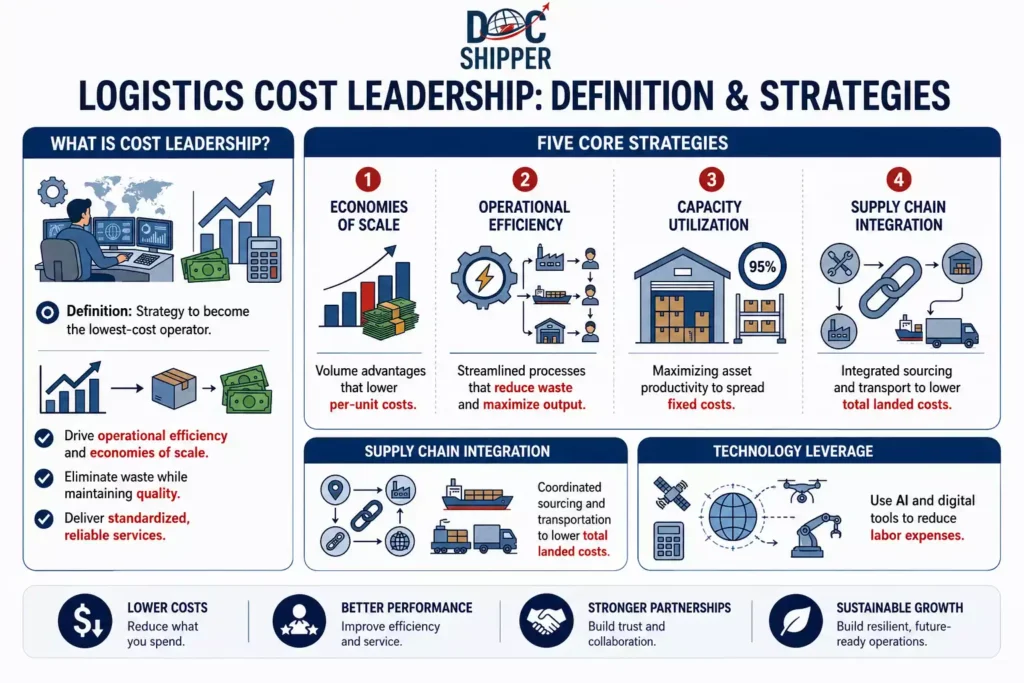
Cost leadership is a competitive strategy where a company becomes the lowest-cost producer in its industry while maintaining acceptable quality levels. This approach enables businesses to offer competitive prices, increase market share, and achieve sustainable profitability through operational efficiency and economies of scale.Introduction
Many companies struggle to differentiate themselves in crowded markets. Price becomes the decisive factor when products appear similar.
Cost leadership addresses this challenge by creating a sustainable competitive advantage through superior cost efficiency. In international logistics and supply chain management, this strategy determines which providers dominate their markets.
Key characteristics of cost leadership include:
- Operational efficiency: Streamlined processes that minimize waste and maximize output
- Economies of scale: Volume advantages that reduce per-unit costs
- Process optimization: Continuous improvement in production and distribution methods
- Strategic sourcing: Procurement practices that secure lowest input costs
- Technology leverage: Automation and digital tools that reduce labor expenses
Cost Leadership Fundamentals & Strategic Framework
Cost leadership requires systematic control over every expense category. Companies must identify cost drivers across their value chain and implement reduction strategies without compromising quality.
The strategy operates on five fundamental pillars. First, standardization eliminates unnecessary complexity. Products and services follow uniform specifications that simplify production and reduce errors.
Second, capacity utilization maximizes asset productivity. Facilities operate at optimal levels to spread fixed costs across larger output volumes. Idle resources represent lost opportunities.
Third, supply chain integration removes intermediary costs. Direct relationships with suppliers and vertical integration reduce markup layers. Transportation consolidation lowers freight expenses.
Fourth, learning curve effects improve efficiency over time. Repetition builds expertise. Workers become faster. Processes become smoother. Defect rates decline.
Fifth, tight cost control monitors every expenditure. Budgeting systems track variances. Management reviews justify expenses. Waste elimination becomes organizational culture.
At DocShipper, we apply cost leadership principles by consolidating shipments across clients, negotiating volume rates with carriers, and optimizing routing to minimize total landed costs for our customers.
According to the World Trade Organization, reducing trade costs by 1% can increase global income by more than $40 billion, demonstrating how cost efficiency impacts international commerce.
Implementation Examples & Industry Data
Real-world applications demonstrate how cost leadership translates into market dominance. The logistics sector provides clear examples of this strategy in action.
Comparative Analysis: Cost Leadership in Freight Forwarding
| Strategy Element | Traditional Approach | Cost Leadership Approach | Cost Reduction |
|---|---|---|---|
| Shipment Consolidation | Individual bookings | Aggregated volumes | 18-25% |
| Documentation Processing | Manual handling | Automated systems | 35-40% |
| Carrier Negotiations | Spot rates | Volume contracts | 12-18% |
| Warehouse Operations | Multiple locations | Centralized hubs | 20-28% |
| Customer Service | Phone-based support | Self-service portals | 30-45% |
Case Study: Container Shipping Cost Leadership
A major container shipping line implemented cost leadership through vessel upsizing. By deploying 20,000 TEU ships instead of 10,000 TEU vessels, they achieved:
- Per-container fuel cost: Reduced from $180 to $95 (47% decrease)
- Crew cost per TEU: Dropped from $12 to $6.50 (46% decrease)
- Port handling efficiency: Improved by 22% through dedicated terminals
- Market share growth: Increased from 8.2% to 12.7% within three years
- Operating margin: Expanded from 4.1% to 9.8%
This strategy enabled competitive pricing that attracted volume-sensitive customers while maintaining profitability through scale advantages.
E-commerce Fulfillment Scenario
Consider an e-commerce business shipping 50,000 packages monthly:
Traditional fulfillment: $8.50 per package × 50,000 = $425,000 monthly
Cost leadership approach: $5.80 per package × 50,000 = $290,000 monthly
Annual savings: $1,620,000
The cost reduction came from warehouse automation ($1.20 savings), carrier volume discounts ($0.90 savings), and packaging optimization ($0.60 savings).
Conclusion
Cost leadership remains the most direct path to competitive advantage in price-sensitive markets. Companies that master operational efficiency and scale economics create barriers competitors struggle to overcome.
Need guidance on implementing cost leadership strategies in your supply chain? Contact DocShipper for expert consultation on optimizing your logistics costs.
📚 Quiz
Test Your Knowledge: Cost Leadership
Q1 — What is the core objective of a cost leadership strategy?
Q2 — A company slashes its prices below all competitors but has no structural cost advantage. Is this cost leadership?
Q3 — A freight forwarder consolidates multiple clients' shipments, negotiates volume contracts with carriers, and automates documentation. Which outcome best reflects cost leadership in action?
🎯 Your Result
📞 Free Quote in 24hFAQ | Cost Leadership: Definition, Strategy & Concrete Examples
Cost leadership focuses on being the lowest-cost producer through operational efficiency, while price leadership simply means charging the lowest prices, which may not be sustainable without cost advantages.
Yes, through niche focus. Small companies achieve cost leadership within specific market segments by specializing, automating key processes, and leveraging strategic partnerships to access scale benefits.
Cost leadership competes on price through efficiency, while differentiation creates value through unique features. Cost leaders minimize expenses; differentiators invest in innovation and branding to justify premium pricing.
Primary risks include quality erosion, technological disruption by competitors, price wars eroding margins, and difficulty adapting when market preferences shift toward premium features rather than low prices.
Larger production volumes spread fixed costs across more units, reducing per-unit expenses. Bulk purchasing, specialized equipment, and efficient capacity utilization all contribute to scale-based cost advantages.
Commodity industries, basic manufacturing, retail discount chains, freight transportation, and standardized services benefit most. Markets where products are undifferentiated and price-sensitive favor cost leaders.
Automation reduces labor costs, data analytics optimize operations, digital platforms eliminate intermediaries, and AI-driven forecasting minimizes inventory waste. Technology amplifies efficiency gains across the value chain.
Absolutely. Cost leadership targets unnecessary expenses, not quality. Effective strategies eliminate waste while maintaining acceptable quality thresholds that meet customer expectations without premium features.
Supply chain optimization directly impacts cost structure through procurement savings, transportation efficiency, inventory reduction, and distribution network design. Integrated supply chains create sustainable cost advantages.
Through continuous improvement, reinvesting savings into further efficiency gains, protecting proprietary processes, building scale barriers, and creating switching costs that lock in customers and suppliers.
Key metrics include cost per unit, operating margin, asset turnover, inventory days, production efficiency ratios, and cost position relative to competitors. Market share growth indicates successful implementation.
Cost-leading logistics providers consolidate shipments, negotiate volume carrier rates, optimize routing, automate documentation, and centralize operations. These efficiencies reduce total landed costs for importers and exporters.
Need Help with
Logistics or Sourcing ?
First, we secure the right products from the right suppliers at the right price by managing the sourcing process from start to finish. Then, we simplify your shipping experience - from pickup to final delivery - ensuring any product, anywhere, is delivered at highly competitive prices.


Fill the Form
Prefer email? Send us your inquiry, and we’ll get back to you as soon as possible.
Contact us




