


In short ⚡
A cost element is the smallest identifiable unit of expense in cost accounting, representing specific resources consumed during production, transportation, or service delivery. In international logistics, cost elements enable precise freight cost allocation, duty calculation, and profitability analysis across multi-modal shipments.
Introduction
Many importers struggle to understand why their landed costs exceed initial quotes. The confusion often stems from inadequate cost element tracking throughout the supply chain. Without granular expense categorization, businesses cannot identify inefficiencies or negotiate better rates.
In international trade, cost elements form the foundation of accurate customs valuation, transfer pricing compliance, and profit margin analysis. Every shipment involves dozens of distinct cost components—from origin handling charges to destination customs clearance fees.
Understanding cost element structure is essential for:
- Customs compliance: Properly declaring dutiable and non-dutiable expenses
- Budget forecasting: Building accurate landed cost models
- Vendor negotiations: Comparing freight quotes on equivalent terms
- Financial reporting: Allocating expenses to correct accounting periods
- Process optimization: Identifying high-cost activities for improvement
Cost Element Classification & Accounting Framework
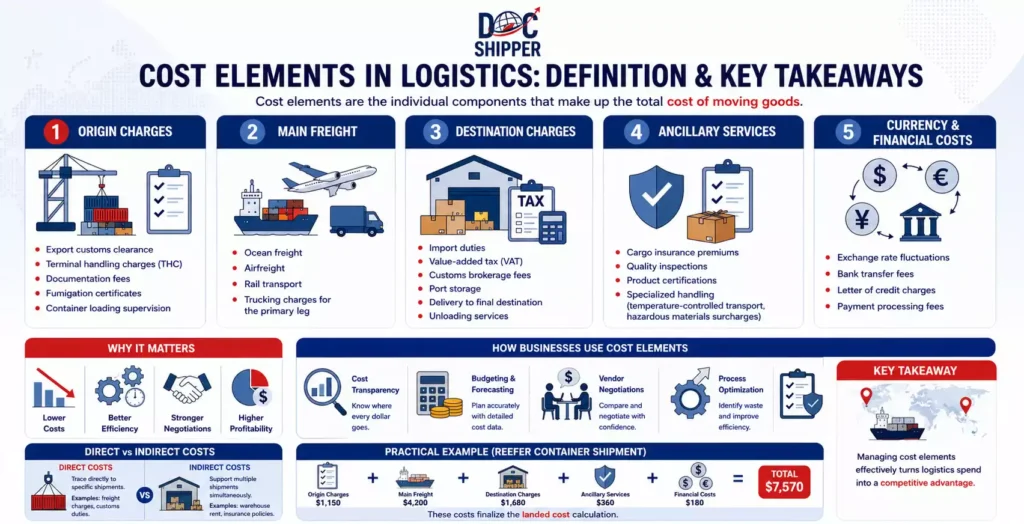
Cost elements in logistics fall into three primary categories: direct costs, indirect costs, and overhead allocations. Direct costs trace directly to specific shipments (freight charges, customs duties). Indirect costs support multiple shipments simultaneously (warehouse rent, insurance policies). Overhead includes administrative expenses distributed across all operations.
The International Financial Reporting Standards (IFRS) and Generally Accepted Accounting Principles (GAAP) require businesses to distinguish between these categories for inventory valuation. According to IAS 2 Inventories, only costs directly attributable to bringing goods to their present location and condition can be capitalized into inventory value.
In international shipping, common cost elements include:
Origin charges: Export customs clearance, terminal handling charges (THC), documentation fees, fumigation certificates, and container loading supervision. These expenses occur before the main carriage begins.
Main freight: Ocean freight, airfreight, rail transport, or trucking charges for the primary leg. This represents the largest single cost element in most shipments, calculated per container (FCL), weight/volume (LCL), or per kilogram (air).
Destination charges: Import duties, value-added tax (VAT), customs brokerage fees, port storage, delivery to final destination, and unloading services. These costs finalize the landed cost calculation.
Ancillary services: Cargo insurance premiums, quality inspections, product certifications, and specialized handling (temperature-controlled transport, hazardous materials surcharges). At DocShipper, we itemize every ancillary charge in our quotations to ensure complete transparency before shipment execution.
Currency and financial costs: Exchange rate fluctuations, bank transfer fees, letter of credit charges, and payment processing fees. These often-overlooked elements can add 2-5% to total shipment costs.
Practical Applications & Data Analysis
Effective cost element management requires structured data collection and comparative analysis. The following table demonstrates how identical shipments can have vastly different cost structures depending on routing and service selection:
| Cost Element | Sea Freight (20′ FCL) | Air Freight (500kg) | Express Courier |
|---|---|---|---|
| Main Transport | $1,800 | $2,500 | $3,200 |
| Origin Handling | $350 | $180 | $0 (included) |
| Customs Clearance | $250 | $250 | $150 |
| Destination Delivery | $420 | $320 | $0 (included) |
| Insurance (2% CIF) | $80 | $65 | $70 |
| Total Landed Cost | $2,900 | $3,315 | $3,420 |
Use Case: Electronics Import from Shenzhen to Hamburg
A German retailer imports 10,000 units of consumer electronics valued at $50,000 FOB. The shipment requires temperature-controlled transport and expedited customs clearance. Cost element breakdown reveals:
- Ocean freight (40′ reefer container): $4,200 (main cost element)
- Reefer power surcharge: $850 (specialized equipment cost)
- Pre-cooling service: $120 (ancillary cost element)
- Import duty (14% on CIF value): $7,700 (regulatory cost)
- VAT (19% on duty-paid value): $10,981 (tax cost element)
- Express customs clearance: $380 (service upgrade cost)
- Final delivery to warehouse: $290 (destination cost)
Total landed cost: $74,521 ($7.45 per unit). By analyzing cost elements separately, the importer identified that temperature control added 20% to base freight costs. This insight led to negotiating annual reefer contracts with volume discounts, reducing per-shipment costs by $680.
Data-driven optimization strategies: Companies tracking cost elements across 50+ shipments annually can identify patterns. Analysis shows that port congestion surcharges fluctuate 300% seasonally, while fuel adjustment factors correlate directly with crude oil prices (lag time: 6-8 weeks). Predictive modeling using historical cost element data enables budget accuracy within ±3%.
Customs valuation considerations: Not all cost elements affect dutiable value. Transportation costs incurred after importation, post-importation assembly costs, and duties/taxes themselves are excluded from customs value calculations. Proper cost element classification prevents overpayment of import duties.
At DocShipper, our proprietary cost tracking system categorizes every expense into 47 distinct cost elements, enabling clients to benchmark performance against industry standards and identify savings opportunities across their supply chain operations.
Conclusion
Mastering cost element identification and classification transforms logistics from a black-box expense into a controllable, optimizable business function. Granular cost tracking enables strategic decision-making, regulatory compliance, and continuous improvement.
Need expert guidance on cost element management for your international shipments? Contact DocShipper for a detailed cost breakdown and optimization consultation.
📚 Quiz
Test Your Knowledge: Cost Element
Q1 — What is a cost element in logistics and cost accounting?
Q2 — Which of the following cost elements is typically EXCLUDED from customs dutiable value?
Q3 — A German importer ships electronics from Shenzhen and notices the total landed cost is much higher than the initial freight quote. Which practice would BEST help identify where the extra costs are coming from?
🎯 Your Result
📞 Free Quote in 24hFAQ | Cost Element: Definition, Classification & Practical Examples
A cost element represents a specific type of expense (e.g., freight charges), while a cost center is an organizational unit that accumulates costs (e.g., logistics department). Cost elements flow into cost centers for budgeting and performance analysis.
Only cost elements incurred up to the port of importation are included in customs value. Post-importation costs like inland transport, warehousing, and assembly are excluded from dutiable value calculations under WTO Valuation Agreement Article 8.
Industry groups like FIATA and IATA publish standard cost element nomenclatures, but individual carriers often use proprietary terminology. Requesting itemized quotes with UN/CEFACT code references ensures comparability across service providers.
FOB (Free On Board) includes all costs until goods are loaded onto the vessel at the origin port: factory costs, export packing, inland transport to port, loading charges, and export customs clearance. All subsequent costs become buyer responsibilities.
Quarterly reviews align with financial reporting cycles, but companies experiencing rapid growth or entering new markets should conduct monthly cost element analysis to detect emerging expense patterns and adjust budgets accordingly.
Bunker Adjustment Factor (BAF) for sea freight and Fuel Surcharge (FSC) for air freight are tracked as distinct cost elements because they fluctuate independently from base rates, typically adjusted monthly based on energy market indices.
International freight after exportation, insurance costs, duties and taxes themselves, post-importation construction/assembly, and buying commissions are generally excluded from customs value. However, selling commissions and royalties are dutiable.
LCL (Less than Container Load) shipments incur additional cost elements: cargo consolidation fees, deconsolidation charges, and per-cubic-meter or per-kilogram freight rates. FCL shipments have simpler structures with flat per-container pricing regardless of utilization.
Shared cost elements like annual insurance policies, warehouse leases, or software subscriptions require allocation methodologies (proportional to shipment value, weight, or volume). GAAP and IFRS provide guidelines for rational and consistent allocation methods.
Enterprise Resource Planning (ERP) systems like SAP, Oracle, and Microsoft Dynamics offer cost element modules. Specialized Transportation Management Systems (TMS) like Freightos and Flexport provide logistics-specific cost tracking with real-time rate comparison capabilities.
Multi-currency shipments require cost elements to be recorded at transaction date exchange rates or using average monthly rates. Unrealized gains/losses from rate changes between booking and payment dates must be tracked separately for accurate financial reporting.
Yes. Demurrage applies to cargo remaining at port terminals beyond free time (cost per day), while detention charges apply to containers held beyond agreed return dates (cost per container per day). Both are penalty-based cost elements subject to negotiation.
Need Help with
Logistics or Sourcing ?
First, we secure the right products from the right suppliers at the right price by managing the sourcing process from start to finish. Then, we simplify your shipping experience - from pickup to final delivery - ensuring any product, anywhere, is delivered at highly competitive prices.


Fill the Form
Prefer email? Send us your inquiry, and we’ll get back to you as soon as possible.
Contact us




