


In short ⚡
Cost Control is the systematic process of monitoring, analyzing, and regulating business expenses to ensure they remain within budgeted limits while maximizing profitability. In international logistics, effective cost control prevents budget overruns, identifies inefficiencies, and maintains competitive pricing across complex supply chains involving multiple stakeholders and regulatory environments.Introduction
Many businesses face unexpected logistics costs that erode profit margins. Hidden fees, currency fluctuations, and inefficient routing can transform a profitable shipment into a financial burden. In international trade, where expenses multiply across borders, cost control becomes the difference between sustainable growth and operational failure.
Cost control integrates financial discipline into every logistics decision. From freight negotiation to customs clearance, controlling costs requires real-time visibility and proactive management. Companies that master this process gain competitive advantages through predictable pricing and optimized resource allocation.
Key characteristics of effective cost control in logistics include:
- Budget variance analysis comparing actual versus projected expenses
- Real-time expense tracking across multi-modal transportation
- Vendor performance benchmarking for rate optimization
- Predictive cost modeling based on historical shipment data
- Automated alerts for budget threshold breaches
Cost Control Mechanisms & Strategic Implementation
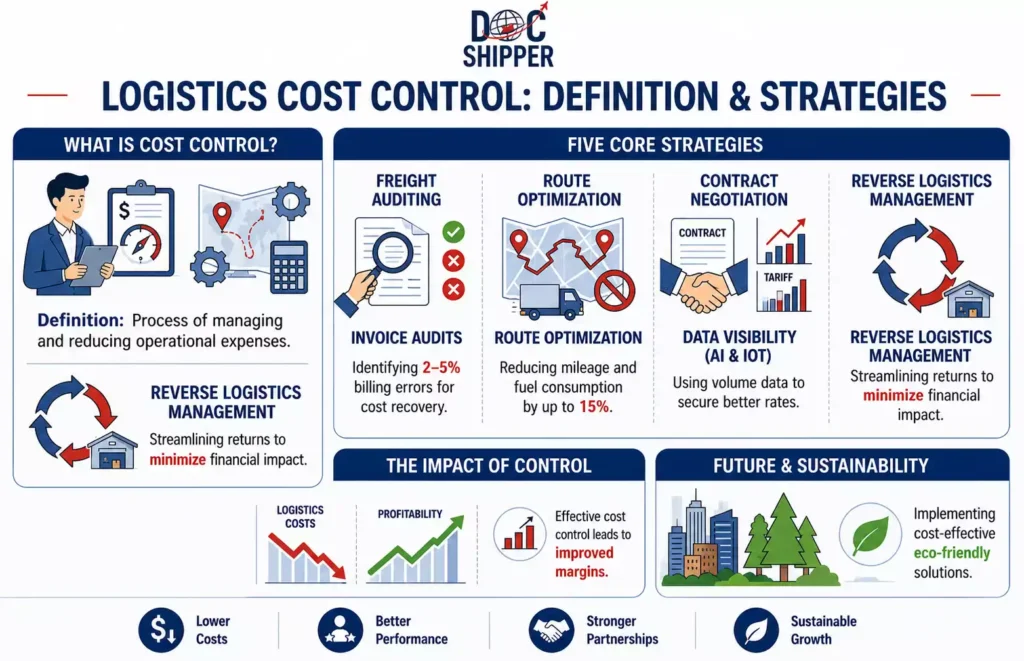
Effective cost control operates through four fundamental mechanisms. Budget establishment creates baseline expectations by analyzing historical data, market rates, and operational requirements. This foundation enables meaningful variance analysis when actual costs deviate from projections.
Expense categorization divides logistics costs into controllable and uncontrollable segments. Freight rates, warehousing fees, and packaging represent controllable costs subject to negotiation and optimization. Regulatory duties, fuel surcharges, and currency exchange represent uncontrollable variables requiring hedging strategies rather than direct reduction.
The third mechanism involves variance reporting. Weekly or monthly comparisons between budgeted and actual expenses reveal patterns. A 15% variance in ocean freight might indicate market volatility, while consistent overages in customs brokerage suggest process inefficiencies requiring procedural adjustments.
Corrective action protocols transform data into operational changes. When warehousing costs exceed budgets by 20%, responses might include renegotiating storage contracts, optimizing inventory turnover, or consolidating distribution centers. At DocShipper, we implement automated cost monitoring systems that flag anomalies before they impact quarterly performance, enabling proactive adjustments rather than reactive damage control.
Regulatory compliance adds complexity to cost control. The WTO Trade Facilitation Agreement promotes transparency in customs procedures, reducing unpredictable administrative costs. Understanding these frameworks helps businesses anticipate mandatory expenses versus negotiable charges.
Technology integration amplifies control capabilities. Transportation Management Systems (TMS) provide real-time cost tracking across carriers, routes, and service levels. Blockchain-enabled platforms create immutable expense records, reducing disputes and enabling precise cost attribution to specific shipments or clients.
Practical Examples & Performance Data
Consider a European electronics importer shipping 500 units monthly from Shenzhen to Rotterdam. Initial budgeting projected $8,500 per shipment based on standard ocean freight rates. Actual costs averaged $10,200, creating a 20% budget variance.
Analysis revealed three cost drivers: demurrage fees from port congestion ($800), premium freight during peak season ($600), and inefficient container utilization (68% capacity). Implementing cost control measures reduced expenses to $8,900:
| Cost Component | Original Cost | Optimized Cost | Savings |
|---|---|---|---|
| Base Ocean Freight | $7,000 | $6,800 | $200 |
| Demurrage/Detention | $800 | $150 | $650 |
| Peak Season Surcharge | $600 | $300 | $300 |
| Documentation/Admin | $450 | $400 | $50 |
| Container Optimization | $1,350 | $1,250 | $100 |
| Total | $10,200 | $8,900 | $1,300 |
This 12.7% reduction demonstrates how granular expense tracking enables targeted interventions. The company negotiated volume discounts during off-peak periods, implemented just-in-time port clearance to eliminate demurrage, and redesigned packaging to achieve 89% container utilization.
Industry data reveals that companies with formal cost control programs reduce logistics expenses by 8-15% annually. A 2023 supply chain benchmarking study showed that businesses tracking costs weekly versus monthly identified savings opportunities 40% faster, translating to $120,000 annual savings for mid-sized importers.
Five critical cost control practices include:
- Rate benchmarking: Quarterly comparison of carrier rates against market indices
- Accessorial charge audits: Verification of fuel surcharges, handling fees, and regulatory charges
- Route optimization: Analysis of alternative ports, transit times, and total landed costs
- Inventory carrying cost calculations: Balancing transportation speed against warehousing expenses
- Currency hedging strategies: Forward contracts to stabilize international payment fluctuations
Conclusion
Cost control transforms logistics from a reactive expense center into a strategic competitive advantage. By implementing systematic monitoring, variance analysis, and corrective protocols, businesses achieve predictable budgets and sustainable profit margins in complex international supply chains.
Need expert guidance on implementing cost control systems for your logistics operations? Contact DocShipper for customized solutions that align financial discipline with operational excellence.
📚 Quiz
Test Your Knowledge: Cost Control
Q1. What is the primary purpose of cost control in international logistics?
Q2. Which of the following is considered a controllable logistics cost — one that can be directly negotiated or optimized?
Q3. A European importer notices their actual shipment costs are consistently 20% above budget. According to cost control best practices, what percentage variance should trigger a formal investigation?
🎯 Your Result
📞 Free Quote in 24hFAQ | Cost Control: Definition, Methods & Practical Examples
Need Help with
Logistics or Sourcing ?
First, we secure the right products from the right suppliers at the right price by managing the sourcing process from start to finish. Then, we simplify your shipping experience - from pickup to final delivery - ensuring any product, anywhere, is delivered at highly competitive prices.


Fill the Form
Prefer email? Send us your inquiry, and we’ll get back to you as soon as possible.
Contact us




