


In short ⚡
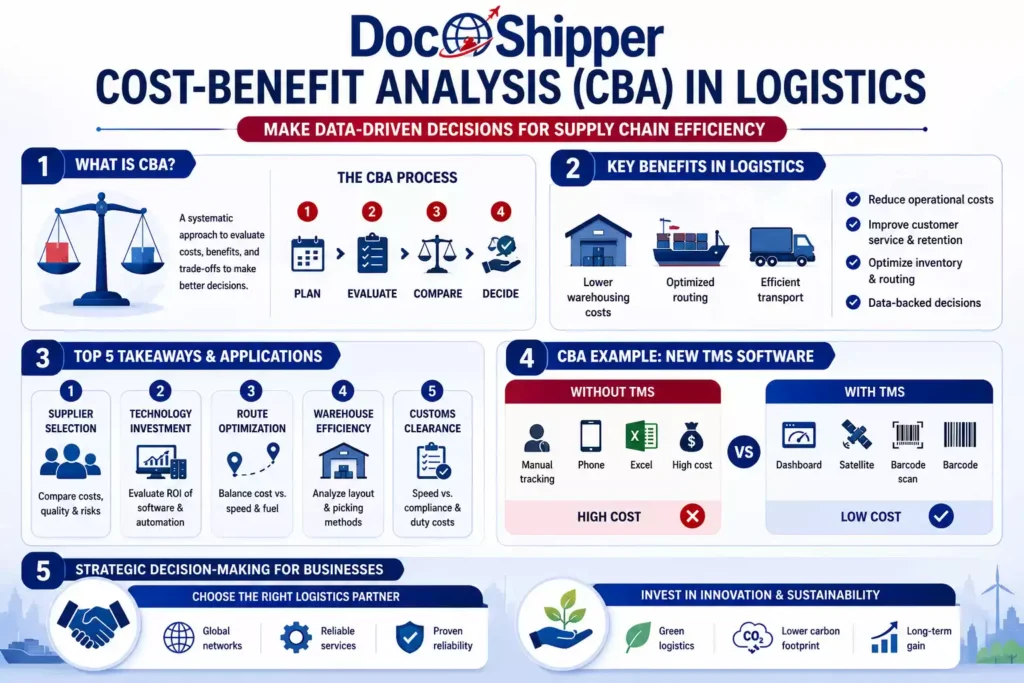
Cost Benefit Analysis (CBA) is a systematic decision-making process that compares the total expected costs against the total expected benefits of a project or investment to determine its economic viability. This financial evaluation tool quantifies both tangible and intangible factors, enabling businesses to make data-driven decisions in international logistics and supply chain management.
Introduction
Many importers and exporters struggle to justify logistics investments without concrete financial metrics. Should you consolidate shipments? Invest in warehouse automation? Switch freight forwarders? Without a structured Cost Benefit Analysis, these decisions rely on intuition rather than evidence.
In international trade, where margins are tight and variables numerous, CBA becomes essential. It transforms complex logistics scenarios into quantifiable comparisons, revealing the true return on investment for every operational choice.
Key characteristics of effective CBA in logistics include:
- Comprehensive cost identification – capturing direct, indirect, and opportunity costs
- Benefit quantification – translating time savings, risk reduction, and efficiency gains into monetary values
- Time-value considerations – applying discount rates to future cash flows
- Risk assessment integration – accounting for uncertainty in international operations
- Stakeholder perspective alignment – balancing short-term expenses against long-term strategic gains
CBA Methodology & Strategic Framework
The fundamental CBA formula appears deceptively simple: Net Benefit = Total Benefits – Total Costs. However, proper application in logistics requires rigorous methodology. The process begins with defining the decision scope and establishing baseline scenarios for comparison.
Cost identification must extend beyond obvious expenses. Direct costs include freight charges, customs duties, and handling fees. Indirect costs encompass administrative overhead, compliance documentation, and quality control. Opportunity costs represent the value of alternative uses for capital and resources—often the most overlooked component.
Benefit calculation demands equal rigor. Tangible benefits include reduced transit times, lower damage rates, and decreased inventory carrying costs. Intangible benefits—improved customer satisfaction, enhanced brand reputation, supply chain resilience—require proxy metrics for monetization.
The time dimension critically impacts CBA accuracy. Future costs and benefits must be discounted to present value using appropriate discount rates (typically 5-12% for logistics projects). This accounts for inflation, risk, and the time-value of money. A benefit realized in five years holds less value than the same benefit today.
Sensitivity analysis addresses uncertainty inherent in international logistics. By testing how results change when key variables shift—fuel prices, exchange rates, demand volumes—decision-makers identify which assumptions most influence outcomes. According to the World Trade Organization, trade costs can vary 15-30% based on route optimization alone, making sensitivity testing essential.
At DocShipper, we integrate CBA into every client consultation, systematically comparing service options to ensure our recommendations deliver measurable financial advantage beyond simple price comparisons.
Practical Applications & Data Analysis
Consider a European electronics importer evaluating two shipping strategies from Shenzhen to Rotterdam:
| Factor | Sea Freight (Standard) | Sea-Air Multimodal |
|---|---|---|
| Transit Time | 35 days | 18 days |
| Freight Cost (per container) | €2,800 | €4,200 |
| Inventory Carrying Cost | €875 (35 days × €25/day) | €450 (18 days × €25/day) |
| Stockout Risk Cost | €600 (higher variability) | €200 (predictable arrival) |
| Total Cost | €4,275 | €4,850 |
Initial analysis suggests sea freight saves €575 per container. However, a complete CBA reveals additional factors:
Use Case: Seasonal Electronics Launch
The importer plans a promotional campaign requiring inventory by September 15. Sea freight departure must occur by August 10, while multimodal allows departure until August 27. This 17-day flexibility enables:
- Negotiation leverage with manufacturers (€400 price reduction secured)
- Production quality assurance (avoiding €1,200 in potential defect costs)
- Exchange rate optimization (€150 benefit from favorable timing)
- Reduced warehouse pre-storage (€300 savings from tighter delivery window)
- Market responsiveness (ability to adjust quantities based on pre-orders, estimated €800 value)
Adjusted CBA calculation:
Sea Freight Net Cost: €4,275 (no flexibility benefits)
Multimodal Net Cost: €4,850 – €2,850 (combined benefits) = €2,000
The multimodal option delivers €2,275 superior value when all factors are quantified. This demonstrates how superficial cost comparison misleads—comprehensive CBA captures strategic advantages invisible in simple price quotes.
Industry data supports this approach. According to supply chain benchmarking studies, companies employing structured CBA for logistics decisions achieve 12-18% better total landed cost performance compared to those focusing solely on freight rates.
Conclusion
Cost Benefit Analysis transforms logistics from a cost center into a strategic advantage by revealing the true financial impact of operational decisions. In international trade, where variables multiply and stakes escalate, CBA provides the analytical foundation for sustainable competitive advantage.
Need expert guidance applying CBA to your specific logistics challenges? Contact DocShipper for a comprehensive evaluation of your supply chain optimization opportunities.
📚 Quiz
Test Your Knowledge: Cost Benefit Analysis
Q1 — What is the primary purpose of a Cost Benefit Analysis (CBA) in logistics?
Q2 — A logistics manager compares two shipping options and concludes that sea freight is cheaper because its freight cost is lower. What critical CBA element is most likely being overlooked?
Q3 — A European importer needs goods delivered by September 15 for a product launch. Sea freight requires departure by August 10; a multimodal option allows departure until August 27. According to CBA principles, which statement best describes the multimodal option's advantage?
🎯 Your Result
📞 Free Quote in 24hFAQ | Cost Benefit Analysis: Definition, Calculation & Concrete Examples
CBA enables data-driven decision-making by quantifying all costs and benefits associated with logistics options, ensuring investments deliver measurable returns rather than relying on assumptions or incomplete information.
Intangible benefits like customer satisfaction or brand reputation are quantified through proxy metrics—customer retention rates, Net Promoter Scores, or market share changes—then converted to monetary values using historical correlation data or industry benchmarks.
Typical discount rates range from 5-12% depending on company cost of capital, project risk profile, and industry standards. Higher-risk international projects warrant higher rates to account for currency, political, and operational uncertainties.
Most logistics CBAs use 3-5 year timeframes, aligning with typical contract durations and technology refresh cycles. Longer projections increase uncertainty; shorter periods may miss significant long-term benefits like relationship development or market positioning.
Frequent errors include omitting opportunity costs, ignoring time-value of money, failing to conduct sensitivity analysis, double-counting benefits, and comparing options with different risk profiles without adjustment. Incomplete cost identification also undermines accuracy.
No. Sunk costs—expenses already incurred regardless of future decisions—should be excluded from CBA. Only incremental costs and benefits affected by the decision under evaluation should be included to avoid analytical bias.
ROI (Return on Investment) measures profitability as a percentage, while CBA provides absolute net benefit values and considers broader factors including non-monetary impacts, risk adjustments, and strategic alignment beyond simple financial returns.
Absolutely. CBA systematically compares routes by evaluating transit time costs, fuel consumption, toll fees, risk exposure, reliability variance, and market access benefits, revealing which routes deliver optimal total value rather than just lowest freight rates.
Risk affects both the probability of outcomes and the discount rate applied. High-risk scenarios require probability weighting of potential outcomes and higher discount rates to reflect uncertainty, ensuring the analysis accounts for variability in international operations.
Initial CBA should be updated quarterly or when significant variables change—fuel prices, exchange rates, trade regulations, or demand patterns. Annual comprehensive reviews ensure strategies remain aligned with evolving market conditions and company objectives.
CBA scales effectively. While detailed analysis suits major investments, simplified CBA frameworks apply to routine decisions. Even basic cost-benefit comparisons for small shipments improve cumulative decision quality, generating significant aggregate savings over time.
Spreadsheet templates provide foundational CBA capability, while specialized tools like supply chain optimization software, ERP modules, and business intelligence platforms automate data collection, scenario modeling, and sensitivity analysis for more sophisticated evaluations.
Need Help with
Logistics or Sourcing ?
First, we secure the right products from the right suppliers at the right price by managing the sourcing process from start to finish. Then, we simplify your shipping experience - from pickup to final delivery - ensuring any product, anywhere, is delivered at highly competitive prices.


Fill the Form
Prefer email? Send us your inquiry, and we’ll get back to you as soon as possible.
Contact us




