


In short ⚡
An air carrier is a company or entity that provides air transportation services for passengers, cargo, or mail using aircraft. These operators hold necessary certifications from aviation authorities and play a critical role in global logistics by connecting markets through scheduled or chartered flights.
Introduction
Many businesses confuse air carriers with freight forwarders, leading to misunderstandings about liability, documentation, and service scope. In international trade, knowing who actually operates the aircraft is crucial for compliance, insurance claims, and shipment tracking.
Air carriers form the backbone of time-sensitive logistics. They enable global commerce by moving goods across continents within hours or days. Understanding their role helps importers and exporters optimize shipping strategies and manage risks effectively.
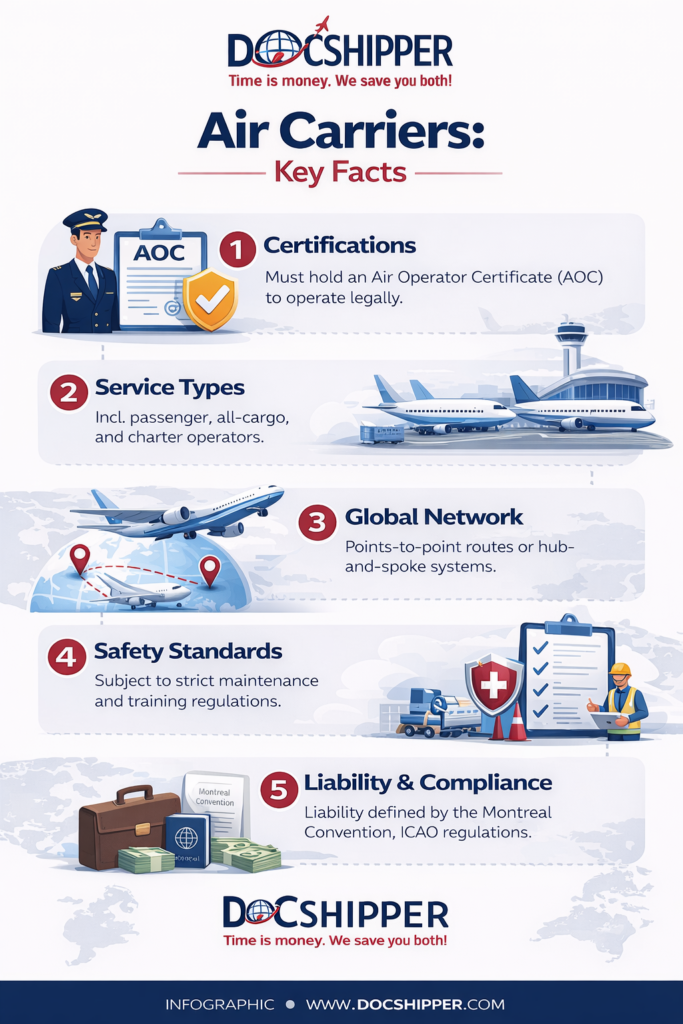
- Certification: Must hold an Air Operator Certificate (AOC) from national aviation authorities like FAA, EASA, or ICAO-compliant bodies.
- Liability: Governed by international conventions such as the Montreal Convention and Warsaw Convention.
- Service Types: Include scheduled passenger airlines, all-cargo carriers, and charter operators.
- Network Reach: Operate point-to-point routes or hub-and-spoke systems connecting major trade corridors.
- Safety Standards: Subject to rigorous inspections, maintenance protocols, and crew training requirements.
Regulatory Framework & Operational Expertise
Air carriers operate under strict regulatory oversight. The Air Operator Certificate (AOC) is the fundamental permit issued by national civil aviation authorities. This certification verifies that the carrier meets safety, operational, and maintenance standards. Without an AOC, no entity can legally transport goods or passengers by air for commercial purposes.
The International Air Transport Association (IATA) establishes industry standards for ticketing, baggage handling, and cargo documentation. IATA’s Dangerous Goods Regulations (DGR) govern how hazardous materials are transported by air. Carriers must train staff specifically on these protocols to prevent incidents.
Legal liability for air carriers is defined by the Montreal Convention, which replaced the Warsaw Convention in 2003. This treaty establishes carrier responsibility for passenger injury, baggage loss, and cargo damage. Compensation limits are specified, and carriers cannot exclude liability through contractual terms. You can review the full convention text at ICAO’s official documentation.
Operationally, carriers distinguish between scheduled and non-scheduled services. Scheduled carriers publish flight timetables and operate regular routes regardless of cargo volume. Non-scheduled or charter carriers operate on-demand, providing flexibility for oversized shipments or urgent deliveries. Both types require the same safety certifications but differ in commercial structure.
At DocShipper, we work directly with certified air carriers to ensure your shipments comply with aviation regulations. Our logistics experts verify carrier credentials and match your cargo requirements with appropriate service levels, eliminating compliance risks before goods leave the ground.
Practical Examples & Industry Data
Understanding air carrier operations becomes clearer through real-world scenarios and comparative data. The global air cargo market transported approximately 68 million metric tons in 2023, with dedicated freighter aircraft handling 60% of this volume.
| Carrier Type | Service Model | Typical Use Cases | Transit Time |
|---|---|---|---|
| Integrated Carriers | Door-to-door express | E-commerce, documents, small parcels | 24-72 hours |
| Combination Carriers | Passenger + belly cargo | General merchandise, perishables | 2-5 days |
| All-Cargo Carriers | Freighter-only operations | Heavy machinery, bulk shipments | 3-7 days |
| Charter Carriers | On-demand flights | Oversized cargo, urgent deliveries | As scheduled |
Use Case Example: A European electronics manufacturer needs to ship 5,000 kg of semiconductors to Singapore within 48 hours. They select an integrated carrier like FedEx or DHL, which operates its own aircraft fleet and customs clearance network. The shipment flies on a dedicated freighter from Frankfurt to Singapore, with real-time tracking throughout. Total cost: approximately $12-15 per kg, including fuel surcharges.
Comparative Scenario: The same manufacturer has a 15,000 kg shipment with a 10-day deadline. Using a combination carrier (e.g., Lufthansa Cargo flying on passenger aircraft belly space) reduces costs to $6-8 per kg. However, the shipment connects through multiple hubs, requiring coordination with ground handlers at each transfer point.
Industry data reveals that Asia-Pacific routes account for 40% of global air cargo volume, driven by manufacturing exports from China, Vietnam, and Thailand. North America-Europe corridors represent 25%, with transatlantic trade in automotive parts, pharmaceuticals, and high-value consumer goods.
Capacity Constraints: During peak seasons (Q4 for retail, Q1 for automotive), available cargo space decreases by 30-40%. Carriers implement dynamic pricing, and rates can spike by 50-100%. Forward planning and carrier relationships become critical for securing capacity.
Sustainability Metrics: Modern air carriers invest in fuel-efficient aircraft like the Boeing 777F or Airbus A350F, which reduce CO2 emissions by 15-20% compared to older models. Sustainable Aviation Fuel (SAF) adoption is growing, with carriers like KLM Cargo and United Airlines Cargo blending SAF into operations.
Conclusion
Air carriers are essential partners in international logistics, providing speed and reliability that no other transport mode matches. Understanding their regulatory environment, service types, and operational constraints enables smarter shipping decisions and risk management.
Need assistance selecting the right air carrier for your shipment? Contact DocShipper for expert guidance on air freight solutions tailored to your timeline and budget.
DocShipper Platform
Cut logistics costs. Not corners.
See exactly where your logistics costs are bleeding — and how to fix it. Book your expert demo.

📚 Quiz
Test Your Knowledge: Air Carrier
Q1 — Which of the following best defines an air carrier?
Q2 — Under which international convention is an air carrier's liability for cargo damage currently governed?
Q3 — A manufacturer needs to ship 15,000 kg of goods with a 10-day deadline at the lowest possible cost. Which air carrier type is the most appropriate choice?
🎯 Your Result
📞 Free Quote in 24hFAQ | Air Carrier: Definition, Types & Practical Examples
An air carrier operates the aircraft and holds the Air Operator Certificate. A freight forwarder arranges transportation but does not own or operate aircraft. Forwarders book space with carriers on behalf of shippers.
Yes, any airline holding an AOC and transporting goods or passengers commercially is an air carrier. This includes passenger airlines that carry cargo in belly holds and dedicated cargo airlines.
The Montreal Convention governs liability. Carriers are liable up to 22 Special Drawing Rights (SDR) per kilogram unless the shipper declares a higher value and pays additional fees. Carriers must prove they took all reasonable measures to avoid damage to escape liability.
No. Carriers must be certified to handle dangerous goods according to IATA DGR. Not all carriers accept hazardous materials, and specific packaging, labeling, and documentation requirements apply.
Standard documents include the Air Waybill (AWB), commercial invoice, packing list, and certificate of origin. Additional permits may be needed for restricted goods like pharmaceuticals, electronics, or food products.
Costs are based on chargeable weight (greater of actual weight or volumetric weight), route, service level, and fuel surcharges. Volumetric weight is calculated as Length × Width × Height (cm) ÷ 6000.
The IATA carrier code is a two-character airline designator (e.g., AA for American Airlines, LH for Lufthansa). This code appears on Air Waybills and tracking systems to identify the operating carrier.
Yes. Carriers can refuse items that violate safety regulations, lack proper documentation, or exceed aircraft capacity limits. Perishables without adequate packaging or undeclared hazardous materials are commonly rejected.
The carrier rebooks the shipment on the next available flight. Delays are documented, and you can file a claim if the delay causes financial loss. Carriers are not automatically liable for consequential damages unless negligence is proven.
Check the carrier's AOC status through national aviation authorities like the FAA (US), EASA (EU), or CAAC (China). IATA membership also indicates compliance with industry standards, though it's not legally required.
Carriers offer limited liability coverage as mandated by the Montreal Convention. Shippers should purchase separate cargo insurance for full replacement value, especially for high-value or fragile goods.
Ground handlers load, unload, and transfer cargo between aircraft and warehouses. They work under contract with carriers but are separate entities. Damage during ground handling may involve shared liability between the carrier and handler.
Need Help with
Logistics or Sourcing ?
First, we secure the right products from the right suppliers at the right price by managing the sourcing process from start to finish. Then, we simplify your shipping experience - from pickup to final delivery - ensuring any product, anywhere, is delivered at highly competitive prices.


Fill the Form
Prefer email? Send us your inquiry, and we’ll get back to you as soon as possible.
Contact us




