


In short ⚡
CBM (Cubic Meter) is the standard unit of volume measurement in international freight shipping, representing the total three-dimensional space occupied by cargo. It is calculated by multiplying length × width × height (in meters) and determines shipping costs, container capacity, and logistics planning for both sea and air freight.
Introduction
One of the most common mistakes in international shipping is underestimating cargo volume. Shippers often focus solely on weight, only to face unexpected surcharges when their shipment occupies more space than anticipated.
In global logistics, CBM serves as the universal language for volume measurement. Whether you’re shipping electronics from China or furniture to Europe, understanding CBM directly impacts your freight costs, container selection, and delivery timelines.
Key characteristics of CBM in shipping:
- Universal standard: Accepted worldwide for sea freight, air cargo, and warehousing
- Cost determinant: Carriers charge based on either actual weight or volumetric weight, whichever is greater
- Container planning: Essential for optimizing 20ft (28 CBM) or 40ft (58 CBM) container loads
- Customs documentation: Required for accurate declaration and duty assessment
- Warehouse efficiency: Determines storage costs and space allocation
Understanding CBM in Freight Logistics
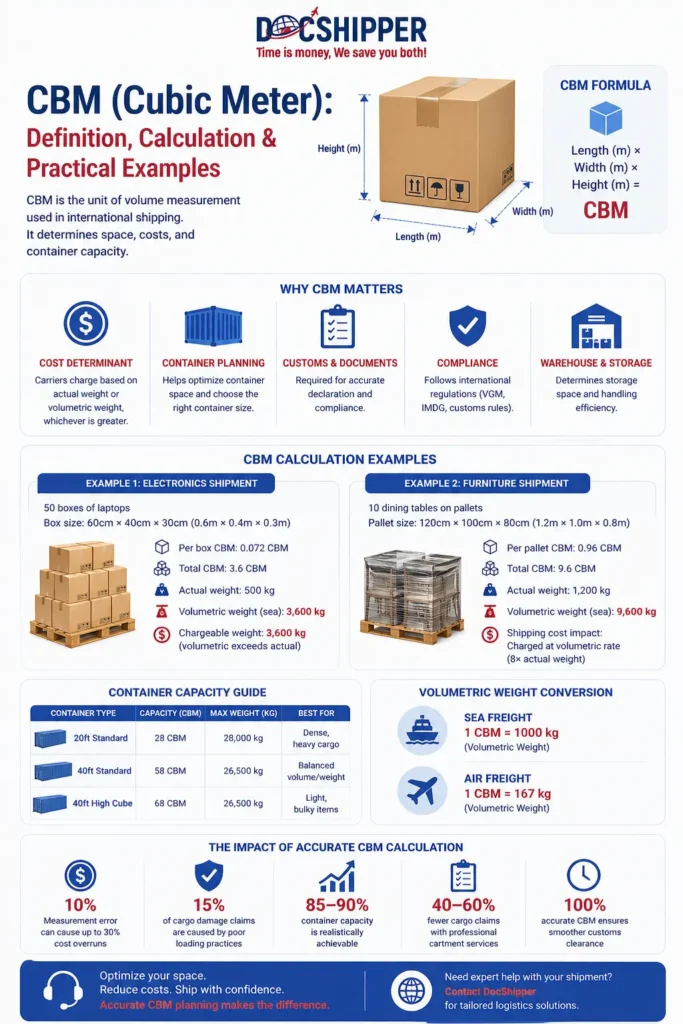
The CBM calculation formula is straightforward: Length (m) × Width (m) × Height (m) = CBM. However, its application in real-world shipping involves several critical considerations that professionals must understand.
For irregular shipments, carriers measure the outermost dimensions, including any protruding parts. This means a machine with an extended arm counts at its maximum reach, not its compact base. Palletized goods include the pallet dimensions in the total CBM.
The concept of volumetric weight (also called dimensional weight) converts CBM into a weight equivalent. For sea freight, the standard conversion is 1 CBM = 1000 kg. Air freight uses 1 CBM = 167 kg (or 6000 cubic centimeters per kilogram). Carriers bill based on whichever is higher: actual weight or volumetric weight.
Container utilization rarely achieves 100% efficiency due to cargo shape irregularities and stacking limitations. Industry standards suggest planning for 85-90% capacity. A standard 20-foot container holds approximately 28 CBM, while a 40-foot container accommodates 58-68 CBM depending on whether it’s standard or high-cube.
At DocShipper, we systematically verify CBM calculations during cargo inspection to prevent billing disputes and ensure optimal container selection. Our team identifies potential volumetric weight issues before shipment, saving clients from unexpected freight charges.
The legal implications of CBM extend to customs declarations. Inaccurate volume reporting can trigger inspections, delays, or penalties. European Union customs regulations (EU Customs Code) require precise cargo dimensions for risk assessment and duty calculation.
Practical Calculations & Cost Examples
Understanding CBM theory is insufficient without practical application. The following scenarios demonstrate how CBM calculations directly impact shipping decisions and costs across different cargo types.
Calculation Example 1: Electronics Shipment
Scenario: 50 boxes of laptops, each measuring 60cm × 40cm × 30cm
- Per box CBM: 0.6m × 0.4m × 0.3m = 0.072 CBM
- Total CBM: 0.072 × 50 = 3.6 CBM
- Actual weight: 500 kg (10 kg per box)
- Volumetric weight (sea): 3.6 CBM × 1000 = 3,600 kg
- Chargeable weight: 3,600 kg (volumetric exceeds actual)
Calculation Example 2: Furniture Shipment
Scenario: 10 dining tables on pallets, each pallet 120cm × 100cm × 80cm
- Per pallet CBM: 1.2m × 1.0m × 0.8m = 0.96 CBM
- Total CBM: 0.96 × 10 = 9.6 CBM
- Actual weight: 1,200 kg
- Volumetric weight: 9.6 × 1000 = 9,600 kg
- Shipping cost impact: Charged at volumetric rate (8× actual weight)
Container Selection Comparison
| Container Type | Capacity (CBM) | Max Weight (kg) | Best For |
|---|---|---|---|
| 20ft Standard | 28 CBM | 28,000 kg | Dense, heavy cargo |
| 40ft Standard | 58 CBM | 26,500 kg | Balanced volume/weight |
| 40ft High Cube | 68 CBM | 26,500 kg | Light, bulky items |
Cost Impact Analysis
Real-world scenario: Shipping 15 CBM of textile goods from Shanghai to Hamburg
- LCL (Less than Container Load): $80 per CBM = $1,200
- Shared 20ft container: $65 per CBM = $975 (18% savings)
- Full 40ft container: $2,800 total (cost-effective only above 35 CBM)
- Air freight equivalent: $4.50 per kg × 2,505 kg (volumetric) = $11,272
These calculations demonstrate why accurate CBM measurement is critical for budget planning. A 10% error in dimensions can result in 30% cost overruns due to volumetric weight penalties.
Conclusion
Mastering CBM calculations is fundamental to cost-effective international shipping. Accurate volume assessment prevents billing surprises, optimizes container selection, and ensures compliance with customs regulations.
Need expert guidance on CBM optimization for your shipments? Contact DocShipper for a comprehensive freight analysis tailored to your logistics needs.
📚 Quiz
Test Your Knowledge: CBM (Cubic Meter)
Q1 — What does CBM measure in international freight shipping?
Q2 — A shipper sends 50 lightweight boxes, each 0.6m × 0.4m × 0.3m, with a total actual weight of 500 kg. For sea freight, which weight will the carrier charge?
Q3 — You need to ship 20 CBM of goods from Shanghai to Hamburg. Which option is most cost-effective?
🎯 Your Result
📞 Free Quote in 24hFAQ | CBM (Cubic Meter): Definition, Calculation & Practical Examples
CBM (Cubic Meter) is the metric system standard, while CFT (Cubic Feet) is used in imperial measurements. 1 CBM equals 35.315 CFT. International shipping predominantly uses CBM for consistency across borders.
Measure the maximum dimensions (length, width, height) at the cargo's widest points, including any protrusions. Use these outer measurements for CBM calculation, as carriers charge based on total space occupied.
Carriers use volumetric weight for lightweight but bulky cargo to account for space consumption. If your cargo's volumetric weight exceeds actual weight, you're charged the higher amount to reflect true transportation costs.
Yes, through optimized packaging. Remove excess void fill, use vacuum-sealed bags for textiles, disassemble furniture when possible, and nest items efficiently. Each 10% CBM reduction can decrease costs by 10-15%.
A 20ft container holds approximately 28 CBM, a 40ft standard container holds 58 CBM, and a 40ft high-cube container holds 68 CBM. Actual usable capacity is typically 85-90% due to loading constraints.
Air cargo uses a volumetric conversion of 1 CBM = 167 kg (or 6000 cm³/kg). Airlines charge based on whichever is greater: actual weight or volumetric weight, making CBM critical for cost estimation.
Yes, always include pallet height and dimensions in your total CBM. Standard Euro pallets (120×80×14.5cm) add approximately 0.14 CBM per pallet to your shipment volume.
Underreporting can result in customs inspections, shipment delays, fines, and potential criminal charges for fraud. Accurate CBM declaration is legally required and verified through physical inspection or scanning.
Professional forwarders physically measure cargo, use 3D scanning technology, or verify supplier-provided dimensions. Discrepancies trigger re-measurement before shipment to prevent billing disputes with carriers.
The measurement unit is identical, but application differs. Sea freight uses 1 CBM = 1000 kg for volumetric weight, while air freight uses 1 CBM = 167 kg, making air freight more sensitive to volume.
LCL (Less than Container Load) is cost-effective below 15 CBM. Between 15-25 CBM, costs are comparable. Above 25 CBM, FCL (Full Container Load) typically offers better value and faster transit times.
Yes, reefer containers have slightly reduced capacity due to refrigeration units. A 40ft reefer holds approximately 54-58 CBM instead of 68 CBM, requiring adjusted calculations for perishable or temperature-sensitive cargo.
Need Help with
Logistics or Sourcing ?
First, we secure the right products from the right suppliers at the right price by managing the sourcing process from start to finish. Then, we simplify your shipping experience - from pickup to final delivery - ensuring any product, anywhere, is delivered at highly competitive prices.


Fill the Form
Prefer email? Send us your inquiry, and we’ll get back to you as soon as possible.
Contact us




:%20Definition%20&%20Calculation%20in%202026)