


In short ⚡
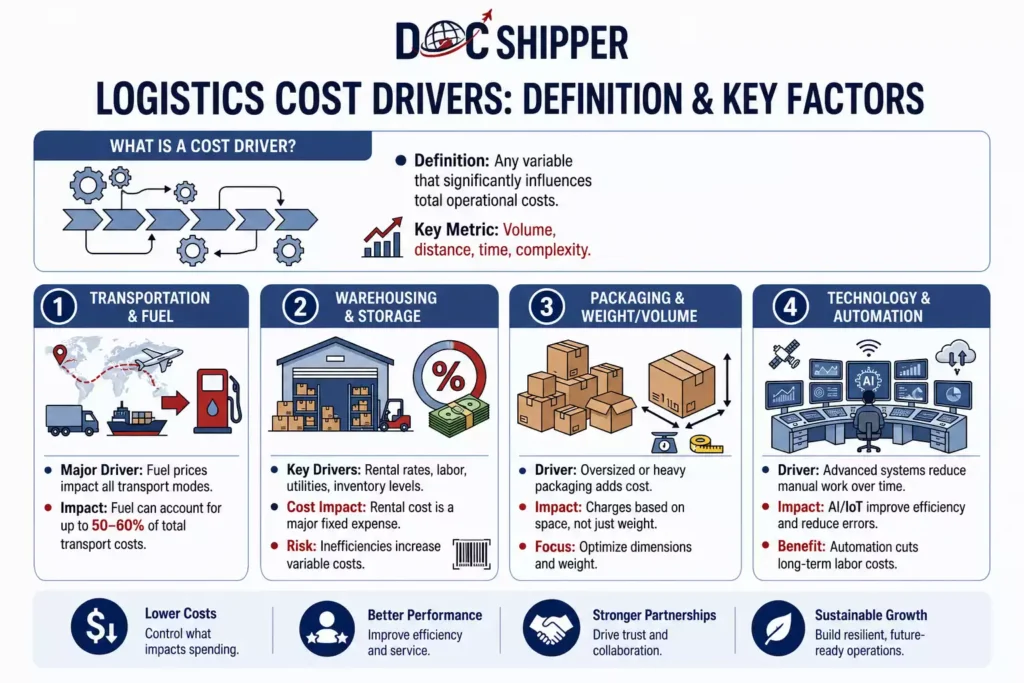
A cost driver is any factor or activity that causes a change in the total cost of producing goods or services. In international logistics, cost drivers directly influence freight rates, warehousing expenses, customs duties, and operational efficiency. Identifying and managing these variables enables businesses to optimize supply chain costs and improve profitability.
Introduction
Many importers struggle to understand why their logistics costs fluctuate dramatically between shipments. The answer lies in cost drivers—the underlying factors that push expenses up or down.
In international trade, recognizing these drivers is essential for accurate budgeting, vendor negotiations, and route optimization. Ignoring them leads to unexpected charges and eroded margins.
Key characteristics of logistics cost drivers include:
- Volume-based: Shipping quantity, container utilization, and cargo weight directly impact unit costs.
- Distance-related: Transportation miles, routing complexity, and geographical zones affect freight charges.
- Time-sensitive: Lead times, storage duration, and seasonal demand create cost variations.
- Regulatory: Customs procedures, compliance requirements, and documentation complexity add administrative expenses.
- Service-level dependent: Express delivery, insurance coverage, and value-added services increase total expenditure.
Understanding Cost Drivers in Logistics
Cost drivers function as the root causes of expense accumulation throughout the supply chain. Unlike simple cost categories, they represent the activities or conditions that trigger spending.
In freight forwarding, fuel surcharges exemplify a classic cost driver. As oil prices fluctuate, carriers adjust their rates accordingly. This variable directly correlates with transportation costs but remains outside the shipper’s control.
Another critical driver is cargo density. Low-density shipments consume more cubic space relative to weight, forcing carriers to charge based on volumetric calculations rather than actual mass. This principle applies universally across air, ocean, and road transport.
Customs complexity serves as a regulatory cost driver. Products requiring special permits, sanitary inspections, or anti-dumping duty assessments incur higher brokerage fees and longer clearance times. According to the World Trade Organization, trade facilitation improvements can reduce costs by up to 14.5% for developing countries.
Handling frequency impacts warehousing expenses. Each time goods are moved—received, stored, picked, packed, or shipped—labor and equipment costs accumulate. Consolidation strategies minimize these touchpoints.
At DocShipper, we systematically analyze cost drivers during quotation to provide transparent pricing. Our team identifies which factors are negotiable, which are regulatory, and which can be optimized through strategic planning.
Concrete Examples & Data Analysis
Understanding cost drivers becomes clearer through practical scenarios and comparative data. The following table illustrates how different drivers affect a standard 20-foot container shipment from Shanghai to Rotterdam:
| Cost Driver | Impact | Example Cost Variation |
|---|---|---|
| Fuel Price | +20% oil increase | +$250 per container |
| Peak Season | Q4 demand surge | +$800–$1,200 per container |
| Port Congestion | 3-day delay | +$150 demurrage charges |
| Cargo Type | Hazardous materials | +$400–$600 handling fees |
| Container Utilization | 50% vs. 95% loaded | Double unit cost per CBM |
Use Case: Electronics Importer
A European electronics distributor imports smartphones from Vietnam. Their primary cost drivers include:
- Air freight weight: High-value, low-weight products favor air transport despite higher rates.
- Insurance requirements: Premium coverage adds 1.2% to cargo value due to theft risk.
- Customs valuation: Complex transfer pricing requires specialized brokerage services (+$350 per shipment).
- Packaging efficiency: Optimized carton dimensions reduce volumetric weight by 18%, saving $2,400 annually.
- Incoterms selection: Switching from EXW to FOB transfers logistics responsibility to the seller, reducing coordination costs by 22%.
By mapping these drivers, the company negotiated volume discounts with carriers and consolidated shipments, reducing per-unit logistics costs from $8.40 to $6.70—a 20% improvement.
Conclusion
Mastering cost drivers transforms logistics from an unpredictable expense into a manageable, optimizable function. Accurate identification enables strategic sourcing, route planning, and vendor negotiations that directly impact bottom-line profitability.
Need expert guidance on optimizing your supply chain cost structure? Contact DocShipper for a comprehensive cost driver analysis tailored to your business.
📚 Quiz
Test Your Knowledge: Cost Driver
Q1 — What is a cost driver in international logistics?
Q2 — A shipment has low density (large volume, low weight). How does this affect air freight costs?
Q3 — A European importer switches their Incoterms from EXW to FOB for shipments from Vietnam. What is the most likely outcome regarding cost drivers?
🎯 Your Result
📞 Free Quote in 24hFAQ | Cost Driver: Definition, Calculation & Concrete Examples
A cost driver is an activity or factor that causes costs to increase, while a cost center is an organizational unit (like a department) where costs are accumulated for accounting purposes.
Conduct a detailed cost breakdown by shipment, analyze variance patterns, and correlate expenses with operational activities. Focus on variables that change frequently and have significant financial impact.
No, but they can be minimized or optimized. Some drivers like distance are fixed, while others like packaging efficiency or routing can be improved through strategic planning.
Seasonal demand is a major cost driver. Peak periods (typically Q3-Q4) see increased cargo volumes, reducing available container space and driving rates upward by 40-60% compared to low seasons.
Airlines charge based on the greater of actual weight or volumetric weight (length × width × height ÷ 6000). Low-density shipments pay higher rates per kilogram due to space consumption.
Incoterms define responsibility boundaries. Choosing DDP over EXW shifts all logistics costs to the seller, affecting pricing, risk allocation, and administrative workload significantly.
Yes. Tariff rates, product classification, and country of origin directly drive import costs. Misclassification can trigger penalties, making accurate HS code determination critical.
Proximity to ports, customers, and transportation hubs reduces last-mile delivery expenses and transit times. Strategic warehouse placement can cut distribution costs by 15-25%.
Absolutely. Transportation Management Systems (TMS), automated customs filing, and real-time tracking minimize manual errors, optimize routes, and improve container utilization—all reducing driver-related expenses.
Exchange rate fluctuations affect international payments for freight, duties, and services. A 5% currency shift can alter total landed costs by 2-3%, making hedging strategies important for high-volume importers.
Frequent small orders increase handling, picking, and administrative costs per unit. Consolidating orders reduces touchpoints and leverages economies of scale, lowering per-item warehousing expenses by up to 30%.
Underutilized containers waste space and increase per-unit costs. Maximizing load efficiency—targeting 90-95% capacity—distributes fixed freight charges across more goods, improving cost-effectiveness substantially.
Need Help with
Logistics or Sourcing ?
First, we secure the right products from the right suppliers at the right price by managing the sourcing process from start to finish. Then, we simplify your shipping experience - from pickup to final delivery - ensuring any product, anywhere, is delivered at highly competitive prices.


Fill the Form
Prefer email? Send us your inquiry, and we’ll get back to you as soon as possible.
Contact us




