Air Waybill (AWB): Definition & Guide for 2026

  • admin 8 Min
  • Published on March 2, 2026 Updated on March 5, 2026
img

In short ⚡

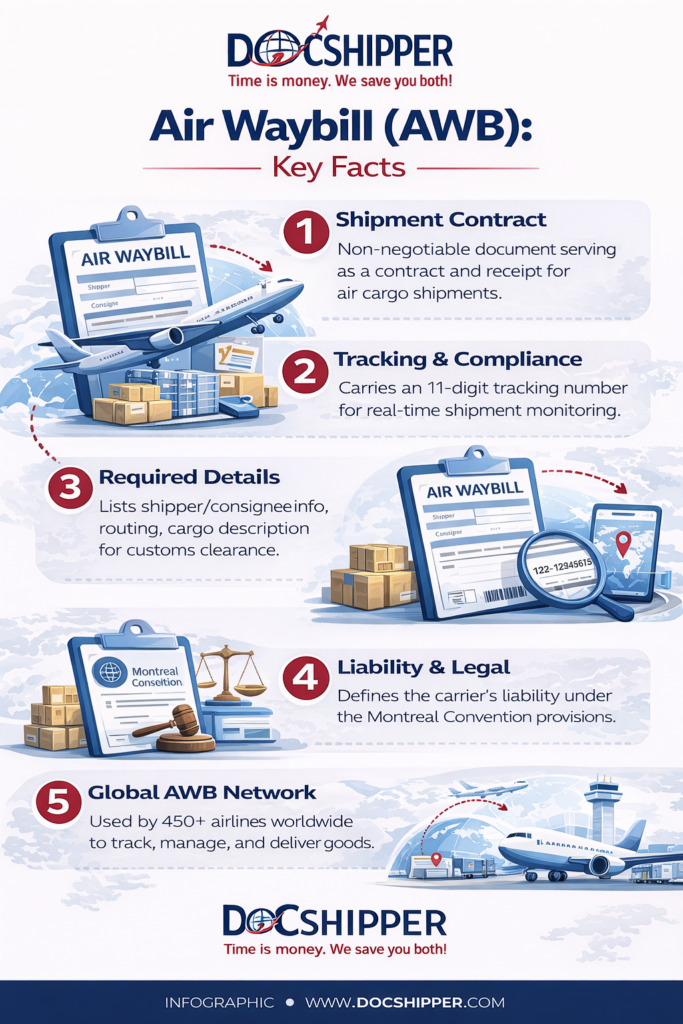
The Air Waybill (AWB) is a non-negotiable transport document issued by an airline or freight forwarder that serves as a contract of carriage and receipt of goods for air shipment. It contains detailed information about the shipment, including shipper and consignee details, routing, and cargo description, enabling tracking throughout the international air freight journey.

Introduction

Confusion between air waybills and bills of lading costs importers thousands in delays annually. Understanding the AWB’s unique role prevents costly shipping errors.

In international air freight, the Air Waybill functions as the cornerstone document linking shippers, carriers, and consignees across borders. Unlike ocean bills of lading, AWBs are non-negotiable and non-transferable, fundamentally changing how cargo ownership and liability are managed.

  • Unique identification: Each AWB carries an 11-digit tracking number enabling real-time shipment monitoring
  • Multi-party contract: Binds shipper, carrier, and consignee under standardized IATA regulations
  • Customs clearance tool: Required documentation for import/export compliance in all jurisdictions
  • Liability framework: Defines carrier responsibility limits under Montreal Convention provisions
  • Proof of delivery: Serves as legal evidence of cargo receipt and condition at departure

Technical Framework & Legal Implications

The Air Waybill operates under the Montreal Convention (1999), which standardizes carrier liability across 137 signatory countries. This international treaty establishes maximum compensation limits and defines force majeure conditions affecting claims.

AWBs exist in two primary formats: the Master Air Waybill (MAWB) issued by airlines and the House Air Waybill (HAWB) issued by freight forwarders. The MAWB covers the airline’s responsibility from origin to destination airport, while HAWBs manage individual shipments within consolidated freight.

Standard AWB documents contain three original copies distributed among carrier, consignee, and shipper, plus additional copies for airport authorities and internal records. Each copy bears identical information but serves different legal purposes in the shipping chain.

The eleven-digit AWB number follows a structured format: the first three digits represent the airline prefix (assigned by IATA), followed by an eight-digit serial number. This systematic numbering enables global tracking through automated systems and customs databases.

Unlike ocean bills of lading, AWBs are straight consignment documents, meaning cargo releases directly to the named consignee without requiring document presentation. This non-negotiable nature accelerates delivery but eliminates the document’s use as collateral for trade finance. At DocShipper, we systematically verify AWB accuracy before shipment departure to prevent customs rejections and delivery delays.

For comprehensive regulatory guidance, consult the IATA Cargo Services Conference Resolutions Manual, which details standardized AWB procedures and carrier obligations.

Air Waybill (AWB)

Practical Examples & Data Analysis

Understanding AWB applications through concrete scenarios clarifies its operational importance in international logistics. The following data demonstrates typical usage patterns and cost implications.

Comparative Analysis: MAWB vs HAWB

Characteristic Master AWB (MAWB) House AWB (HAWB)
Issued By Airlines (carrier) Freight forwarders
Scope Entire consolidated shipment Individual consignments within consolidation
Liability Party Airline (airport-to-airport) Freight forwarder (door-to-door)
Customs Documentation Used for consolidated cargo clearance Required for individual shipment clearance
Typical Cost Impact Lower per-kg rates (bulk pricing) Higher per-kg rates (handling fees included)

Use Case: Electronics Shipment from Shenzhen to Frankfurt

Scenario: A German importer orders 500kg of smartphone components requiring expedited delivery.

  • AWB Number: 180-12345678 (Lufthansa Cargo prefix)
  • Chargeable Weight: 625kg (volumetric calculation: 2.5m³ × 250kg/m³ dimensional factor)
  • Freight Cost: €3.80/kg × 625kg = €2,375
  • Transit Time: 48 hours door-to-door with customs pre-clearance
  • Insurance Coverage: Declared value €85,000 with 0.35% premium rate

In this case, the shipper received both MAWB (airline-issued) and HAWB (forwarder-issued) documents. The HAWB enabled direct delivery to the consignee’s warehouse, while the MAWB facilitated customs clearance at Frankfurt Airport.

Key Data Points for AWB Management

  • Error Rate Impact: Incorrect AWB data causes 23% of air freight delays, averaging 2.7 days per incident (IATA 2023 data)
  • Digital Adoption: Electronic AWBs (e-AWB) now represent 78% of global air cargo shipments, reducing processing time by 40%
  • Liability Limits: Montreal Convention caps carrier liability at 22 Special Drawing Rights per kilogram (approximately $30/kg)
  • Tracking Efficiency: AWB numbers enable real-time tracking through 450+ airline systems worldwide
  • Compliance Requirements: 100% of air shipments require AWB presentation for customs clearance in EU and US jurisdictions

At DocShipper, we leverage automated AWB verification systems that cross-reference shipment details against customs databases before departure, reducing error-related delays by 89% compared to manual processing.

Conclusion

The Air Waybill remains the indispensable document in air freight operations, combining legal contract, tracking tool, and customs declaration in a single standardized format. Mastering AWB mechanics directly impacts shipment speed, cost control, and regulatory compliance.

Need expert guidance on air freight documentation? Contact DocShipper for comprehensive logistics support tailored to your shipping requirements.

📚 Quiz
Test Your Knowledge: Air Waybill (AWB)

FAQ | Air Waybill (AWB): Definition, Components & Practical Examples

An Air Waybill is non-negotiable and specific to air transport, while a bill of lading (used in ocean freight) is negotiable and can serve as a title document for trade finance purposes.

Ask us anything!

Need Help with Logistics or Sourcing ?

First, we secure the right products from the right suppliers at the right price by managing the sourcing process from start to finish. Then, we simplify your shipping experience - from pickup to final delivery - ensuring any product, anywhere, is delivered at highly competitive prices.

Live Chat

Get instant assistance from our team—just click and start chatting!

Live Chat Now
image

Fill the Form

Prefer email? Send us your inquiry, and we’ll get back to you as soon as possible.

Contact us
image

Call us

Reach out to us on WhatsApp for quick, convenient, and personal support.

Call us
image