


In short ⚡
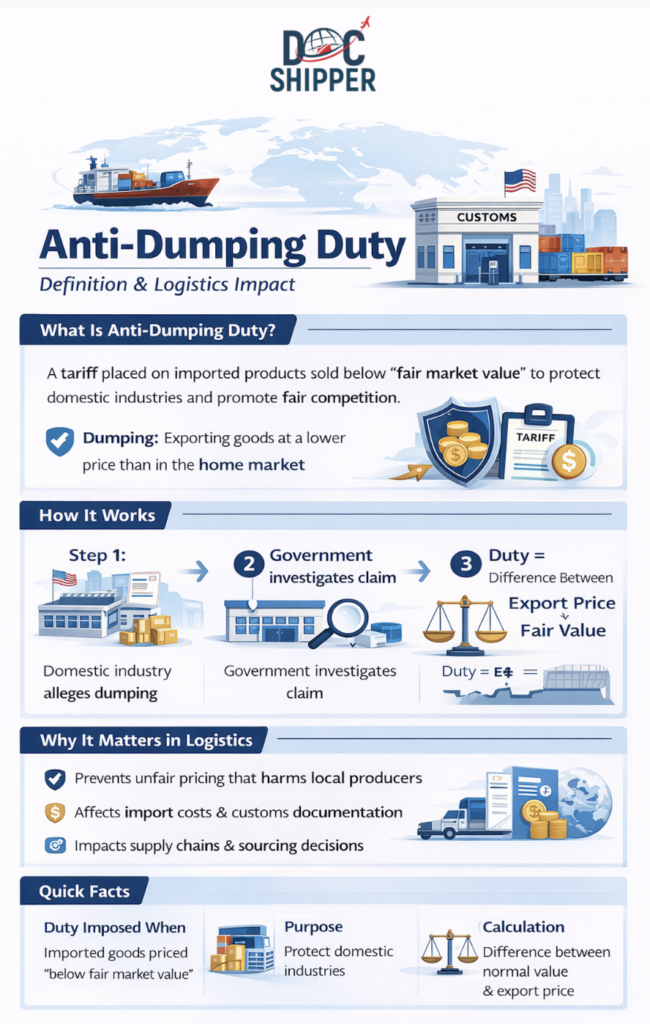
Anti-dumping duty is a protectionist tariff imposed by governments on foreign imports believed to be priced below fair market value. This customs duty aims to prevent predatory pricing practices that could harm domestic industries by leveling the competitive playing field and ensuring fair trade practices across international markets.Introduction
Many importers face unexpected costs when their shipments are suddenly subject to additional duties. This confusion often stems from anti-dumping measures—tariffs that can dramatically increase import costs overnight. Understanding these duties is essential for anyone involved in international trade.
Anti-dumping duties protect domestic markets from unfair pricing strategies. When foreign manufacturers sell products abroad for less than their home market price, they engage in “dumping.” This practice can destroy local competition and create monopolistic conditions.
Key characteristics of anti-dumping duties include:
- Applied to specific products from specific countries, not blanket tariffs
- Calculated based on the margin of dumping (price difference)
- Subject to periodic review and sunset clauses (typically 5 years)
- Require formal investigations and evidence of material injury
- Governed by WTO Anti-Dumping Agreement rules
Mechanisms & Legal Framework
The implementation of anti-dumping duties follows a rigorous legal process. Domestic industries must petition their government, providing evidence that imports are being sold below normal value and causing material injury to local producers.
Investigating authorities examine three critical elements. First, they establish the dumping margin—the difference between the export price and the normal value in the exporting country. Second, they assess whether domestic industry has suffered measurable harm. Third, they verify a causal link between dumping and injury.
The World Trade Organization’s Anti-Dumping Agreement provides the international legal framework. According to WTO guidelines, duties cannot exceed the dumping margin and must be removed after five years unless renewed through review.
Normal value determination uses several methods. The preferred approach compares the export price to the actual domestic selling price in the exporter’s home market. When home market data is unavailable, authorities use either prices in a third country or a constructed value based on production costs plus reasonable profit.
At DocShipper, we monitor anti-dumping investigations across multiple jurisdictions to alert our clients before duties take effect. This proactive approach allows businesses to adjust sourcing strategies or prepare for increased costs, minimizing supply chain disruptions.
Calculation Methods & Examples
Anti-dumping duty calculation varies by case, but the fundamental principle remains consistent: the duty equals the dumping margin. Understanding these calculations helps importers anticipate costs and evaluate alternative sourcing options.
Calculation Formula
The basic formula is:
Dumping Margin = Normal Value – Export Price
Anti-Dumping Duty Rate = (Dumping Margin / Export Price) × 100
Concrete Example: Steel Imports
| Parameter | Value |
|---|---|
| Normal Value (domestic price) | $800 per ton |
| Export Price | $600 per ton |
| Dumping Margin | $200 per ton |
| Anti-Dumping Duty Rate | 33.3% |
| Final Import Cost (including duty) | $800 per ton |
DocShipper Platform
Cut logistics costs. Not corners.
See exactly where your logistics costs are bleeding — and how to fix it. Book your expert demo.

Real-World Case Study: Solar Panels
In 2012, the United States imposed anti-dumping duties on Chinese solar panels. Investigation revealed Chinese manufacturers sold panels in the U.S. for $0.78 per watt while domestic prices in China ranged from $1.10 to $1.18 per watt.
Key findings from this case:
- Dumping margins ranged from 18.32% to 249.96% depending on the manufacturer
- U.S. solar panel production had declined by 40% during the investigation period
- Duties remained in effect for five years before undergoing sunset review
- Some companies circumvented duties by routing production through third countries
- Total duties collected exceeded $500 million over the initial period
Regional Variations
Different jurisdictions apply anti-dumping measures with varying intensity:
- European Union: Uses the “lesser duty rule”—imposing only the duty necessary to eliminate injury, even if lower than the dumping margin
- United States: Applies the full dumping margin without considering lesser duty alternatives
- China: Has become increasingly active in imposing anti-dumping duties, particularly on chemical and steel products
- India: Ranks among the world’s most frequent users of anti-dumping measures, protecting pharmaceutical and textile sectors
DocShipper maintains a comprehensive database of active anti-dumping measures worldwide. Our customs experts analyze product classifications to determine exposure and recommend compliant sourcing strategies that minimize duty impact while maintaining supply chain reliability.
Conclusion
Anti-dumping duties represent a complex but essential mechanism in international trade, protecting fair competition while adding layers of cost and compliance for importers. Understanding calculation methods and legal frameworks enables businesses to navigate these measures strategically.
Need guidance on anti-dumping duty exposure for your imports? Contact DocShipper for expert customs consulting and duty optimization strategies.
📚 Quiz
Test Your Knowledge: Anti-Dumping Duty
Q1 — What is the primary purpose of an anti-dumping duty?
Q2 — A foreign manufacturer sells steel in the U.S. at $600/ton while its domestic price is $800/ton. What is the correct anti-dumping duty rate applied to this shipment?
Q3 — An importer discovers their Chinese solar panels are now subject to anti-dumping duties. Which of the following is a legally compliant strategy to reduce duty exposure?
🎯 Your Result
📞 Free Quote in 24hFAQ | Anti-Dumping Duty: Definition, Calculation & Concrete Examples
Anti-dumping duties generally remain active for five years from imposition. After this period, they undergo sunset review where authorities determine whether removal would likely lead to continued or recurring dumping and injury. If so, duties may be extended for another five years.
Yes, companies can request new shipper reviews or changed circumstances reviews. New exporters not investigated in the original case may qualify for separate rates. Established exporters can demonstrate changed business practices that eliminate dumping, potentially reducing or eliminating their duty rate.
Anti-dumping duties address pricing below fair market value by private companies. Countervailing duties target government subsidies that artificially lower export prices. Both aim to level the competitive field but address different unfair trade practices. Products may face both simultaneously.
The importer of record legally pays anti-dumping duties to customs authorities upon entry. However, commercial negotiations between buyer and seller determine who ultimately bears the cost. Some contracts specify duty responsibility, while others require renegotiation when duties are imposed.
Check your country's customs authority website for active anti-dumping orders. In the U.S., consult the International Trade Administration database. The EU maintains TARIC (Tariff Integrated of the European Communities). Product classification by HS code and country of origin determines applicability.
Domestic industry petitions trigger investigations. Petitioners must represent at least 25% of domestic production and demonstrate prima facie evidence of dumping, material injury, and causal connection. Authorities may also self-initiate investigations in exceptional circumstances without industry petition.
Yes, in limited circumstances. Authorities may impose retroactive duties up to 90 days before preliminary determination if they find critical circumstances—evidence that dumping history suggests injury will be difficult to repair. Importers may face unexpected liabilities for goods already entered.
The dumping margin represents the amount by which normal value exceeds export price. Calculation compares the weighted average normal value to individual export transactions or weighted average export prices. Margins vary by company based on their specific pricing practices during investigation.
No, most free trade agreements preserve each country's right to impose anti-dumping duties. While FTAs reduce or eliminate regular tariffs, they typically include provisions allowing members to protect against unfair trade practices including dumping. WTO rules govern these measures regardless of FTA status.
Legal strategies include sourcing from non-subject countries, purchasing from exporters with lower duty rates, or establishing production in the destination market. Some companies modify products enough to fall outside the scope definition. Customs authorities actively monitor and investigate circumvention attempts.
Investigating authorities examine production volume, sales, market share, profits, productivity, return on investment, capacity utilization, employment levels, and wages. They analyze whether these indicators declined during the period of dumped imports. Causation analysis separates dumping impact from other factors like technological change or competition.
Yes, when dumping margins are extreme, duties can exceed product value. Some cases have resulted in duties over 200%. These prohibitive rates effectively block imports from specific suppliers. Companies facing such duties typically exit the market or restructure operations to eliminate dumping practices.
Need Help with
Logistics or Sourcing ?
First, we secure the right products from the right suppliers at the right price by managing the sourcing process from start to finish. Then, we simplify your shipping experience - from pickup to final delivery - ensuring any product, anywhere, is delivered at highly competitive prices.


Fill the Form
Prefer email? Send us your inquiry, and we’ll get back to you as soon as possible.
Contact us




