


In short ⚡
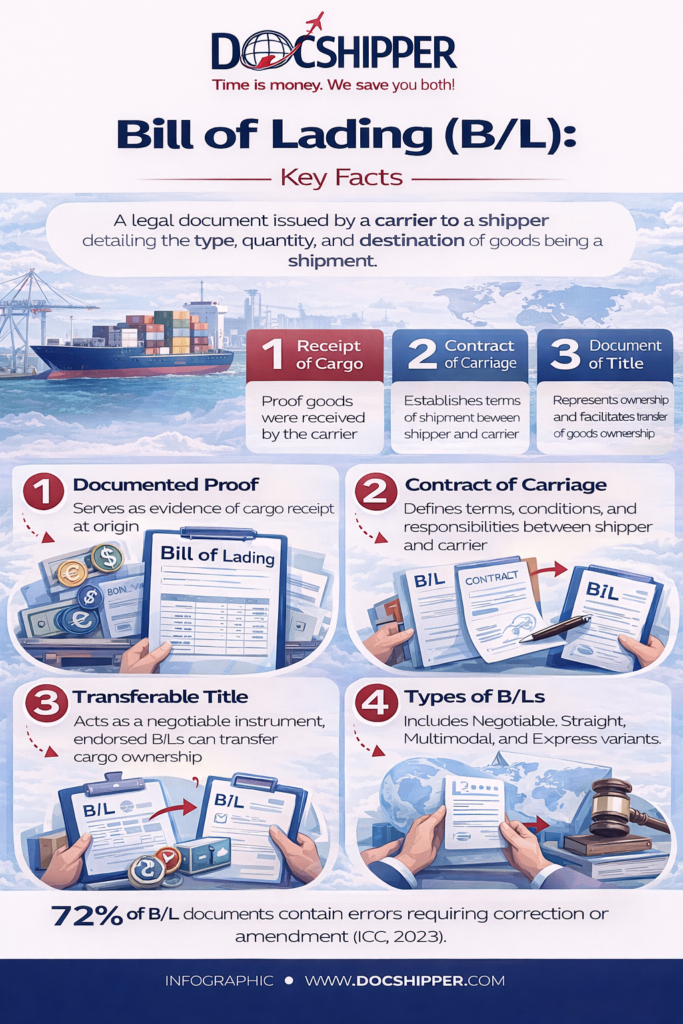
A Bill of Lading (B/L) is a legal document issued by a carrier to a shipper that details the type, quantity, and destination of goods being transported. It serves three critical functions: receipt of cargo, contract of carriage, and document of title. The B/L is essential for international trade, enabling ownership transfer and customs clearance.
Introduction
Confusion surrounding Bills of Lading often leads to shipment delays, payment disputes, and customs issues. Many importers struggle to understand which B/L type suits their transaction or how to properly endorse the document.
The Bill of Lading represents the backbone of maritime trade documentation. Without it, cargo cannot be released at destination, banks won’t process letters of credit, and legal disputes become difficult to resolve.
Key characteristics include:
- Tripartite function: Receipt, contract, and title document combined
- Negotiability: Can be transferred to third parties when properly endorsed
- Legal protection: Governed by international conventions (Hague-Visby Rules, Rotterdam Rules)
- Financial instrument: Required for documentary credit operations
- Liability framework: Defines carrier responsibility and limitation clauses
Types of B/L & Legal Framework
Understanding B/L variations is crucial for selecting the appropriate document structure. Each type serves specific commercial and legal purposes.
The Ocean Bill of Lading remains the standard for sea freight, issued by the shipping line or their agent. It confirms cargo loading and creates a contract between shipper and carrier. This document must be surrendered at destination to claim goods.
A Negotiable (Order) B/L allows ownership transfer through endorsement. Consigned “to order” or “to order of shipper,” it enables banks to hold security in letter of credit transactions. The document circulates like a check until final endorsement.
The Straight (Non-Negotiable) B/L names a specific consignee who alone can claim cargo. No endorsement is possible. This format suits transactions between related companies or when payment is secured outside documentary credit.
Express B/L or Sea Waybill eliminates paper documentation. The carrier releases cargo upon identity verification without requiring document surrender. Common in trusted trade relationships, it accelerates delivery but removes negotiability.
A Multimodal Transport Document covers door-to-door shipments using multiple transport modes. The issuing carrier assumes responsibility for the entire journey, simplifying documentation for complex routing.
Legal frameworks vary by jurisdiction. The Hague-Visby Rules (1968) govern most international shipments, limiting carrier liability to approximately $500 per package unless higher value is declared. The Hamburg Rules (1978) increase carrier responsibility but have limited adoption. The recent Rotterdam Rules (2009) attempt modernization but lack widespread ratification.
According to International Maritime Organization guidelines, carriers must issue B/Ls within 24 hours of loading completion. Failure creates legal vulnerabilities and delays payment cycles.
At DocShipper, we systematically verify B/L accuracy before cargo departure, ensuring all commercial terms align with purchase agreements and preventing costly amendments or destination holds.
Practical Examples & Scenarios
Real-world applications demonstrate how B/L selection impacts transaction security and operational efficiency.
Scenario 1: Letter of Credit Transaction
A Vietnamese textile exporter ships 500 cartons to a German buyer under a $75,000 LC. The bank requires a full set of clean on-board ocean B/Ls (typically 3 originals) made out “to order of issuing bank.”
The exporter presents documents within 21 days of shipment. The bank examines the B/L for discrepancies: correct consignee designation, matching commercial invoice amounts, “freight prepaid” notation, and absence of damage clauses. Upon approval, the bank releases payment before cargo arrives.
The German importer receives endorsed B/Ls from their bank, surrenders them to the carrier, and claims goods. This structure protects both parties—the exporter receives guaranteed payment, the importer controls cargo release.
Scenario 2: Express Release for Time-Sensitive Goods
A pharmaceutical company ships temperature-controlled vaccines from Belgium to Singapore. Transit time: 18 days. Original B/Ls would arrive after cargo, creating storage costs and temperature exposure risks.
Solution: The carrier issues an Express B/L (Sea Waybill). Upon vessel arrival, the Singapore consignee presents identification and company authorization. Cargo releases within 4 hours without document surrender.
This method reduces delivery time by 3-5 days but requires established trust—payment must be secured through alternative means (advance payment or open account terms).
Comparative Analysis: B/L Types by Use Case
| B/L Type | Negotiability | Best For | Risk Level | Processing Time |
|---|---|---|---|---|
| Negotiable Ocean B/L | Yes | LC transactions, unknown buyers | Low (bank secured) | 5-7 days |
| Straight B/L | No | Intra-company transfers | Medium | 4-6 days |
| Express B/L | No | Trusted partners, perishables | High (no document control) | 1-2 days |
| Multimodal Document | Varies | Door-to-door shipments | Medium | 3-5 days |
DocShipper Platform
Cut logistics costs. Not corners.
See exactly where your logistics costs are bleeding — and how to fix it. Book your expert demo.
Key Data Points
- Document discrepancy rate: 70% of initial B/L presentations contain errors (ICC Banking Commission, 2023)
- Amendment costs: $150-$400 per B/L correction, plus demurrage if cargo waits
- Express B/L adoption: Increased 340% since 2020 for intra-Asia trade lanes
- Average B/L courier time: 7-12 days via postal service, 3-5 days via DHL/FedEx
- Digital B/L penetration: Still below 2% of global trade volume despite blockchain initiatives
At DocShipper, we manage over 12,000 B/Ls annually across 45 countries. Our verification protocol reduces discrepancies by 94%, ensuring smooth customs clearance and payment processing for our clients.
Conclusion
The Bill of Lading remains the cornerstone of international maritime trade, balancing legal protection with operational flexibility. Selecting the appropriate B/L type and ensuring documentary accuracy directly impacts payment security and delivery speed.
Need expert guidance on B/L management or full-service freight forwarding? Contact DocShipper for customized logistics solutions.
📚 Quizz
Test Your Knowledge: Bill of Lading (B/L)
Q1 — A Bill of Lading serves which combination of functions?
Q2 — A pharmaceutical company needs to release temperature-sensitive vaccines in Singapore as fast as possible upon vessel arrival, without waiting for paper documents. Which B/L type is most appropriate?
Q3 — A bank processing a Letter of Credit receives a B/L with a notation indicating damaged packaging. What is the correct interpretation?
🎯 Your Result
📞 Free Quote in 24hFAQ | Bill of Lading (B/L): Definition, Types & Practical Examples
The shipper must obtain a Letter of Indemnity (LOI) from a bank, guaranteeing the carrier against duplicate claims. The carrier then issues a new B/L or releases cargo against the LOI. This process takes 5-10 days and costs $500-$2,000.
Yes, but it becomes a "received for shipment" B/L rather than "on-board." Banks may reject this for LC transactions. Carriers typically issue on-board B/Ls within 24 hours of departure with actual loading date stamped.
A clean B/L contains no notations about cargo defects. A claused (or dirty) B/L notes damage, insufficient packaging, or quantity discrepancies. Banks refuse claused B/Ls under documentary credits, as they indicate potential cargo problems.
The party named as consignee or "to order of" can endorse by signing the reverse and specifying the new holder. Banks often hold endorsed-in-blank B/Ls (no named transferee) for maximum flexibility in LC transactions.
Typically three originals, all equally valid. Surrendering one original to the carrier cancels the others. Some carriers now issue only one original to reduce fraud risk, especially for express releases.
A B/L is a document of title (negotiable), while a Sea Waybill is merely a receipt (non-negotiable). Sea Waybills allow cargo release without document surrender, speeding delivery but eliminating ownership transfer capability.
Yes. "Freight Prepaid" means the shipper paid; "Freight Collect" means the consignee pays at destination. For LC transactions, "Freight Prepaid" is usually required to ensure the buyer receives cargo without additional payment demands.
An electronic message from the origin port instructing the destination port to release cargo without surrendering original B/Ls. Common when originals won't arrive in time. The shipper must request and authorize this with the carrier.
Yes, in jurisdictions recognizing the UNCITRAL Model Law on Electronic Transferable Records (2017). Platforms like Bolero, essDOCS, and TradeLens offer blockchain-based e-B/Ls, but adoption remains limited due to regulatory inconsistencies across countries.
Mandatory elements: shipper and consignee names/addresses, vessel name, port of loading/discharge, cargo description (quantity, weight, marks), freight terms, number of originals issued, date of shipment, and carrier signature. Missing elements may void the document.
No fixed expiration, but banks under LCs require presentation within 21 days of shipment date. For cargo claims, the Hague-Visby Rules allow one year from delivery date to file suit against the carrier for loss or damage.
Yes, through a Letter of Correction issued by the carrier. Both shipper and carrier must agree. Amendments cost $150-$400 and delay document processing. Common changes: consignee name corrections, notify party additions, or cargo description clarifications.
Need Help with
Logistics or Sourcing ?
First, we secure the right products from the right suppliers at the right price by managing the sourcing process from start to finish. Then, we simplify your shipping experience - from pickup to final delivery - ensuring any product, anywhere, is delivered at highly competitive prices.


Fill the Form
Prefer email? Send us your inquiry, and we’ll get back to you as soon as possible.
Contact us




:%20Definition%20&%20Guide%20for%202026)