


In short ⚡
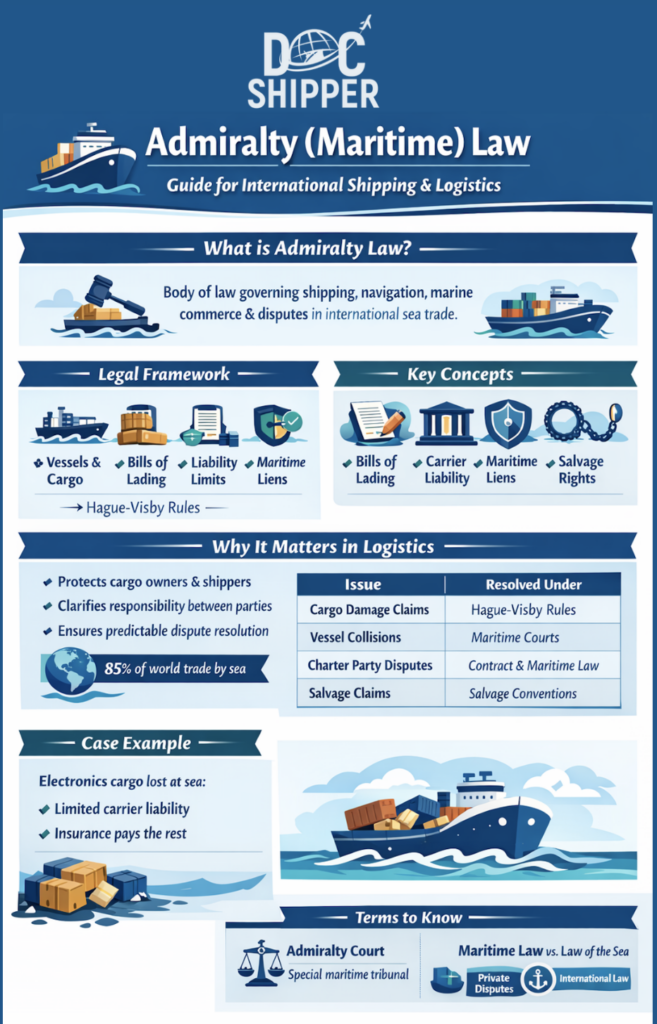
Admiralty (Adm.) is a maritime legal jurisdiction governing disputes related to shipping, navigation, cargo transport, and marine commerce. It encompasses contractual obligations, cargo damage claims, collision liability, and salvage operations under international conventions and national maritime laws.Introduction
Confusion often arises when cargo owners face disputes during international shipping. Who holds liability when goods are damaged at sea? Which court has jurisdiction over maritime contracts?
Admiralty law provides the legal framework that governs these complex maritime situations. For businesses engaged in import/export operations, understanding admiralty jurisdiction is essential to protect commercial interests and enforce contractual rights.
Key characteristics of admiralty jurisdiction include:
- Specialized maritime courts with exclusive competence over shipping disputes
- International conventions such as the Hague-Visby Rules governing bills of lading
- Limitation of liability provisions protecting shipowners under specific conditions
- Maritime liens granting creditors security interests in vessels
- Salvage rights rewarding parties who rescue vessels or cargo at sea
Legal Framework & Maritime Jurisdiction
Admiralty law operates through a distinct legal system separate from general commercial law. Maritime courts possess exclusive jurisdiction over disputes involving vessels, cargo, and maritime contracts.
The Hague-Visby Rules establish carrier liability standards for cargo damage during sea transport. These rules define carrier obligations, limitation periods, and compensation calculations. Most international shipping contracts incorporate these provisions through bills of lading clauses.
Maritime liens create powerful security interests that attach directly to vessels. Unlike standard commercial liens, maritime liens travel with the ship regardless of ownership changes. Suppliers, crew members, and salvors can enforce these liens through vessel arrest procedures.
The limitation of liability principle allows shipowners to cap financial exposure based on vessel tonnage. This centuries-old doctrine encourages maritime commerce by preventing catastrophic losses from bankrupting shipping companies. However, willful misconduct or gross negligence voids this protection.
Collision liability follows specialized rules distinct from land-based accident law. The proportionate fault doctrine allocates damages based on each vessel’s degree of negligence. International regulations such as COLREG (Convention on the International Regulations for Preventing Collisions at Sea) establish navigation standards that courts apply when determining fault.
At DocShipper, we coordinate with maritime legal experts to ensure your shipping contracts include proper admiralty clauses, protecting your interests throughout the logistics chain.
Practical Applications & Industry Data
Understanding admiralty law’s practical impact helps businesses navigate maritime commerce effectively. Real-world scenarios demonstrate how these legal principles affect import/export operations.
| Dispute Type | Applicable Law | Typical Resolution Time | Average Cost Range |
|---|---|---|---|
| Cargo Damage Claims | Hague-Visby Rules | 6-18 months | $15,000-$80,000 |
| Vessel Collision | COLREG + National Law | 12-36 months | $200,000-$2M+ |
| Maritime Lien Enforcement | Local Admiralty Code | 3-12 months | $25,000-$150,000 |
| Charter Party Disputes | Contract Terms + Maritime Law | 8-24 months | $50,000-$500,000 |
| Salvage Claims | Lloyd’s Open Form / LOF | 4-18 months | 10-30% of saved value |
Use Case: Container Damage During Pacific Crossing
A European electronics importer shipped 500 laptops valued at $400,000 from Shanghai to Rotterdam. During heavy seas, container stacking collapsed, destroying 200 units ($160,000 loss).
Under admiralty law, the carrier‘s liability was limited to $500 per package under the Hague-Visby Rules, totaling $100,000. The importer’s marine cargo insurance covered the remaining $60,000 shortfall. The claim resolution took 14 months through London maritime arbitration.
This scenario illustrates why proper cargo insurance remains essential despite carrier liability provisions.
Key Industry Statistics:
- Approximately 85% of global trade travels by sea, making admiralty jurisdiction universally relevant
- Maritime disputes average $180,000 in legal costs for mid-sized claims
- 68% of cargo claims settle through arbitration rather than litigation
- Vessel arrest procedures typically cost $30,000-$75,000 in legal and court fees
- The global marine insurance market exceeds $28 billion annually
DocShipper assists clients in structuring shipping contracts with appropriate admiralty clauses and insurance coverage, minimizing exposure to maritime legal risks.
DocShipper Platform
Optimize Your Global Logistics with Cutting-Edge Solutions
Enhance efficiency, cut costs, and gain 24/7 visibility  over your entire supply chain.
- Cut your shipping costs and maximize your margins
- Manage sourcing, freight, & customs on one platform
- Get real-time tracking and analytics
Conclusion
Admiralty law provides the specialized legal framework essential for maritime commerce, protecting parties through established liability limits, lien rights, and dispute resolution mechanisms. Understanding these principles safeguards your international shipping operations.
Need expert guidance on maritime legal compliance? Contact DocShipper for comprehensive logistics support tailored to your import/export requirements.
📚 Quiz
Test Your Knowledge: Admiralty (Adm.)
1. What does Admiralty (Adm.) law primarily govern?
2. Under the Hague-Visby Rules, what happens to a carrier's liability limit if a shipper does NOT declare a higher cargo value?
3. A supplier has not been paid for fuel provided to a vessel. The ship is later sold to a new owner. Can the supplier still enforce their maritime lien against the vessel?
🎯 Your Result
📞 Free Quote in 24hFAQ | Admiralty (Adm.): Definition, Calculation & Concrete Examples
The terms are often used interchangeably. Technically, admiralty refers to court jurisdiction over maritime matters, while maritime law encompasses the substantive legal rules governing shipping activities. In practice, both terms describe the same legal domain.
Specialized maritime courts or admiralty divisions within federal court systems hear these cases. In the United States, federal district courts exercise admiralty jurisdiction. The United Kingdom maintains the Admiralty Court within the High Court system.
The Hague-Visby Rules limit carrier liability to approximately $500 per package or unit, unless the shipper declares higher value. This protects carriers from unlimited exposure while incentivizing proper cargo insurance by shippers.
Yes. Maritime lien holders can petition admiralty courts to arrest vessels as security for unpaid claims. The vessel remains detained until the debt is satisfied or adequate security is posted by the owner.
A maritime lien is a privileged claim against a vessel that arises from services provided or damages caused. Unlike standard liens, it attaches to the ship itself and survives ownership changes, giving creditors powerful enforcement rights.
Under the Hague-Visby Rules, claimants must provide written notice within three days of delivery for visible damage, and within one year for concealed damage. Failure to meet these deadlines typically bars recovery.
Salvage refers to voluntary assistance provided to vessels or cargo in maritime peril. Salvors earn compensation based on the value of property saved, the degree of danger, and the skill required. Lloyd's Open Form standardizes salvage agreements.
Generally yes, if the waterway connects to navigable seas or supports interstate/international commerce. Rivers, canals, and lakes used for commercial shipping typically fall under admiralty jurisdiction in most countries.
Admiralty courts apply the proportionate fault doctrine, analyzing each vessel's compliance with navigation rules (COLREG). Damages are allocated based on each party's percentage of negligence. Both vessels may share liability.
Yes, under limitation of liability statutes. Owners can cap exposure to the vessel's post-incident value plus pending freight, unless the incident resulted from the owner's personal fault or privity (direct knowledge and involvement).
Marine insurance provides essential financial protection beyond carrier liability limits. Policies typically cover cargo loss, vessel damage, and third-party liability. Insurance companies often subrogate claims, pursuing recovery rights against responsible parties.
Yes, arbitration clauses are widely enforced in maritime contracts. Major shipping hubs like London, New York, and Singapore host specialized maritime arbitration institutions that resolve disputes faster and more cost-effectively than litigation.
Need Help with
Logistics or Sourcing ?
First, we secure the right products from the right suppliers at the right price by managing the sourcing process from start to finish. Then, we simplify your shipping experience - from pickup to final delivery - ensuring any product, anywhere, is delivered at highly competitive prices.


Fill the Form
Prefer email? Send us your inquiry, and we’ll get back to you as soon as possible.
Contact us




