


In short ⚡
An Aframax tanker is a medium-sized crude oil vessel with a deadweight tonnage (DWT) between 80,000 and 120,000 tons. Designed for flexibility, it serves regional routes, coastal terminals, and ports with draft restrictions, making it essential for global petroleum distribution networks.
Introduction
Confusion often arises when distinguishing between tanker classes. Importers and charterers frequently mistake Aframax vessels for Suezmax or Panamax ships, leading to costly routing errors and port compatibility issues.
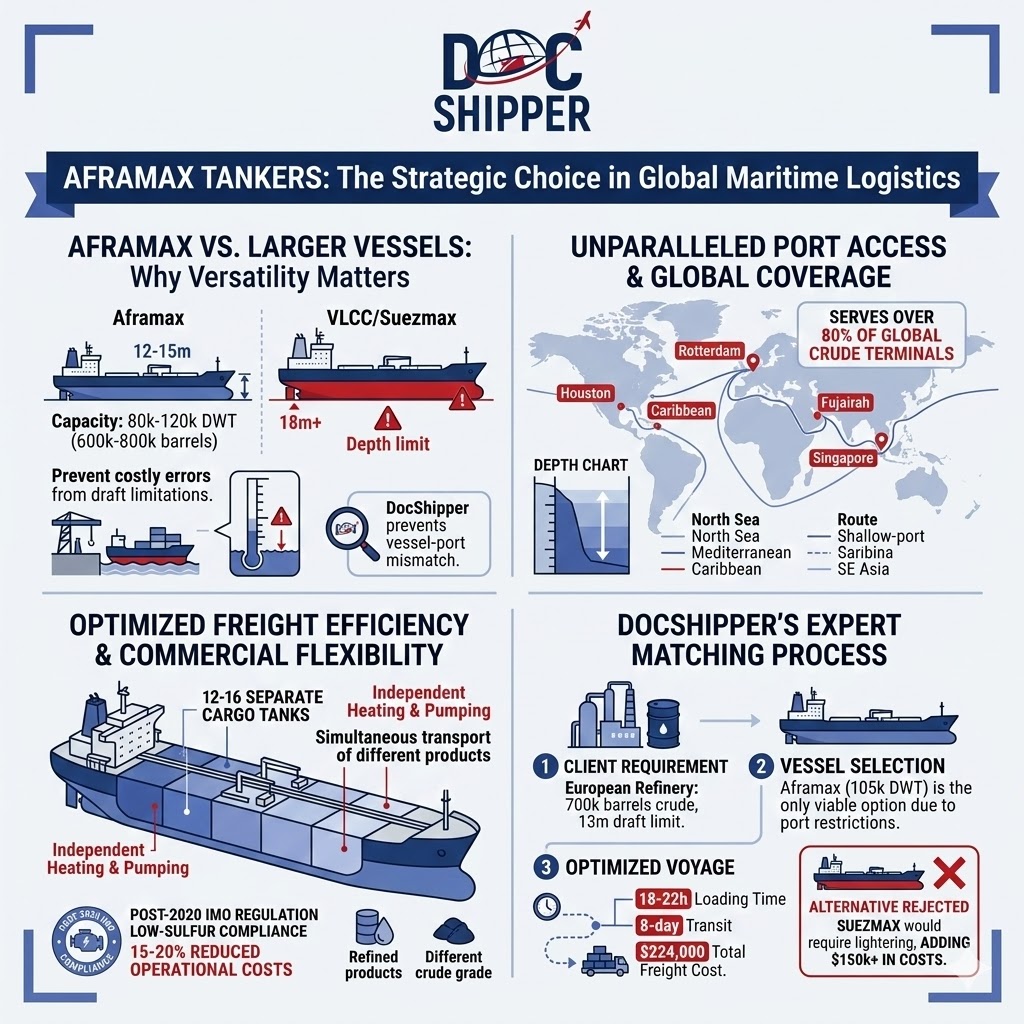
The Aframax tanker occupies a strategic position in maritime logistics. Its balanced capacity enables efficient crude oil transport from production hubs to regional refineries without the draft limitations of larger vessels. This versatility makes it indispensable for terminals in the North Sea, Mediterranean, Caribbean, and Southeast Asian routes.
- Capacity range: 80,000 to 120,000 DWT (approximately 600,000 to 800,000 barrels)
- Primary cargo: Crude oil, occasionally refined petroleum products
- Operational advantage: Access to ports with 12-15 meter draft restrictions
- Fleet distribution: Dominant in regional trades, especially North Sea-Mediterranean corridors
- Charter rates: Highly sensitive to regional supply-demand dynamics and geopolitical factors
Technical Specifications & Operational Framework
The Aframax classification stems from the Average Freight Rate Assessment (AFRA) system developed by Shell in the 1950s. This standardization allows precise freight calculations and risk assessment across international shipping markets.
Dimensional parameters define operational capabilities. Typical Aframax vessels measure 240-250 meters in length with a beam of 42-44 meters. The maximum draft rarely exceeds 14.5 meters, enabling access to shallow-water terminals that larger VLCCs cannot reach.
Cargo segregation systems enhance commercial flexibility. Modern Aframax tankers feature 12-16 separate cargo tanks with independent heating and pumping systems. This configuration permits simultaneous transport of different crude grades or refined products, critical for traders managing diverse portfolios.
Propulsion and fuel efficiency have evolved significantly. Post-2020 IMO regulations mandate low-sulfur fuel compliance. New builds incorporate dual-fuel engines and scrubber systems, reducing operational costs by 15-20% compared to conventional designs. At DocShipper, we verify vessel specifications and compliance certificates before recommending charter options to our clients.
Port compatibility matrices determine route feasibility. Unlike Suezmax vessels requiring 18+ meter drafts, Aframax tankers serve over 80% of global crude terminals. This includes strategically important locations like Rotterdam, Singapore, Houston, and Fujairah, where berth restrictions prohibit larger tonnage.
For regulatory frameworks governing tanker operations, consult the International Maritime Organization guidelines on vessel classification and safety standards.
Market Data & Practical Use Cases
Understanding Aframax economics requires analyzing real-world charter scenarios and market benchmarks. Current data reveals significant regional variations in utilization and profitability.
Charter Rate Comparison (Q1 2024)
| Route | Worldscale Rate | Daily Equivalent (USD) | Voyage Duration |
|---|---|---|---|
| North Sea → Mediterranean | WS 95 | $28,000 | 7-9 days |
| Caribbean → US Gulf | WS 110 | $35,000 | 5-6 days |
| West Africa → Asia | WS 75 | $18,500 | 28-32 days |
| Baltic → UK Continent | WS 120 | $42,000 | 4-5 days |
Practical Use Case: Regional Refinery Supply
Scenario: A European refinery requires 700,000 barrels of Brent crude from a North Sea terminal with a 13-meter draft limit.
- Vessel selection: Aframax (105,000 DWT) — only viable option due to port restrictions
- Loading time: 18-22 hours at Sullom Voe terminal
- Transit duration: 8 days to Rotterdam at 13.5 knots average speed
- Total freight cost: $224,000 (based on WS 95 rate)
- Alternative rejected: Suezmax vessel would require lightering operations, adding $150,000+ in costs
At DocShipper, we calculate these variables during the charter selection process, ensuring optimal vessel-route matching for our clients’ shipments.
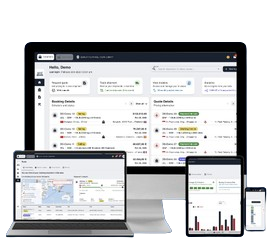
DocShipper Platform
One platform. Your entire supply chain
Sourcing, freight, customs & documents — all centralised, all visible, 24/7.
Fleet Deployment Statistics
Global Aframax fleet composition (2024 data):
- Total active vessels: Approximately 850 units
- Average age: 11.2 years (newer than VLCC fleet at 13.8 years)
- Scrubber-fitted percentage: 42% (rising due to IMO 2020 compliance)
- Regional concentration: 35% deployed in Atlantic Basin, 28% in Middle East routes
- Newbuild orderbook: 68 vessels (8% of existing fleet), indicating moderate expansion
Conclusion
The Aframax tanker remains the workhorse of regional crude oil distribution, balancing capacity with port accessibility. Its technical specifications and operational flexibility make it irreplaceable in modern petroleum logistics.
Need expert guidance on tanker charter selection or import compliance? Contact DocShipper for tailored logistics solutions.
📚 Quiz
Test Your Knowledge: Aframax Tanker
Q1 — What is the deadweight tonnage (DWT) range that defines an Aframax tanker?
Q2 — A common misconception is that Aframax tankers cannot transit the Suez Canal fully loaded. Is this correct?
Q3 — A European refinery needs to receive 700,000 barrels of crude oil from a North Sea terminal with a 13-meter draft restriction. Which vessel is the most appropriate choice?
🎯 Your Result
📞 Free Quote in 24hFAQ | Aframax Tanker: Definition, Specifications & Practical Examples
An Aframax typically carries 600,000 to 800,000 barrels of crude oil, depending on specific gravity and loading conditions. The industry standard assumes 7.33 barrels per metric ton for capacity calculations.
North Sea terminals have draft restrictions (12-14 meters) that prevent larger vessels from loading. Aframax tankers maximize cargo volume while meeting these port limitations, making them economically optimal for the region.
Aframax rates average 20-30% lower per day than Suezmax vessels but offer better utilization on short-haul routes. The total voyage cost often favors Aframax for distances under 2,000 nautical miles.
Yes, all Aframax vessels can transit the Suez Canal fully loaded. The canal's draft limit is 20.1 meters, well above the Aframax maximum of 14.5 meters, providing unrestricted passage.
Modern Aframax tankers operate economically for 20-25 years with proper maintenance. Vessels exceeding 20 years face increasing charter restrictions and higher insurance premiums due to aging hull integrity concerns.
While designed for crude oil, Aframax tankers can carry refined products like gasoline or diesel. However, dedicated product carriers with specialized coatings are preferred for sensitive cargoes to prevent contamination.
IMO 2020 sulfur cap mandates 0.5% sulfur fuel or scrubber systems. Additionally, ballast water management conventions and double-hull requirements (post-OPA 90) apply to all Aframax vessels in international trade.
Protection and Indemnity (P&I) premiums for Aframax vessels average $450,000-$650,000 annually, approximately 40% lower than VLCC rates due to reduced cargo value and lower casualty exposure.
At typical cruising speed (13-14 knots), an Aframax consumes 30-40 metric tons of fuel daily. Slow steaming at 11 knots reduces consumption to 22-28 tons, significantly lowering voyage costs.
Yes, most US Gulf terminals accommodate Aframax vessels. Key ports like Houston, Corpus Christi, and Louisiana Offshore Oil Port (LOOP) maintain 14+ meter channels specifically designed for this vessel class.
LR2 (Long Range 2) tankers carry refined products and have 80,000-120,000 DWT capacity similar to Aframax. The key difference lies in cargo handling systems—LR2 vessels feature specialized coatings and segregation for clean petroleum products.
Regional conflicts immediately affect Aframax rates. For example, Black Sea tensions in 2022 increased Baltic-UK rates by 180% within weeks as traders sought alternative supply routes, demonstrating the vessel class's sensitivity to localized disruptions.
Need Help with
Logistics or Sourcing ?
First, we secure the right products from the right suppliers at the right price by managing the sourcing process from start to finish. Then, we simplify your shipping experience - from pickup to final delivery - ensuring any product, anywhere, is delivered at highly competitive prices.


Fill the Form
Prefer email? Send us your inquiry, and we’ll get back to you as soon as possible.
Contact us




