


In short ⚡
An agent (Agt.) in international logistics is an intermediary who acts on behalf of a principal (shipper, consignee, or carrier) to facilitate transactions, negotiate contracts, and coordinate operations without taking ownership of goods. Agents earn commissions and represent their clients' interests throughout the supply chain.
Introduction
Many importers and exporters confuse agents with freight forwarders or brokers. Understanding the distinct role of an agent (Agt.) is crucial for optimizing costs and responsibilities in cross-border trade.
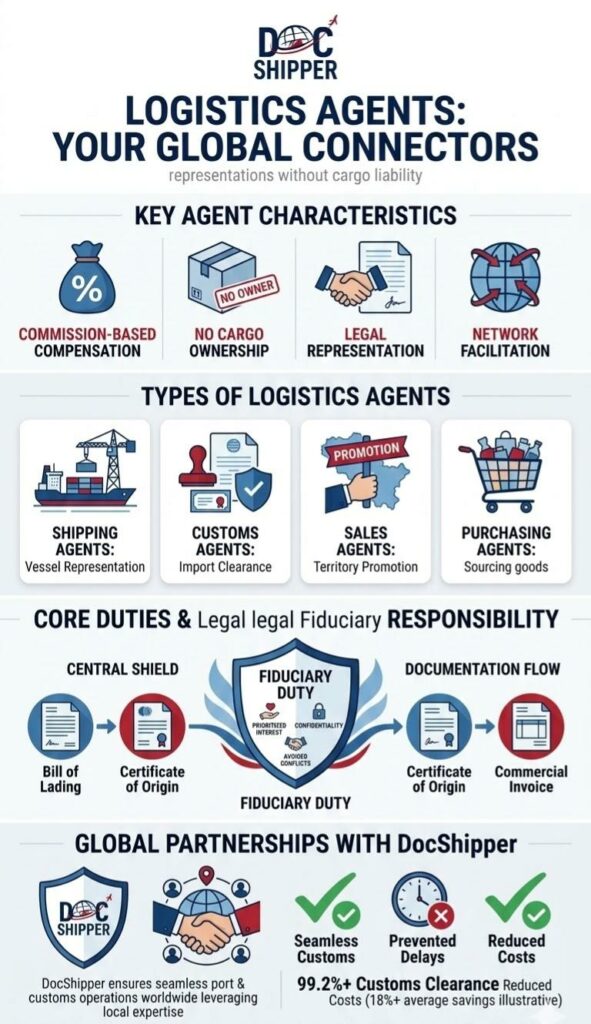
In international logistics, agents serve as vital connectors between parties, handling negotiations, documentation, and compliance without assuming cargo liability. Their commission-based model makes them cost-effective for businesses seeking representation without full-service logistics providers.
- Commission-based compensation – Agents work for a percentage rather than fixed fees
- No cargo ownership – They never take title to goods
- Legal representation – Authorized to act on behalf of their principal
- Specialized market knowledge – Deep understanding of local regulations and practices
- Network facilitation – Connect buyers, sellers, and service providers efficiently
Roles & Expertise of Logistics Agents
Logistics agents operate across multiple domains. Shipping agents represent vessel owners or charterers at ports, coordinating berthing, cargo operations, and documentation. Customs agents handle clearance procedures and regulatory compliance on behalf of importers.
Sales agents promote services or products in specific territories, while purchasing agents source goods for foreign buyers. Each type operates under a principal-agent relationship governed by agency law and contractual terms.
The fiduciary duty distinguishes agents from independent contractors. Agents must prioritize their principal’s interests, maintain confidentiality, and avoid conflicts of interest. This legal obligation is recognized in international commercial law, including the ICC Incoterms framework.
Key responsibilities include contract negotiation, ensuring favorable terms for their principal, and risk assessment, identifying potential issues in transactions or shipments. Agents also manage documentation flow, coordinating bills of lading, certificates of origin, and commercial invoices.
At DocShipper, we work closely with local agents worldwide to ensure seamless customs clearance and port operations, leveraging their expertise to prevent delays and reduce costs for our clients.
Practical Examples & Data
Consider a European electronics importer purchasing components from Southeast Asia. Instead of establishing a local office, they appoint a purchasing agent in Vietnam who:
| Agent Type | Commission Rate | Primary Function | Liability Level |
|---|---|---|---|
| Shipping Agent | 1.5-3% | Port operations coordination | Limited (no cargo ownership) |
| Customs Agent | 2-5% | Clearance & compliance | Professional indemnity only |
| Sales Agent | 5-15% | Market representation | None (acts for principal) |
| Purchasing Agent | 3-8% | Supplier sourcing & negotiation | None (buyer assumes risk) |
Use Case: A U.S. furniture retailer appoints a shipping agent in Shanghai to handle a 40-foot container shipment. The agent coordinates with the terminal, arranges documentation, and ensures compliance with export regulations—all for a 2% commission on the freight value ($800 on a $40,000 shipment), compared to $2,500+ for a full freight forwarding service.
Industry data shows that commission-based agents reduce transaction costs by 15-30% for companies making regular shipments on established routes. However, they provide less comprehensive service than freight forwarders, making them ideal for experienced importers with in-house logistics expertise.
The distinction matters legally: agents act in the name of their principal, meaning contracts bind the principal directly. Freight forwarders, by contrast, often contract as principals themselves, creating different liability structures.
Conclusion
Understanding the agent’s role in logistics enables businesses to structure their supply chains more efficiently, balancing cost control with service requirements. The commission-based model and limited liability make agents strategic partners for specific operational needs.
Need guidance on selecting the right representation model for your imports or exports? Contact DocShipper for expert consultation tailored to your supply chain.
DocShipper Platform
Cut logistics costs. Not corners.
See exactly where your logistics costs are bleeding — and how to fix it. Book your expert demo.

📚 Quiz
Test Your Knowledge: Agent (Agt.) in Logistics
Q1 — Which of the following best defines a logistics agent (Agt.)?
Q2 — A shipment is damaged in transit. Who is generally liable for the cargo damage when a logistics agent is involved?
Q3 — A U.S. furniture retailer needs someone to coordinate port operations, handle documentation, and ensure export compliance for a container shipment from Shanghai — all at a lower cost than a full freight forwarder. Which solution is most appropriate?
🎯 Your Result
📞 Free Quote in 24hFAQ | Agent (Agt.) in Logistics: Definition, Roles & Practical Examples
An agent acts on behalf of a principal without taking ownership of goods, while a freight forwarder typically contracts as a principal and may assume temporary custody of cargo.
Agents receive commission-based payments, typically 1-15% of transaction value depending on service type, rather than fixed fees or markups on services.
Generally no, unless negligence is proven. Agents don't take possession of goods, so cargo liability remains with the carrier or principal.
Shipping agents coordinate vessel operations at ports, including berthing arrangements, cargo handling supervision, and documentation for ship owners or charterers.
While self-clearance is possible in some jurisdictions, customs agents provide expertise in classification, valuation, and compliance that prevents costly errors and delays.
Sales agents never take title to goods and earn commissions, while distributors purchase inventory and resell at markup, assuming market risk.
Request a power of attorney or agency agreement document. Legitimate agents provide written authorization specifying their scope of representation.
Yes, rates vary by service complexity, shipment volume, and market conditions. Establishing long-term relationships often yields better commission terms.
Agents manage bills of lading, commercial invoices, packing lists, certificates of origin, and customs declarations depending on their specialization.
Yes, many logistics firms provide multi-service agency representation, though conflicts of interest must be disclosed and managed appropriately.
Regulatory frameworks vary—EU agents operate under different legal standards than those in Asia or the Americas, affecting liability and authorization requirements.
Professional indemnity insurance covers errors and omissions in their representation duties, though cargo insurance remains the principal's responsibility.
Need Help with
Logistics or Sourcing ?
First, we secure the right products from the right suppliers at the right price by managing the sourcing process from start to finish. Then, we simplify your shipping experience - from pickup to final delivery - ensuring any product, anywhere, is delivered at highly competitive prices.


Fill the Form
Prefer email? Send us your inquiry, and we’ll get back to you as soon as possible.
Contact us




:%20Definition%20&%20Roles%20in%20Logistics%20for%202026)