


In short ⚡
AID (Agency for International Development) is a U.S. government agency established to administer economic assistance programs in developing countries. It promotes sustainable development, trade capacity building, and infrastructure improvements that directly impact international logistics and supply chain efficiency in emerging markets.Introduction
Many importers and exporters overlook how development agencies shape the logistics landscape in emerging markets. Infrastructure deficits, regulatory gaps, and customs inefficiencies in developing nations create significant barriers to international trade.
The Agency for International Development (AID) plays a critical role in addressing these challenges. By funding port modernization, customs reform, and trade facilitation programs, AID initiatives directly reduce shipping delays and operational costs for businesses engaged in cross-border commerce.
Understanding AID’s function is essential for companies targeting growth markets:
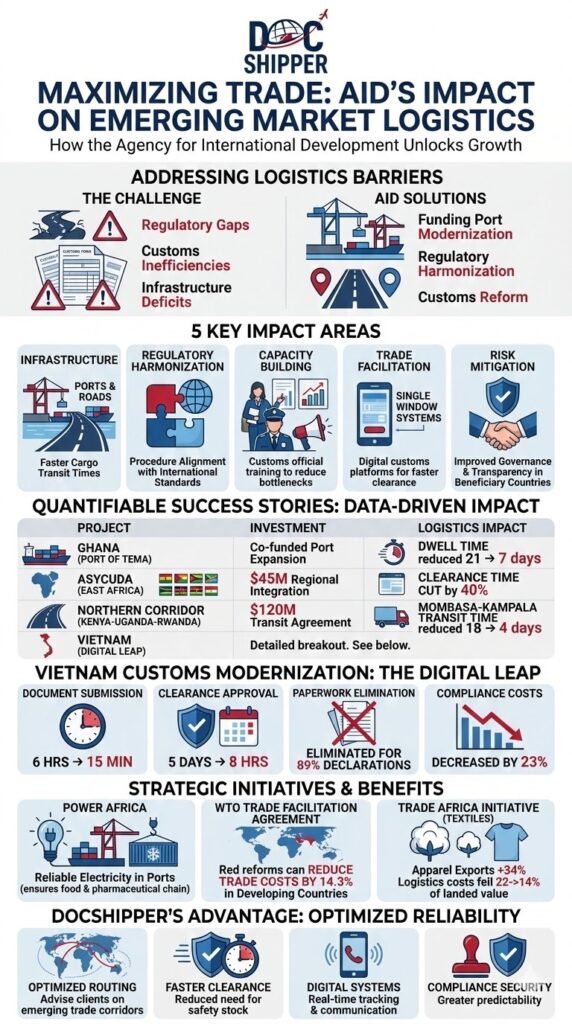
- Infrastructure Development: Ports, roads, and logistics hubs funded by AID improve cargo transit times
- Regulatory Harmonization: Programs that align customs procedures with international standards
- Capacity Building: Training programs for customs officials reduce clearance bottlenecks
- Trade Facilitation: Single-window systems and digital customs platforms supported by AID funding
- Risk Mitigation: Improved governance and transparency in beneficiary countries lower compliance risks
Expertise & Strategic Impact
AID operates through bilateral agreements and multilateral partnerships to strengthen trade infrastructure in partner countries. These interventions transform logistical bottlenecks into competitive corridors for international freight movement.
The agency’s Trade and Investment Hubs program specifically targets supply chain optimization. Projects include warehouse modernization, cold chain development for perishables, and intermodal connectivity improvements. These upgrades reduce dwell times and handling costs—critical factors in freight forwarding profitability.
From a regulatory standpoint, AID supports customs modernization initiatives aligned with the World Customs Organization’s frameworks. Automated risk assessment systems, pre-arrival processing, and authorized economic operator (AEO) programs receive technical and financial backing. According to the WTO Trade Facilitation Agreement, such reforms can reduce trade costs by up to 14.3% in developing countries.
The Power Africa initiative exemplifies cross-sectoral impact. Reliable electricity supply in port zones and free trade areas prevents cargo handling interruptions. Energy stability also enables temperature-controlled storage—essential for pharmaceutical and food shipments.
At DocShipper, we track AID-funded infrastructure projects across our operational regions. This intelligence allows us to optimize routing strategies and advise clients on emerging trade corridors with improved logistics reliability.
AID’s Development Credit Authority provides loan guarantees that reduce financing costs for logistics operators in high-risk markets. Lower capital costs translate to competitive freight rates and expanded service networks in previously underserved regions.
Concrete Examples & Data
Quantifying AID’s logistics impact requires examining specific interventions and their measurable outcomes. The following data illustrates how development assistance reshapes trade operations:
| Project | Country/Region | Investment | Logistics Impact |
|---|---|---|---|
| Port of Tema Expansion | Ghana | $1.5B (co-funded) | Reduced container dwell time from 21 to 7 days |
| ASYCUDA World Implementation | East Africa | $45M | Customs clearance time cut by 40% across 6 countries |
| Northern Corridor Transit Agreement | Kenya-Uganda-Rwanda | $120M | Transit time Mombasa-Kampala reduced from 18 to 4 days |
| Cold Chain Infrastructure | Bangladesh | $30M | Enabled $200M annual increase in seafood exports |
| Trade Facilitation Office | West Bank/Gaza | $8M | Reduced border crossing delays by 35% |
Case Study: Vietnam Customs Modernization
Between 2015 and 2020, AID invested $22 million in Vietnam’s National Single Window system. The program integrated 17 government agencies into a unified clearance platform. Results for freight forwarders included:
- Document submission time reduced from 6 hours to 15 minutes
- Clearance approval accelerated from 5 days to 8 hours for standard shipments
- Paper-based processes eliminated for 89% of declarations
- Compliance costs decreased by 23% for regular importers
- Predictability improved, enabling just-in-time inventory strategies
For businesses like DocShipper operating in AID-supported markets, these improvements translate to competitive advantages. Faster clearance enables tighter delivery windows. Reduced unpredictability lowers the need for safety stock. Digital systems provide real-time tracking that enhances client communication.
The Trade Africa Initiative demonstrates sector-specific impact. AID’s $120 million investment in East African textile value chains included logistics components: dedicated export processing zones with streamlined customs, temperature-controlled warehousing for cotton, and preferential trucking lanes. Apparel exports from the region increased 34% within three years, with logistics costs falling from 22% to 14% of landed value.
Conclusion
The Agency for International Development fundamentally reshapes logistics feasibility in emerging markets through infrastructure investment, regulatory reform, and capacity building. For freight forwarders and importers, tracking AID projects provides strategic intelligence on evolving trade corridors and operational efficiencies.
Need expert guidance navigating logistics in developing markets? Contact DocShipper for customized supply chain solutions that leverage infrastructure developments and regulatory improvements.
DocShipper Platform
One platform. Your entire supply chain
Sourcing, freight, customs & documents — all centralised, all visible, 24/7.
📚 Quiz
Test Your Knowledge: AID (Agency for International Development)
Q1 — What is the primary mandate of the Agency for International Development (AID)?
Q2 — A logistics manager assumes that private freight companies can directly apply for AID grants to expand their warehouse network in Sub-Saharan Africa. Is this interpretation correct?
Q3 — An importer is evaluating a new sourcing route through Vietnam. Which AID-supported outcome would most directly benefit their just-in-time inventory strategy?
🎯 Your Result
📞 Free Quote in 24hFAQ | AID (Agency for International Development): Definition, Role & Impact in Global Trade
AID-funded infrastructure reduces operational expenses through faster customs clearance, improved port efficiency, and better road networks. These savings typically lower freight rates by 8-15% in beneficiary countries within 2-3 years of project completion.
Primary recipients include Sub-Saharan African nations, Southeast Asian countries, and select Latin American markets. Focus areas are determined by U.S. foreign policy priorities and development needs assessments conducted biennially.
Direct grants to commercial entities are rare. AID typically funds government agencies, NGOs, or multilateral organizations. However, private companies can participate through public-private partnerships or as subcontractors in infrastructure projects.
Infrastructure projects average 4-7 years from approval to completion. Customs modernization initiatives show results faster, often within 18-24 months. Capacity-building programs require 3-5 years for sustainable institutional change.
AID collaborates with the World Bank, Asian Development Bank, and EU development programs through co-financing arrangements and harmonized technical standards. This coordination prevents duplication and maximizes impact across regional trade corridors.
AID provides technical assistance for countries implementing commitments under agreements like AGOA or bilateral FTAs. This includes customs training, regulatory alignment, and infrastructure upgrades required to meet preferential trade program standards.
Yes. All projects undergo environmental impact assessments per U.S. regulations. Port expansions and road projects must meet International Finance Corporation performance standards, which often exceed local requirements and improve long-term sustainability.
AID publishes project databases on USAID.gov. Industry associations and freight forwarders with regional expertise track infrastructure developments. Monitoring customs performance indicators published by the World Bank also reveals improvement trends.
Increasingly, yes. Recent initiatives fund blockchain-based trade documentation systems, AI-powered customs risk engines, and mobile applications for small-scale traders. Digital transformation is now a core component of AID's trade facilitation strategy.
Projects may be suspended or redesigned based on risk assessments. AID maintains contingency plans and often shifts to humanitarian logistics support during crises. Long-term infrastructure investments include governance safeguards to protect against political disruptions.
Key performance indicators include customs clearance time reduction, trade volume increases, compliance cost decreases, and infrastructure utilization rates. Third-party evaluations assess sustainability and economic impact 3-5 years post-completion.
Indirectly, yes. Improved infrastructure and regulatory transparency lower operational unpredictability. Enhanced customs professionalism reduces corruption risks. Better connectivity provides alternative routing options during disruptions, improving overall supply chain resilience.
Need Help with
Logistics or Sourcing ?
First, we secure the right products from the right suppliers at the right price by managing the sourcing process from start to finish. Then, we simplify your shipping experience - from pickup to final delivery - ensuring any product, anywhere, is delivered at highly competitive prices.


Fill the Form
Prefer email? Send us your inquiry, and we’ll get back to you as soon as possible.
Contact us




%20:%20Guide%20for%202026)