In short ⚡
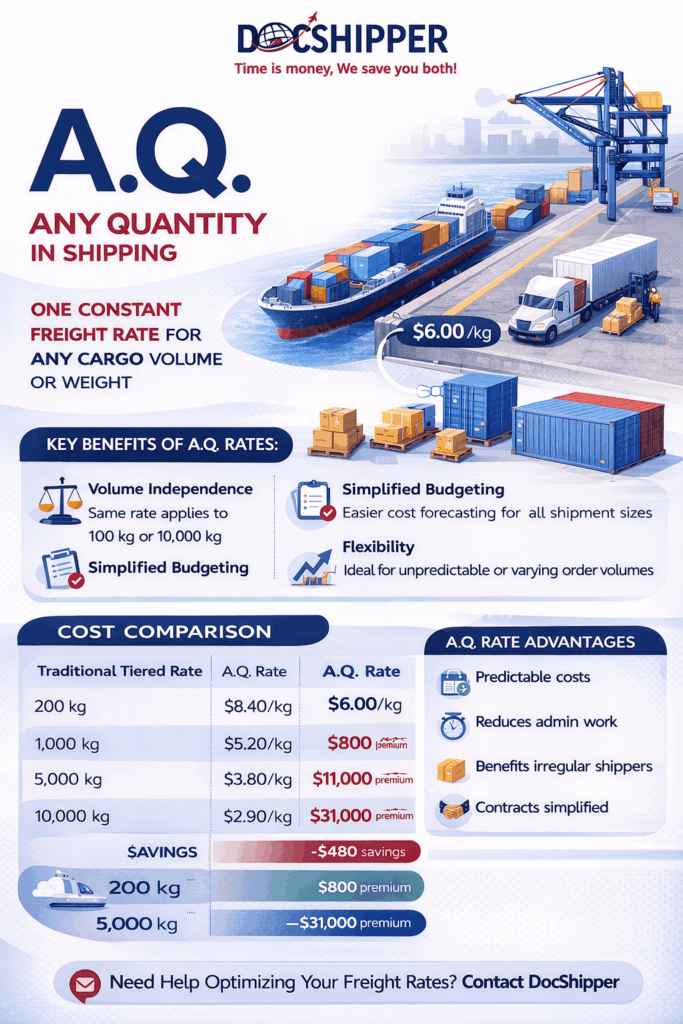
Any Quantity (A.Q.) is a shipping term indicating that a freight rate applies regardless of cargo volume or weight. Unlike tiered pricing structures, A.Q. rates remain constant whether shipping one pallet or a full container, simplifying cost forecasting for importers and exporters with variable shipment sizes.
Introduction
Freight rate structures often confuse shippers navigating international logistics. Many businesses struggle with unpredictable costs when shipment volumes fluctuate between orders.
The Any Quantity (A.Q.) pricing model addresses this challenge by offering rate stability across all cargo volumes. This approach proves particularly valuable in industries with irregular shipping patterns or testing new markets.
Key characteristics of A.Q. rates include:
- Volume independence: Same rate applies to 100 kg or 10,000 kg
- Simplified budgeting: Eliminates complex tier calculations
- Flexibility: Ideal for businesses with unpredictable order volumes
- Transparency: No hidden breakpoint penalties or surcharges
- Contract simplicity: Reduces negotiation complexity with carriers
Understanding A.Q. in Freight Contracts
The Any Quantity rate structure represents a departure from traditional weight-break or volume-tiered pricing. In conventional freight agreements, carriers establish multiple rate brackets—shipping 500 kg costs more per unit than 5,000 kg.
A.Q. rates eliminate these tiers entirely. Whether you ship minimum quantities or full container loads (FCL), the per-unit cost remains identical. This model benefits small-to-medium enterprises lacking consistent volume commitments.
Carriers offering A.Q. rates typically operate in three scenarios:
Niche trade lanes where demand predictability justifies simplified pricing. Routes with stable demand allow carriers to absorb volume variations without financial risk.
Consolidation services where cargo from multiple shippers fills containers. The carrier manages volume optimization internally, passing fixed rates to individual clients.
Premium service contracts emphasizing convenience over cost optimization. Businesses prioritize rate certainty and administrative simplicity over marginal per-unit savings.
According to the International Chamber of Commerce, transparent pricing structures like A.Q. reduce contractual disputes by 34% compared to complex tiered models.
At DocShipper, we evaluate whether A.Q. rates align with your shipping profile during contract negotiations, ensuring you don’t overpay for flexibility you don’t need.
Practical Examples & Cost Comparisons
Understanding A.Q. rates requires comparing them against traditional weight-break pricing. The following analysis demonstrates when each model proves advantageous.
| Shipment Weight | Traditional Rate (per kg) | A.Q. Rate (per kg) | Total Cost Difference |
|---|---|---|---|
| 200 kg | $8.50 | $6.00 | -$500 savings |
| 1,000 kg | $5.20 | $6.00 | +$800 premium |
| 5,000 kg | $3.80 | $6.00 | +$11,000 premium |
| 10,000 kg | $2.90 | $6.00 | +$31,000 premium |
Use Case: E-commerce Startup
A fashion retailer imports samples and initial inventory from Vietnam. Monthly volumes range from 150 kg (samples) to 800 kg (restocks). With traditional pricing, their per-kg cost fluctuates between $7.20 and $5.40.
By negotiating an A.Q. rate of $6.10/kg, they achieve:
- Predictable cash flow: Fixed costs simplify financial planning
- Reduced administrative burden: No need to optimize shipment timing around weight breaks
- Net savings: 18% cost reduction on small shipments outweighs 13% premium on larger ones
Break-even analysis: A.Q. rates prove cost-effective when 60% or more of your shipments fall below the first weight-break threshold. Businesses shipping consistently above 3,000 kg should pursue tiered contracts instead.
DocShipper conducts volume pattern analysis to determine your optimal rate structure, ensuring you select the model aligned with your actual shipping behavior.
Conclusion
Any Quantity rates offer strategic advantages for businesses with variable shipment volumes, eliminating the complexity of tiered pricing while providing cost predictability. The model works best when flexibility outweighs marginal per-unit savings on high-volume shipments.
Need guidance on freight rate structures for your import/export operations? Contact DocShipper for a customized shipping strategy assessment.
📚 Quiz
Test Your Knowledge: Any Quantity (A.Q.)
Q1. What does an Any Quantity (A.Q.) freight rate mean?
Q2. A company ships 5,000 kg per month at an A.Q. rate of $6.00/kg. A traditional tiered contract offers $3.80/kg at that volume. Which statement is correct?
Q3. An e-commerce startup imports goods from Vietnam with monthly volumes ranging from 150 kg to 800 kg. Which rate structure best suits their situation?
🎯 Your Result
📞 Free Quote in 24hFAQ | Any Quantity (A.Q.): Definition, Calculation & Practical Examples
A.Q. rates eliminate volume uncertainty, allowing businesses to forecast freight costs accurately regardless of shipment size fluctuations. This simplifies budgeting and cash flow management.
Avoid A.Q. rates if you consistently ship large volumes exceeding 3,000 kg. Tiered pricing typically offers 30-40% savings on high-volume shipments compared to flat A.Q. structures.
A.Q. pricing appears most commonly in LCL ocean freight and air cargo. FCL ocean shipping rarely uses A.Q. rates since container costs are inherently volume-independent.
Carriers calculate A.Q. rates by averaging costs across typical shipment volumes on specific trade lanes, adding a premium for rate stability and administrative simplicity.
Yes. Forwarders with consolidation services often offer customized A.Q. rates based on your shipping frequency and destination consistency. Annual contracts yield better rates than spot bookings.
Most carriers impose minimum chargeable weights (typically 50-100 kg) even under A.Q. pricing. Shipments below this threshold incur the minimum charge regardless of actual weight.
A.Q. rates don't directly impact customs duties, which calculate on CIF value. However, consistent freight costs simplify landed cost calculations and duty drawback claims.
This varies by carrier. Some A.Q. contracts include all surcharges (all-in rates), while others add BAF/CAF separately. Always clarify surcharge treatment during contract negotiation.
Hybrid models exist where A.Q. rates apply within tiers. For example, $6/kg for 0-2,000 kg (any quantity), then $4.50/kg for 2,001+ kg (any quantity above threshold).
A.Q. rates typically apply to either actual or dimensional weight, whichever is greater. The "any quantity" aspect refers to rate consistency, not exemption from dim weight rules.
Express carriers (DHL, FedEx, UPS) rarely offer pure A.Q. rates due to highly optimized weight-break systems. However, corporate accounts may negotiate simplified rate cards resembling A.Q. structures.
Look for "flat rate," "single-tier pricing," or explicit "A.Q." notation in service contracts and rate confirmations. Ensure the contract specifies whether surcharges apply separately.
Need Help with Logistics or Sourcing ?
First, we secure the right products from the right suppliers at the right price by managing the sourcing process from start to finish. Then, we simplify your shipping experience - from pickup to final delivery - ensuring any product, anywhere, is delivered at highly competitive prices.
Fill the Form
Prefer email? Send us your inquiry, and we’ll get back to you as soon as possible.
Contact us