


In short ⚡
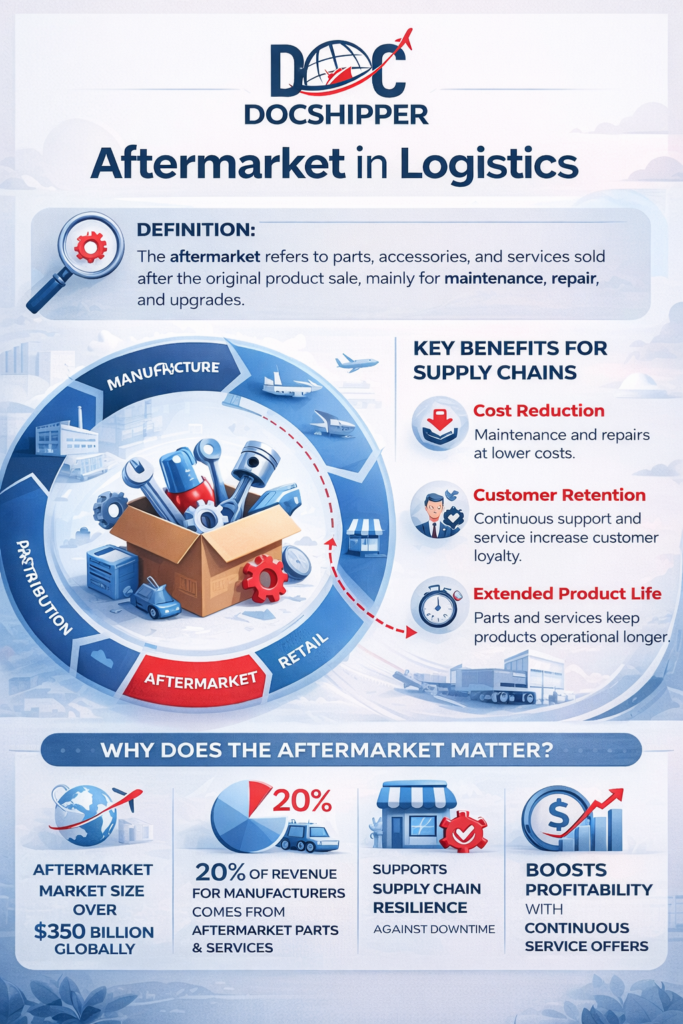
Aftermarket refers to the secondary market for replacement parts, accessories, and services provided after the original sale of a product. In international logistics, it encompasses the entire supply chain managing spare parts distribution, warranty fulfillment, and post-sale support across borders.
Introduction
Many importers underestimate the complexity of aftermarket logistics. They focus on initial product delivery but neglect the critical post-sale phase.
This oversight creates significant risks. Delayed spare parts shipments damage customer relationships. Inefficient reverse logistics inflate costs. Poor aftermarket planning erodes profit margins.
Understanding aftermarket logistics is essential for sustainable international trade. It directly impacts customer retention, warranty compliance, and long-term profitability.
- Spare parts management: Ensuring timely availability of replacement components across multiple markets
- Reverse logistics: Handling returns, repairs, and product recalls efficiently
- Warranty fulfillment: Managing cross-border warranty claims and service obligations
- Service networks: Coordinating authorized repair centers and technical support globally
- Inventory optimization: Balancing stock levels to minimize holding costs while preventing stockouts
In-Depth Analysis & Expertise
The aftermarket supply chain operates under different constraints than primary distribution. Response time becomes critical. A delayed spare part can immobilize expensive equipment for days.
Customs classification for aftermarket parts requires precise HS code determination. Misclassification triggers duty penalties and shipment delays. Many spare parts fall under different tariff categories than complete products.
Regulatory compliance varies significantly across jurisdictions. The EU’s Waste Electrical and Electronic Equipment (WEEE) Directive mandates specific handling for returned electronics. Similar regulations exist in California and Japan. Non-compliance results in substantial fines.
The European Commission provides detailed guidelines on end-of-life vehicle regulations affecting automotive aftermarket operations.
Inventory positioning determines service levels and costs. Centralized warehouses reduce overhead but increase delivery times. Regional distribution centers improve responsiveness but multiply inventory holding costs. The optimal strategy depends on product value, demand variability, and customer expectations.
Documentation requirements for aftermarket shipments differ from original equipment. Technical datasheets, material safety data sheets (MSDS), and certificates of conformity become mandatory. Missing documentation causes customs holds.
At DocShipper, we implement dedicated aftermarket logistics protocols. Our teams verify all technical documentation before shipment departure. This proactive approach eliminates 90% of potential customs delays for our clients’ spare parts operations.
Concrete Examples & Data
Real-world aftermarket scenarios illustrate the strategic importance of proper logistics planning. These examples demonstrate cost implications and operational challenges.
Comparative Analysis: Aftermarket Distribution Models
| Model | Delivery Time | Inventory Cost | Best For |
|---|---|---|---|
| Centralized Hub | 5-7 days | Low (single location) | Low-value parts, predictable demand |
| Regional Distribution | 2-3 days | Medium (3-5 locations) | Balanced approach, moderate volumes |
| Local Stock Points | Same day | High (10+ locations) | Critical parts, high equipment value |
| Drop-Shipping | 7-10 days | None (direct from manufacturer) | Slow-moving parts, low criticality |
Use Case: Industrial Equipment Manufacturer
A European machinery producer exports to 45 countries. Their aftermarket operation previously relied on air freight from Germany for all spare parts requests.
Challenge: Average delivery time exceeded 8 days. Air freight costs consumed 23% of spare parts revenue. Customer satisfaction scores declined.
Solution implemented: Established three regional distribution centers (Singapore, Dubai, Miami). Categorized parts into A/B/C classes based on criticality and demand frequency.
Results after 12 months:
- Average delivery time reduced to 3.2 days (60% improvement)
- Logistics costs decreased to 14% of revenue (9-point reduction)
- Customer satisfaction index increased from 72% to 89%
- Inventory turnover improved from 4.1 to 6.8 times per year
- Emergency air shipments dropped by 67%
DocShipper Platform
Cut logistics costs. Not corners.
See exactly where your logistics costs are bleeding — and how to fix it. Book your expert demo.

Key Aftermarket Metrics
- Fill rate: Percentage of orders fulfilled from available stock (industry benchmark: 95%+)
- Order cycle time: Hours from order receipt to shipment departure (target: <24h for critical parts)
- Perfect order rate: Complete, accurate, on-time deliveries (best-in-class: 98%)
- Return processing time: Days to inspect, repair, or replace returned items (standard: 5-7 days)
- Obsolescence rate: Annual value of parts becoming obsolete (acceptable: <3% of inventory value)
Conclusion
Aftermarket logistics represents a strategic competitive advantage. Companies that excel in spare parts delivery and warranty fulfillment build lasting customer relationships and recurring revenue streams.
Need expert support for your aftermarket operations? Contact DocShipper for tailored logistics solutions.
📚 Quiz
Test Your Knowledge: Aftermarket
Q1 — What does "aftermarket" refer to in international logistics?
Q2 — A common misconception about aftermarket logistics is that it only involves delivering spare parts. What does it actually also include?
Q3 — A European machinery manufacturer needs same-day delivery of critical spare parts to customers across multiple continents. Which aftermarket distribution model is most appropriate?
🎯 Your Result
📞 Free Quote in 24hFAQ | Aftermarket: Definition, Scope & Concrete Examples
OEM (Original Equipment Manufacturer) parts are produced by the original product manufacturer. Aftermarket parts are manufactured by third parties. Both serve replacement needs, but OEM parts typically carry higher price points and guaranteed compatibility.
Spare parts often have different HS codes than complete products. Duty rates vary accordingly. Some jurisdictions offer reduced duties for warranty replacement parts. Proper classification and documentation are essential to avoid overpayment or penalties.
Reverse logistics manages the flow of returned products, defective parts, and warranty claims back to repair centers or manufacturers. It includes inspection, repair, refurbishment, recycling, or disposal processes. Efficient reverse logistics reduces costs and environmental impact.
Use ABC analysis to categorize parts by criticality and demand. Implement demand forecasting based on equipment age and failure rates. Position high-turnover items closer to customers. Use vendor-managed inventory for slow-moving parts. Monitor metrics continuously.
Essential documents include commercial invoice, packing list, certificate of origin, technical datasheets, MSDS for hazardous materials, and conformity certificates. Warranty replacement shipments may require additional proof of original purchase and failure reports.
Aftermarket extends product lifecycle beyond initial sale. Manufacturers must plan spare parts availability for 7-15 years post-production. This requires forecasting obsolescence, managing supplier relationships, and sometimes reverse-engineering discontinued components.
Aftermarket operations typically generate 40-60% gross margins, significantly higher than original equipment sales (15-25%). However, logistics costs, inventory carrying costs, and warranty obligations reduce net margins to 15-25% in most industries.
Establish clear warranty terms in sales contracts. Designate authorized service centers in key markets. Implement a centralized warranty claim management system. Ensure compliance with local consumer protection laws. Partner with logistics providers experienced in warranty fulfillment.
Third-party logistics providers offer specialized aftermarket services including spare parts warehousing, order fulfillment, repair depot management, and reverse logistics. They provide scalability, regional expertise, and cost efficiency compared to self-managed operations.
IoT sensors enable predictive maintenance and automatic parts ordering. AI forecasts demand patterns. Blockchain ensures parts authenticity. Cloud-based inventory systems provide real-time visibility. 3D printing enables on-demand production of obsolete parts.
Key challenges include unpredictable demand patterns, long product lifecycles requiring extended parts availability, managing obsolescence, coordinating global service networks, balancing inventory costs versus service levels, and navigating varying regulatory requirements across markets.
Calculate based on service level targets, demand variability, lead times, and holding costs. Use the formula: Safety Stock = Z-score × Standard Deviation × √Lead Time. Balance investment against cost of stockouts (lost sales, customer dissatisfaction, expedited shipping).
Need Help with
Logistics or Sourcing ?
First, we secure the right products from the right suppliers at the right price by managing the sourcing process from start to finish. Then, we simplify your shipping experience - from pickup to final delivery - ensuring any product, anywhere, is delivered at highly competitive prices.


Fill the Form
Prefer email? Send us your inquiry, and we’ll get back to you as soon as possible.
Contact us




