


In short ⚡
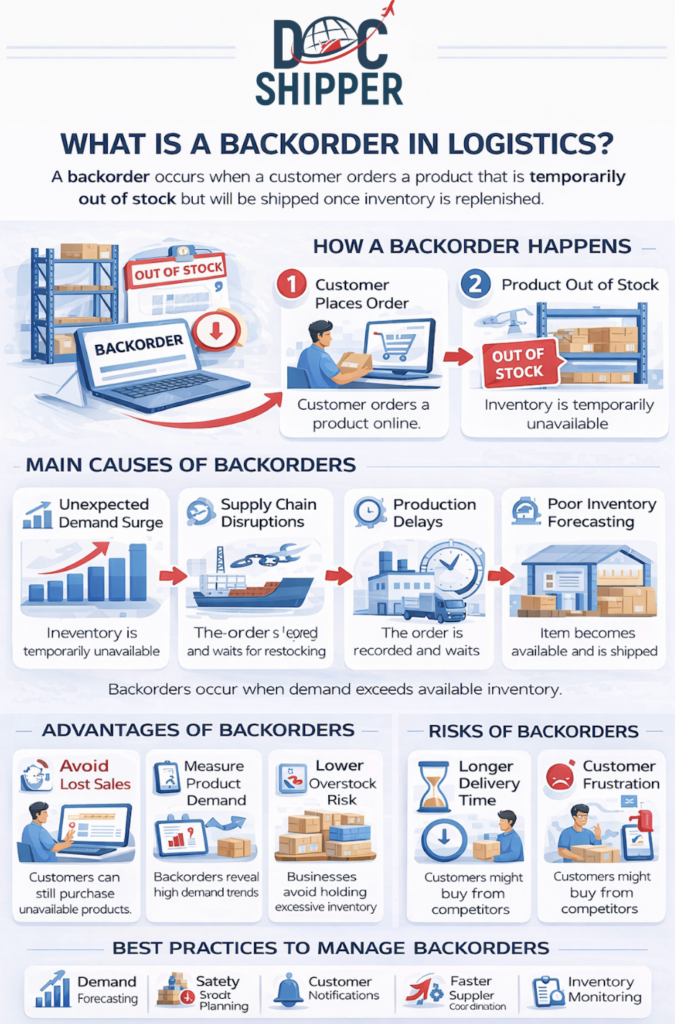
Backorder is an order for a product temporarily out of stock that will be fulfilled once inventory is replenished. This supply chain mechanism allows businesses to maintain customer commitments despite stock shortages, while providing visibility into future demand and revenue streams.
Introduction
A common challenge in international trade: a client places an order, but your inventory shows zero availability. Do you lose the sale or preserve the relationship? This dilemma defines the strategic importance of backorders in modern logistics.
In import/export operations, backorders represent both a risk and an opportunity. They expose supply chain vulnerabilities while simultaneously capturing latent demand that competitors might miss.
Key characteristics of effective backorder management include:
- Real-time inventory visibility across global warehouses
- Transparent communication of expected fulfillment dates
- Automated order prioritization based on customer value
- Integration with procurement and production planning systems
- Clear policies on cancellation rights and deposit requirements
Understanding backorder dynamics becomes essential when coordinating suppliers across continents, managing customs delays, or navigating seasonal demand fluctuations.
Understanding Backorder Mechanisms & Management
The backorder process begins when available inventory falls below committed order quantities. Unlike lost sales, backordered items remain in the system as pending fulfillments, creating obligations that impact cash flow, warehouse planning, and customer satisfaction metrics.
Inventory allocation hierarchy determines which orders receive priority when stock arrives. Most ERP systems rank by order date, customer tier, or profit margin. At DocShipper, we help clients configure allocation rules that balance contractual obligations with strategic account management.
Lead time calculation becomes critical for managing customer expectations. The formula combines supplier production time, international transit duration, customs clearance, and last-mile delivery. Accurate estimates require real-time data from freight forwarders and customs brokers.
Partial shipment policies affect backorder resolution speed. Splitting orders reduces individual wait times but increases shipping costs and administrative complexity. This trade-off requires analysis of per-unit margins versus customer retention value.
Financial implications extend beyond delayed revenue. Backorders tie up working capital in deposits, create accounting complexities around revenue recognition, and may trigger penalty clauses in B2B contracts. European regulations (EU Consumer Rights Directive) mandate specific disclosure requirements for delivery timelines.
System integration requirements span inventory management, order processing, and customer communication platforms. Modern solutions use API connections to update backorder status across sales channels, preventing overselling while maintaining accurate availability displays.
Concrete Examples & Performance Data
Backorder performance varies dramatically across industries and business models. The following data illustrates typical scenarios encountered in international logistics:
| Scenario | Backorder Rate | Avg. Fulfillment Time | Customer Retention |
|---|---|---|---|
| Electronics (Asia-EU) | 12-18% | 35-45 days | 73% |
| Fashion/Apparel | 8-15% | 21-28 days | 58% |
| Industrial Parts (B2B) | 22-30% | 60-90 days | 89% |
| Perishable Goods | 3-6% | 7-14 days | 41% |
Use Case: Automotive Parts Distributor
A European auto parts importer faced 28% backorder rates during semiconductor shortages. By implementing a three-tier system, they reduced cancellations by 34%:
- Tier 1 customers (fleet operators): Guaranteed allocation with 10% deposit
- Tier 2 customers (repair shops): Estimated delivery windows with substitution options
- Tier 3 customers (retail): No backorder acceptance, redirected to alternative SKUs
DocShipper’s inventory forecasting module helped this client anticipate restock dates by integrating real-time shipping data from Asian suppliers, reducing communication overhead by 52%.
Cost Impact Analysis: A backorder extending 30 days typically incurs 4-7% additional costs from expedited shipping, storage fees, and customer service labor. However, maintaining the order prevents 100% revenue loss and preserves customer lifetime value averaging 8.3x the initial transaction.
Conversion Metrics: Transparent backorder communication increases fulfillment rates by 23-31% compared to vague “out of stock” messages. Providing exact restock dates converts 67% of potential cancellations into completed orders.
DocShipper Platform
Cut logistics costs. Not corners.
See exactly where your logistics costs are bleeding — and how to fix it. Book your expert demo.

Conclusion
Backorders transform inventory shortages from absolute failures into managed commitments, preserving revenue and customer relationships when executed with precision. Success requires integrated systems, transparent communication, and strategic prioritization aligned with business objectives.
Need expert guidance on backorder management in your international supply chain? Contact DocShipper for customized logistics solutions.
📚 Quiz
Test Your Knowledge: Backorder
Q1 — What is the correct definition of a backorder?
Q2 — A backorder rate above 25% in a consumer goods business typically signals:
Q3 — A European auto parts distributor is managing high backorder volumes during a semiconductor shortage. Which approach best reduces cancellations?
🎯 Your Result
📞 Free Quote in 24hFAQ | Backorder: Definition, Calculation & Concrete Examples
A backorder occurs when previously available stock depletes, while a preorder involves purchasing items before official release. Backorders indicate supply disruption; preorders represent planned future inventory.
Backorders delay revenue recognition while potentially requiring deposits or partial payments. They tie up working capital in unfulfilled obligations and may trigger early payment to suppliers for expedited restocking.
Cancellation rights depend on jurisdiction and contract terms. EU law allows cancellation before shipment with full refund. B2B contracts often include cancellation penalties after production begins.
Industry benchmarks range from 5-15% for consumer goods to 20-35% for specialized industrial products. Rates above 25% indicate systemic inventory planning issues requiring process redesign.
Modern WMS platforms maintain separate backorder queues with allocation rules. Items move from "backordered" to "allocated" status when incoming shipments arrive, triggering automated fulfillment workflows.
Backorders themselves don't affect customs, but expedited shipments to fulfill them may use different Incoterms or shipping methods, altering duty calculations and clearance procedures.
Best practices include immediate order confirmation, estimated fulfillment date, weekly status updates, and 48-hour shipping notice. Transparency reduces cancellation rates by 40-50%.
Backorder data reveals true demand unconstrained by stock availability. Analyzing backorder patterns improves safety stock calculations and identifies products requiring larger buffer inventory.
Yes, split shipments fulfill available quantities immediately while backordering the remainder. This reduces total wait time but increases shipping costs and requires clear customer communication.
Sellers must disclose expected delivery timelines before purchase. Failure to deliver within stated periods may allow cancellation with full refund under consumer protection laws.
Peak seasons (holidays, industry cycles) increase backorder rates by 30-80%. Proactive demand planning and safety stock adjustments mitigate seasonal spikes in unfulfilled orders.
Key indicators include backorder rate (unfulfilled orders/total orders), fill rate (immediate fulfillment percentage), backorder aging (days pending), and backorder conversion rate (fulfilled vs. canceled).
Need Help with
Logistics or Sourcing ?
First, we secure the right products from the right suppliers at the right price by managing the sourcing process from start to finish. Then, we simplify your shipping experience - from pickup to final delivery - ensuring any product, anywhere, is delivered at highly competitive prices.


Fill the Form
Prefer email? Send us your inquiry, and we’ll get back to you as soon as possible.
Contact us




