


In short ⚡
The Bill of Resources (BOR) is a comprehensive document listing all resources—machinery, labor, tools, and facilities—required to manufacture a product. Unlike a Bill of Materials (BOM), which focuses on raw materials and components, the BOR identifies production capacity, equipment, and human resources needed throughout the manufacturing process.
Introduction
Many manufacturers focus exclusively on material costs while overlooking resource allocation—a critical oversight that leads to production bottlenecks and cost overruns. The Bill of Resources addresses this gap by providing visibility into capacity planning, equipment utilization, and workforce requirements.
In international logistics and manufacturing, the BOR serves as the operational backbone for production scheduling, cost estimation, and supply chain synchronization. It answers essential questions: Do we have sufficient machinery? Is our workforce adequately trained? Can our facilities handle projected volumes?
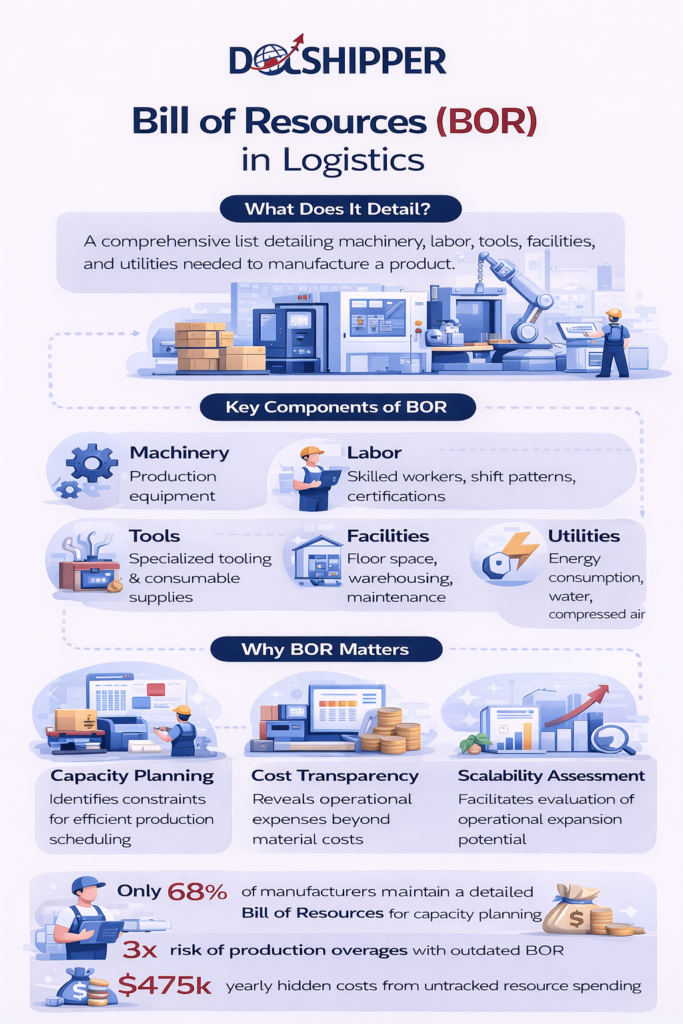
- Resource categorization: Machinery, labor, tooling, facilities, and utilities
- Capacity planning: Identifies production constraints before they become critical
- Cost transparency: Reveals hidden operational expenses beyond raw materials
- MRP integration: Works alongside Material Requirements Planning systems
- Scalability assessment: Determines expansion needs for increased production
Understanding BOR Structure & Strategic Importance
The Bill of Resources operates as a multi-layered framework that maps every non-material input required for production. At its core, it distinguishes between fixed resources (equipment, facilities) and variable resources (labor hours, consumable tooling).
Manufacturing operations typically organize BORs into five primary categories. Machinery and equipment includes all production assets with their cycle times, maintenance schedules, and throughput capacities. Labor resources specify skill levels, shift patterns, and headcount requirements per production stage. Tooling and fixtures encompasses dies, molds, jigs, and specialized instruments needed for specific operations. Facility infrastructure accounts for floor space, utilities, environmental controls, and storage capacity. Finally, auxiliary services include quality control stations, material handling equipment, and support functions.
From a regulatory perspective, the BOR plays a crucial role in compliance documentation. According to ISO 9001:2015 quality management standards, organizations must demonstrate adequate resource provision for product conformity. The BOR provides auditable evidence of resource planning and allocation.
Advanced manufacturers integrate BORs with Enterprise Resource Planning (ERP) systems to enable real-time capacity analysis. This integration allows production planners to simulate scenarios, identify constraints, and optimize resource utilization before committing to production schedules. At DocShipper, we help clients align their BOR documentation with international manufacturing partners, ensuring resource capabilities match production requirements before orders are placed.
The strategic value extends beyond internal operations. When sourcing internationally, the BOR becomes a critical evaluation tool. Assessing a supplier’s resource capacity reveals whether they can scale production, maintain quality standards, and meet delivery timelines—factors that material availability alone cannot predict.
Practical Applications & Data-Driven Scenarios
Consider a European electronics company planning to manufacture 50,000 smartphone cases monthly through an Asian supplier. The BOM lists plastics, adhesives, and packaging materials. The BOR, however, reveals the complete operational picture:
| Resource Category | Specification | Capacity Impact |
|---|---|---|
| Injection Molding Machines | 4 units × 45-second cycle time | 76,800 units/day (3 shifts) |
| Skilled Operators | 12 technicians (certified) | 3 per machine per shift |
| Quality Control Equipment | 2 dimensional scanners | 10% sampling rate maintained |
| Production Floor Space | 1,200 m² dedicated area | Includes staging and WIP storage |
| Utilities | 280 kW electrical capacity | Continuous operation supported |
This BOR analysis reveals a critical constraint: while material availability supports 50,000 units monthly, the four molding machines operating at 85% efficiency (accounting for changeovers and maintenance) can produce approximately 58,000 units. The bottleneck isn’t materials—it’s labor availability. The facility requires 12 certified operators, but local labor markets typically experience 15% turnover in manufacturing roles, creating periodic capacity fluctuations.
Use Case: Automotive Component Manufacturing
A German automotive supplier evaluated two Chinese manufacturers for brake caliper production (200,000 units annually). Manufacturer A offered 8% lower material costs but their BOR revealed only two CNC machining centers with 12-hour daily operation limits. Manufacturer B had higher material costs but operated six CNC centers across two shifts with cross-trained personnel. The BOR comparison showed Manufacturer B could absorb a 30% demand spike without capital investment, while Manufacturer A would require six months and €400,000 in equipment upgrades. DocShipper’s resource capacity audit identified this discrepancy before contract signing, saving the client potential delays and penalty costs.
Key Data Points for BOR Evaluation:
- Equipment utilization rates: Industry standard targets 75-85% for sustainable operations
- Labor efficiency metrics: Track output per labor hour against industry benchmarks
- Maintenance downtime: Typically 5-10% of available production time
- Changeover frequency: Impacts effective capacity in multi-product environments
- Energy consumption patterns: Reveals operational cost structures and sustainability metrics
Conclusion
The Bill of Resources transforms abstract production capabilities into quantifiable, manageable parameters. It bridges the gap between material planning and operational reality, ensuring manufacturers can deliver on commitments. For international sourcing decisions, the BOR provides the operational transparency that material costs alone cannot reveal.
Need expert guidance on evaluating supplier resource capacity or optimizing your production BOR? Contact DocShipper for comprehensive logistics and manufacturing support.
DocShipper Platform
Cut logistics costs. Not corners.
See exactly where your logistics costs are bleeding — and how to fix it. Book your expert demo.

📚 Quizz
Test Your Knowledge: Bill of Resources (BOR)
Q1 — What does a Bill of Resources (BOR) primarily document?
Q2 — A manufacturer has sufficient raw materials to produce 50,000 units per month, but their BOR analysis reveals only 12 certified operators are available with a 15% turnover rate. What does this situation illustrate?
Q3 — A European company is choosing between two Asian suppliers for a large production contract. Supplier A offers lower material costs, but their BOR shows limited CNC capacity and no ability to absorb demand spikes. Supplier B has higher material costs but a well-documented BOR showing scalable resources. Which is the better sourcing decision?
🎯 Your Result
📞 Free Quote in 24hFAQ | Bill of Resources (BOR): Definition, Components & Practical Examples
A Bill of Materials (BOM) lists components and raw materials needed to build a product, while a Bill of Resources (BOR) specifies the machinery, labor, facilities, and equipment required to manufacture it. The BOM answers "what materials," the BOR answers "what capabilities."
BOR reveals indirect costs often overlooked in material-only calculations: machine depreciation, labor rates, energy consumption, tooling replacement, and facility overhead. These can represent 40-60% of total manufacturing costs in capital-intensive industries.
Absolutely. By mapping resource capacity against production requirements, BOR analysis immediately highlights constraints—whether insufficient machinery, inadequate labor, or facility limitations. This enables proactive capacity planning rather than reactive crisis management.
Even small operations benefit from basic BOR documentation. It clarifies resource availability, supports accurate quotations, and facilitates growth planning. A simple spreadsheet listing equipment, labor, and space requirements provides immediate operational visibility.
Update BORs whenever significant changes occur: new equipment acquisition, process modifications, labor skill changes, or facility expansions. Quarterly reviews ensure alignment with current operational capabilities, while annual comprehensive audits maintain accuracy.
BOR assessment is critical for supplier audits. It verifies claimed production capacity, identifies scalability limitations, and reveals operational maturity. Suppliers with well-documented BORs typically demonstrate stronger process control and reliability.
Modern MRP systems use BOR data to calculate capacity requirements, schedule production, and identify resource conflicts. The integration enables finite capacity planning, where the system only schedules work based on actual resource availability.
Yes. BOR documentation includes energy consumption, waste generation, and resource efficiency metrics. This data supports carbon footprint calculations, identifies improvement opportunities, and demonstrates environmental compliance to stakeholders.
Frequent errors include omitting maintenance downtime, ignoring operator skill requirements, underestimating changeover times, and failing to account for quality control resources. These oversights create unrealistic capacity expectations and scheduling failures.
Labor entries should specify skill levels, certification requirements, quantity per shift, and any specialized training needed. For complex operations, include learning curve factors for new employees and productivity variance ranges.
The concept translates well. Service organizations use resource bills to document personnel skills, technology platforms, facility requirements, and support tools needed to deliver services. Consulting firms, IT services, and logistics providers all benefit from resource planning.
Analyze resource utilization rates to identify underutilized assets, cross-train labor to increase flexibility, standardize tooling across product lines, and negotiate volume discounts on consumable resources. Regular BOR reviews reveal optimization opportunities that material focus alone misses.
Need Help with
Logistics or Sourcing ?
First, we secure the right products from the right suppliers at the right price by managing the sourcing process from start to finish. Then, we simplify your shipping experience - from pickup to final delivery - ensuring any product, anywhere, is delivered at highly competitive prices.


Fill the Form
Prefer email? Send us your inquiry, and we’ll get back to you as soon as possible.
Contact us




:%20Definition%20&%20Guide%20en%202026)