


In short ⚡
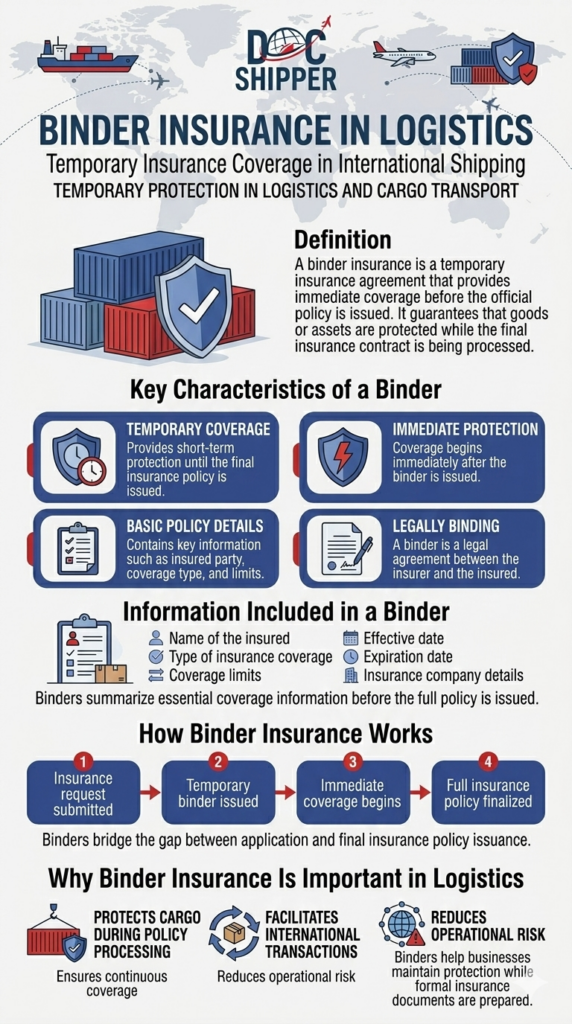
A binder is a temporary insurance certificate issued by a broker or insurer that provides immediate coverage for goods in transit before the formal policy is finalized. It serves as proof of insurance and legally binds the insurer to honor claims during international shipments.
Introduction
Many importers and exporters face a critical gap: goods ready to ship, but insurance documentation still pending. This delay can halt entire shipments and expose businesses to uninsured risks worth thousands of dollars.
The binder solves this problem by providing instant coverage. In international trade, where timing dictates profitability, this temporary insurance instrument ensures compliance with Incoterms requirements and bank guarantees without delaying cargo movement.
- Immediate coverage: Activates protection within hours of issuance
- Legal validity: Recognized by customs authorities and financial institutions worldwide
- Temporary nature: Valid typically for 30 to 90 days until permanent policy replaces it
- Flexibility: Covers single shipments or multiple consignments under one agreement
- Compliance tool: Satisfies documentary credit requirements and letter of credit conditions
Technical Framework & Legal Implications
A binder operates under the principle of utmost good faith (uberrimae fidei), the foundational doctrine in marine insurance law. The issuing party commits to honor all terms as if the full policy were already in force.
The document must contain five essential elements: insured party identification, cargo description, coverage amount, voyage details, and effective dates. Without these, the binder lacks enforceability in claim situations.
Under the Marine Insurance Act 1906, which remains the global reference framework, binders carry the same legal weight as formal policies. This means insurers cannot refuse valid claims simply because permanent documentation hasn’t been issued.
The Institute Cargo Clauses (A, B, or C) typically govern coverage scope. Clause A provides all-risk protection, while B and C offer named-peril coverage. At DocShipper, we systematically verify which clause applies to your binder to ensure adequate protection matches your cargo value and risk profile.
Regulatory compliance varies by jurisdiction. The European Union requires binders to reference Solvency II compliant insurers, while U.S. shipments must align with Federal Maritime Commission regulations. Failure to meet these standards can void coverage during customs clearance.
Practical Applications & Use Cases
Understanding how binders function in real scenarios clarifies their strategic value. Consider three common situations where this instrument proves essential.
Use Case 1: Urgent Electronics Shipment
A French importer orders €200,000 worth of smartphones from China under CIF terms. The permanent insurance policy requires underwriting approval, estimated at 5 business days. The vessel departs in 48 hours.
| Scenario | Without Binder | With Binder |
|---|---|---|
| Shipment Departure | Delayed 5 days | Departs on schedule |
| Insurance Cost | €1,200 + €800 demurrage | €1,200 (no extra fees) |
| Risk Exposure | Uninsured during delay | Fully covered from departure |
| Bank Acceptance | Letter of credit rejected | Documents accepted |
The binder enabled immediate departure while the formal policy was processed, saving €800 in container storage fees and preventing letter of credit discrepancies.
Use Case 2: Multi-Shipment Coverage
A textile exporter ships weekly consignments from Bangladesh to Germany. Rather than issuing individual policies, the broker provides a blanket binder covering all shipments for 60 days, with automatic conversion to an open cover policy.
Key advantages in this scenario:
- Administrative efficiency: Single documentation process instead of 8-10 separate policies
- Cost reduction: 15% lower premiums through volume commitment
- Automatic renewal: Seamless transition to permanent coverage without re-application
- Claims simplification: Unified claim reference system across all shipments
DocShipper Platform
Cut logistics costs. Not corners.
See exactly where your logistics costs are bleeding — and how to fix it. Book your expert demo.

Comparative Analysis: Binder vs. Certificate of Insurance
| Criterion | Binder | Certificate of Insurance |
|---|---|---|
| Issuance Speed | 2-6 hours | Issued from existing policy (instant) |
| Validity Period | 30-90 days (temporary) | Matches underlying policy duration |
| Legal Standing | Creates new contract | Evidence of existing contract |
| Use Case | When policy doesn’t exist yet | When policy already active |
| Cost | Premium paid upfront | No additional cost (part of policy) |
At DocShipper, we evaluate your shipment timeline and recommend the appropriate instrument. For time-sensitive cargo without existing coverage, binders provide the fastest protection pathway while maintaining full compliance with trade finance requirements.
Conclusion
The binder remains an indispensable tool for managing insurance gaps in international logistics. It bridges the critical period between cargo readiness and permanent policy activation, ensuring continuous protection and regulatory compliance.
Need guidance on insurance documentation for your next shipment? Contact DocShipper for expert support tailored to your specific trade requirements.
📚 Quiz
Test Your Knowledge: Binder
1. What is a binder in international logistics?
2. A shipper assumes that if a claim occurs while only a binder is active, the insurer can refuse to pay until the permanent policy is issued. Is this correct?
3. A French importer needs to ship €200,000 of electronics in 48 hours, but the permanent insurance policy requires 5 days for underwriting approval. Which document should the broker issue to ensure the shipment departs on time with valid coverage?
🎯 Your Result
📞 Free Quote in 24hFAQ | Binder: Definition, Role & Practical Examples in Logistics
Most binders remain valid for 30 to 90 days. Some insurers extend this to 120 days for complex shipments requiring extended underwriting review, though this requires specific approval from the underwriting department.
Yes, but cancellation terms depend on the binder agreement. If goods haven't shipped, full premium refunds typically apply. Once cargo is in transit, pro-rata refunds may apply based on the unused coverage period.
Most international banks accept binders if they meet documentary credit specifications, including proper endorsement, coverage amount matching invoice value, and reference to recognized Institute Cargo Clauses. Verify specific bank requirements before shipment.
Claims filed during the binder period are processed identically to permanent policy claims. The insurer must honor all valid claims up to the coverage limit, provided all terms and conditions were met at the time of loss.
Yes, electronic binders carry full legal validity under most jurisdictions, including the EU's eIDAS regulation and the U.S. ESIGN Act. Ensure the email contains all essential elements and comes from an authorized representative of the insurer or broker.
While both provide temporary coverage, a cover note is typically issued by brokers as evidence of insurance arrangement, whereas a binder represents a direct commitment from the insurer. Binders generally carry stronger legal enforceability in claim disputes.
Yes, blanket binders or floating binders cover multiple consignments over a specified period. Each shipment must be declared to the insurer, and total aggregate value cannot exceed the binder's overall limit without amendment.
Essential elements include: insured party name, cargo description, sum insured, voyage route (origin and destination), conveyance details, coverage terms (ICC clauses), effective dates, and authorized signatory. Missing any element may invalidate the document.
Customs authorities in most countries accept binders as proof of insurance during clearance, provided they contain complete cargo and coverage details. Some jurisdictions require the binder to be on the insurer's official letterhead with visible company registration numbers.
Binders usually carry no additional premium beyond the standard cargo insurance rate. However, some brokers charge administrative fees ranging from $25 to $100 for binder issuance, particularly for single-shipment coverage requests.
Transfer depends on the policy terms. Most binders include an assignment clause allowing transfer to buyers or consignees, but this requires written endorsement from the insurer. The original insured party remains liable unless formally released.
If discrepancies arise, the binder terms generally prevail for the period it was active. However, significant differences may require retroactive adjustment or supplemental agreements. Always review final policy wording against the original binder to identify variances.
Need Help with
Logistics or Sourcing ?
First, we secure the right products from the right suppliers at the right price by managing the sourcing process from start to finish. Then, we simplify your shipping experience - from pickup to final delivery - ensuring any product, anywhere, is delivered at highly competitive prices.


Fill the Form
Prefer email? Send us your inquiry, and we’ll get back to you as soon as possible.
Contact us




