


In short ⚡
A business plan is a strategic document outlining a company's objectives, operational methodology, financial projections, and market positioning. In international logistics, it serves as the foundational framework for establishing import/export operations, securing financing, and demonstrating viability to partners and customs authorities. This comprehensive roadmap guides decision-making and risk management throughout the supply chain.
Introduction
Many entrepreneurs underestimate the critical role of a structured business plan when launching international trade operations. Without this document, securing bank loans, negotiating with suppliers, or obtaining import licenses becomes exponentially harder.
In the logistics sector, a business plan transcends traditional business documentation. It demonstrates compliance readiness, operational capacity, and financial sustainability to customs brokers, freight forwarders, and regulatory bodies.
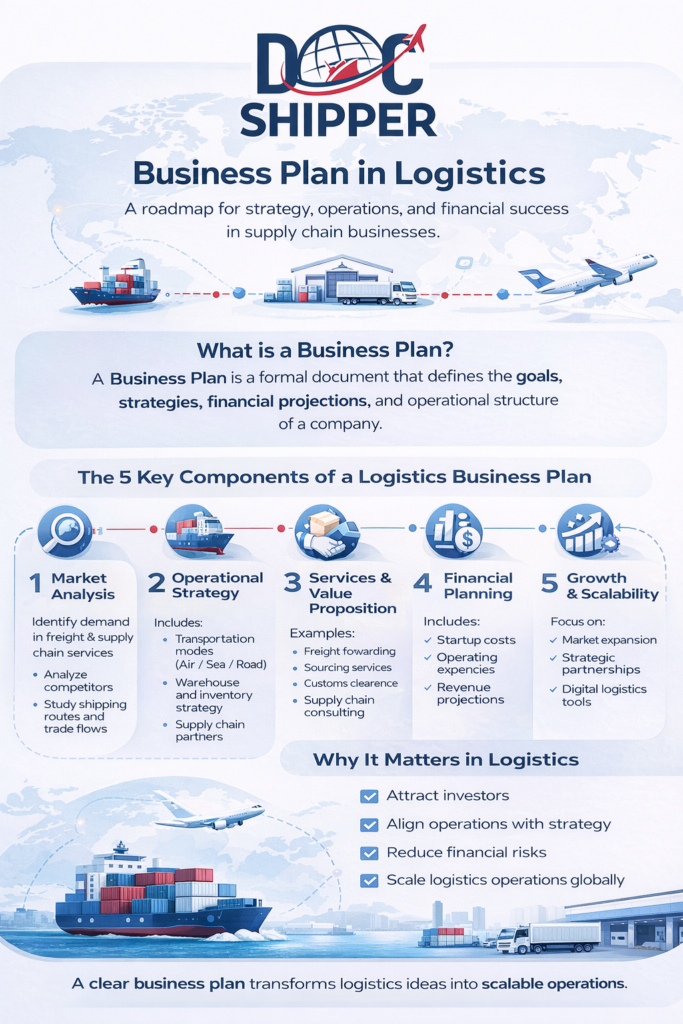
A robust business plan for import/export activities typically includes:
- Executive summary presenting the core business model and unique value proposition
- Market analysis identifying target countries, competitors, and regulatory environments
- Operational plan detailing supply chain logistics, warehousing, and transportation strategies
- Financial projections covering cash flow, profit margins, and break-even analysis
- Risk assessment addressing currency fluctuations, customs delays, and compliance challenges
Key Components & Strategic Framework
The executive summary functions as your elevator pitch. In 1-2 pages, it must capture your business model, target market, competitive advantage, and financial highlights. Investors and banks read this first—make it compelling.
The market analysis section requires deep research into trade regulations, tariff classifications (HS codes), and local competition. According to the World Trade Organization, understanding regional trade agreements can reduce import duties by 15-40%.
Your operational plan must detail the entire logistics chain. This includes supplier selection criteria, Incoterms preferences, freight forwarding partnerships, and customs clearance procedures. At DocShipper, we systematically review this section to identify potential bottlenecks before they become costly delays.
The financial model should project at least three years forward. Include startup costs, working capital requirements, revenue forecasts, and sensitivity analysis. Banks typically require a debt-service coverage ratio above 1.25 for trade finance approval.
Finally, the risk mitigation strategy addresses currency hedging, insurance coverage (cargo, liability, political risk), and contingency plans for supply chain disruptions. This demonstrates operational maturity to stakeholders.
Concrete Examples & Financial Data
Consider a European importer planning to source consumer electronics from Asia. Their business plan would include specific financial projections based on real market data:
| Metric | Year 1 | Year 2 | Year 3 |
|---|---|---|---|
| Import Volume (containers) | 24 TEU | 48 TEU | 72 TEU |
| Revenue | €480,000 | €960,000 | €1,440,000 |
| Gross Margin | 28% | 32% | 35% |
| Logistics Costs | €72,000 (15%) | €134,400 (14%) | €187,200 (13%) |
| Net Profit | €38,400 (8%) | €115,200 (12%) | €201,600 (14%) |
This projection demonstrates economies of scale as volume increases. Logistics costs decrease proportionally, while negotiated supplier discounts improve gross margins.
Use Case: A textile importer from Bangladesh to the US included a detailed compliance section addressing CTPAT certification, ISF filing requirements, and Section 301 tariff implications. This thoroughness secured a $250,000 trade finance facility at 5.2% interest—well below the 7-9% market average.
Key success factors identified across multiple business plans:
- Diversified supplier base reduces dependency risk (minimum 3 suppliers per product category)
- Pre-negotiated credit terms with freight forwarders improve cash flow predictability
- Automated inventory management systems reduce holding costs by 18-25%
- Forward currency contracts lock in exchange rates, protecting profit margins
- Quarterly plan reviews allow agile responses to market shifts or regulatory changes
DocShipper Platform
One platform. Your entire supply chain
Sourcing, freight, customs & documents — all centralised, all visible, 24/7.
Conclusion
A well-structured business plan transforms abstract import/export ambitions into actionable, fundable strategies. It demonstrates operational readiness and financial viability to all stakeholders in your supply chain.
Need expert guidance developing your international trade business plan? Contact DocShipper for specialized consulting that aligns logistics operations with financial objectives.
📚 Quiz
Test Your Knowledge: Business Plan
1. What is the primary purpose of a business plan in international logistics?
2. A common misconception is that a business plan and a feasibility study are the same thing. What is the key difference?
3. A textile importer applying for trade finance wants to maximize their chances of approval at a competitive interest rate. Which approach, based on business plan best practices, is most effective?
🎯 Your Result
📞 Free Quote in 24hFAQ | Business Plan: Definition, Structure & Concrete Examples
Between 20-35 pages for comprehensive import/export operations. Executive summaries should remain under 2 pages, while financial projections require detailed appendices.
Yes. Regulatory environments, tariff structures, and logistics infrastructure vary significantly. Adapt your operational and compliance sections for each target region.
Quarterly reviews for financial performance, annual comprehensive updates for strategy. Major regulatory changes (new trade agreements, tariff modifications) require immediate revisions.
Debt-service coverage ratio (minimum 1.25), working capital adequacy, gross profit margins above 25%, and demonstrated supplier payment history.
Absolutely. Specify preferred Incoterms (FOB, CIF, DDP) as they directly impact cost structure, risk allocation, and cash flow timing.
Include supplier locations, transportation modes, transit times, warehousing points, and customs clearance procedures. Visual flowcharts enhance clarity.
A feasibility study assesses whether a project should proceed. A business plan details how it will proceed, including operational execution and financial management.
Yes, especially for expansion, financing, or partnership opportunities. It demonstrates growth strategy and operational maturity to potential investors or lenders.
Base projections on market research, competitor analysis, and confirmed purchase orders. Conservative first-year estimates (60-70% of capacity) build credibility.
Mandatory. Detail alternative suppliers, expedited shipping options, and buffer inventory strategies. This shows risk awareness and operational resilience.
Cargo insurance (all-risk coverage), general liability, errors and omissions, and potentially political risk insurance for volatile markets.
Highlight exclusive supplier relationships, proprietary logistics networks, regulatory expertise, or unique market access that competitors cannot easily replicate.
Need Help with
Logistics or Sourcing ?
First, we secure the right products from the right suppliers at the right price by managing the sourcing process from start to finish. Then, we simplify your shipping experience - from pickup to final delivery - ensuring any product, anywhere, is delivered at highly competitive prices.


Fill the Form
Prefer email? Send us your inquiry, and we’ll get back to you as soon as possible.
Contact us




