


In short ⚡
Blocking and bracing refers to the use of wood, metal, or other materials to secure cargo inside containers, trucks, or vessels, preventing movement during transit. This critical load securement technique protects goods from damage caused by shifting, vibration, or sudden stops, ensuring safe delivery in international logistics.
Introduction
Cargo damage during transportation remains one of the most costly issues in international trade. Inadequate load securement causes billions in losses annually, with blocking and bracing serving as the primary defense against transit damage.
In ocean freight, road transport, and rail shipping, cargo faces constant forces—acceleration, deceleration, cornering, and vibration. Without proper securement, even minor shifts can cascade into complete load failure, resulting in damaged goods, insurance claims, and delivery delays.
Understanding blocking and bracing is essential for:
- Shippers preparing cargo for international transport
- Freight forwarders ensuring compliance with carrier requirements
- Warehouse operators loading containers safely
- Customs brokers verifying proper documentation for secured loads
- Insurance professionals assessing risk and liability in cargo claims
This article examines the technical standards, materials, and real-world applications of cargo securement in global logistics.
Technical Expertise & Load Securement Standards
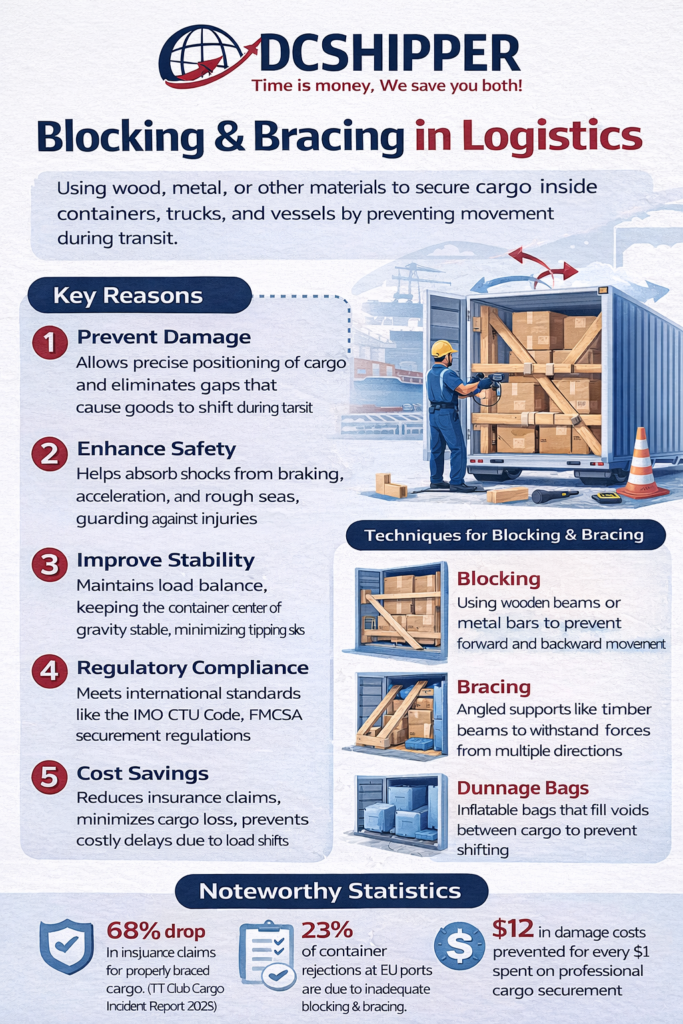
Blocking involves placing barriers directly against cargo to prevent forward, backward, or lateral movement. Bracing uses angled supports to resist forces from multiple directions, creating a triangulated resistance structure.
International standards govern cargo securement practices. The International Maritime Organization (IMO) publishes the CTU Code (Code of Practice for Packing of Cargo Transport Units), which establishes global benchmarks for container loading. In North America, the Federal Motor Carrier Safety Administration (FMCSA) enforces securement regulations under 49 CFR Part 393.
Key technical concepts include:
Load distribution: Weight must be evenly distributed to maintain the container’s center of gravity. Improper distribution causes tipping, especially in intermodal transfers between trucks and rail cars.
Friction coefficient: Different materials provide varying levels of grip. Anti-slip mats increase friction between cargo and floor surfaces, reducing the force required from blocking materials. Wood-on-wood contact typically provides a friction coefficient of 0.3-0.4, while rubber mats can reach 0.6-0.8.
G-forces in transit: Cargo experiences forces measured in “g” (gravitational units). Ocean vessels may generate 0.3g longitudinally and 0.5g laterally during rough seas. Road transport can produce sudden stops exceeding 0.8g. Blocking and bracing systems must withstand these forces without failure.
Material selection: Lumber (2×4, 4×4 timbers) remains the most common blocking material due to cost and availability. Steel bracing provides superior strength for heavy machinery. Inflatable dunnage bags offer rapid deployment for filling voids between palletized cargo.
Securement points: Containers feature standardized lashing rings and D-rings for attaching straps and chains. Proper bracing connects cargo to these anchor points, creating a unified load that moves as a single unit.
At DocShipper, we systematically verify blocking and bracing compliance before container departure, preventing costly rejections at destination ports and ensuring our clients’ cargo arrives intact.
The IMO Cargo Securement Guidelines provide comprehensive technical specifications for international shippers.
Practical Examples & Case Studies
Real-world applications demonstrate how proper blocking and bracing techniques prevent cargo damage across different shipping scenarios.
Case Study 1: Machinery Export from Germany to Brazil
A German manufacturer shipped industrial printing equipment (8,500 kg) in a 40-foot high-cube container. The cargo required:
- Base blocking: 4×4 inch timber secured to container floor with lag bolts
- Lateral bracing: Diagonal 2×6 inch lumber at 45-degree angles to container sidewalls
- Void filling: Inflatable dunnage bags (1,200 x 2,400 mm) between machinery and container doors
- Top restraint: Ratchet straps (5,000 kg working load limit) anchored to container D-rings
Result: Zero damage after 32-day ocean transit and inland trucking to São Paulo. Total securement cost: €420. Estimated damage prevention value: €47,000.
Comparative Analysis: Blocking Methods by Cargo Type
| Cargo Type | Primary Method | Materials Required | Average Cost (20′ Container) | Installation Time |
|---|---|---|---|---|
| Palletized goods | Dunnage bags + strapping | 6-8 airbags, 4 ratchet straps | $180-250 | 45 minutes |
| Heavy machinery | Timber blocking + steel bracing | 120 board feet lumber, 8 steel brackets | $350-500 | 2-3 hours |
| Automotive parts | Anti-slip mats + lateral blocking | 12 m² rubber matting, 2×4 lumber | $220-320 | 1 hour |
| Electronics (fragile) | Custom crating + foam bracing | Plywood crate, high-density foam inserts | $400-650 | 3-4 hours |
| Bulk bags (powder/granules) | Bulkhead + horizontal bracing | Plywood bulkhead, 2×6 cross-bracing | $280-380 | 1.5 hours |
Use Case: Preventing Lateral Shift in Ocean Freight
A textile importer shipped 18 pallets (1,200 x 1,000 mm) of fabric rolls from Vietnam to Los Angeles. Initial loading used only shrink wrap, resulting in a 15-degree pallet lean discovered during container inspection.
Corrective measures implemented:
- Installation of transverse timber blocking between pallet rows
- Placement of four Level 2 dunnage bags (900 x 1,800 mm) in rear void space
- Application of anti-slip sheets under bottom pallets
Outcome: Container passed pre-shipment inspection. Transit time: 14 days across Pacific. No cargo movement detected upon unloading. Additional securement cost: $165. Avoided damage claim: estimated $8,200.
DocShipper Platform
Cut logistics costs. Not corners.
See exactly where your logistics costs are bleeding — and how to fix it. Book your expert demo.

Key Data Points
- Insurance impact: Properly blocked cargo reduces claim frequency by 68% (source: TT Club Cargo Incident Report 2023)
- Regulatory compliance: 23% of container rejections at EU ports result from inadequate blocking (European Commission Transport Statistics)
- Cost-benefit ratio: Every $1 spent on professional blocking prevents average $12 in damage costs
- Time savings: Pre-approved blocking methods reduce customs clearance time by 30-40%
- Material efficiency: Reusable steel bracing systems reduce per-shipment costs by 55% after 8 uses
Conclusion
Effective blocking and bracing transforms cargo securement from reactive damage control into proactive risk management. Proper implementation protects goods, reduces insurance claims, and ensures regulatory compliance across international supply chains.
Need expert guidance on cargo securement for your next shipment? Contact DocShipper for professional load planning and container optimization services.
📚 Quiz
Test Your Knowledge: Blocking & Bracing
Q1 — What is the primary purpose of blocking and bracing in cargo transport?
Q2 — A common misconception is that blocking and bracing are the same technique. What is the key difference?
Q3 — A shipper is loading 18 pallets of fabric rolls for a 14-day ocean transit and uses only shrink wrap. During inspection, a 15-degree pallet lean is discovered. Which corrective measure is most appropriate?
🎯 Your Result
📞 Free Quote in 24hFAQ | Blocking and Bracing: Definition, Techniques & Practical Examples
Blocking prevents linear movement by placing barriers perpendicular to cargo. Bracing uses angled supports to resist forces from multiple directions simultaneously, creating triangulated resistance against shifting.
Costs range from $150-650 per container depending on cargo type, weight, and complexity. Heavy machinery requires more materials and labor than standard palletized goods. Professional installation typically costs 60% less than potential damage claims.
Yes, but materials must meet structural integrity standards. Recycled lumber should be free from rot, cracks, and insect damage. Carriers may reject containers with substandard blocking materials that compromise cargo safety.
Dunnage bags are inflatable air cushions placed between cargo and container walls to fill voids. Use them for palletized shipments with irregular spacing, or to secure loads that don't reach container doors. Available in paper (Level 1) and polywoven (Level 2) materials.
Most carriers require adequate securement for all cargo. Specific requirements depend on cargo type, weight distribution, and transit mode. Ocean freight faces stricter standards due to extended transit times and rough sea conditions.
Multiply cargo weight by expected g-force (typically 0.8g for road, 0.5g for ocean). Divide by friction coefficient (0.3-0.4 for wood). Result indicates minimum blocking resistance required. Professional load planners use software for precise calculations.
Shifted cargo may cause container rejection at destination, damage to goods, voided insurance coverage, and additional handling fees. Severe shifts can compromise container structural integrity, leading to safety hazards during unloading.
Simple palletized loads can be secured by trained warehouse staff. Heavy machinery, fragile electronics, or high-value cargo benefit from professional blocking services. Incorrect blocking may void insurance claims if damage occurs.
Under-bracing (insufficient material strength), improper angle placement (less than 30 degrees ineffective), inadequate anchor points, mixing incompatible materials, and ignoring void spaces. Each mistake significantly increases damage risk during transit.
Blocking materials typically add 100-300 kg to gross weight. Always verify total container weight (cargo + blocking + packaging) remains below maximum gross weight (typically 28,000-30,480 kg for standard containers) to avoid overweight penalties.
Yes, software like CargoWiz, EasyCargo, and Container Loading Calculator optimize load distribution and suggest blocking configurations. These tools reduce planning time by 70% and minimize material waste through precise calculations.
Timestamped photos showing blocking installation, material specifications, loading diagrams, and container seal numbers. Many insurers require third-party inspection certificates for high-value shipments. Documentation must be collected before container departure.
Need Help with
Logistics or Sourcing ?
First, we secure the right products from the right suppliers at the right price by managing the sourcing process from start to finish. Then, we simplify your shipping experience - from pickup to final delivery - ensuring any product, anywhere, is delivered at highly competitive prices.


Fill the Form
Prefer email? Send us your inquiry, and we’ll get back to you as soon as possible.
Contact us




