


In short ⚡
A bogie is a wheeled chassis assembly located beneath railway wagons, freight containers, or heavy transport vehicles. It distributes load weight across multiple axles, enabling smooth movement, directional stability, and efficient cargo handling in intermodal logistics operations.
Introduction
In international freight transport, confusion often arises between axles, chassis, and bogies—yet understanding the bogie is essential for anyone managing rail freight, intermodal containers, or heavy haulage. This wheeled framework is the backbone of efficient cargo movement across continents.
The bogie plays a critical role in the global supply chain by ensuring structural integrity, load distribution, and operational safety. Whether transporting containerized goods via rail or moving oversized cargo on specialized trailers, the bogie determines transit efficiency and cost-effectiveness.
Key characteristics of bogies in logistics include:
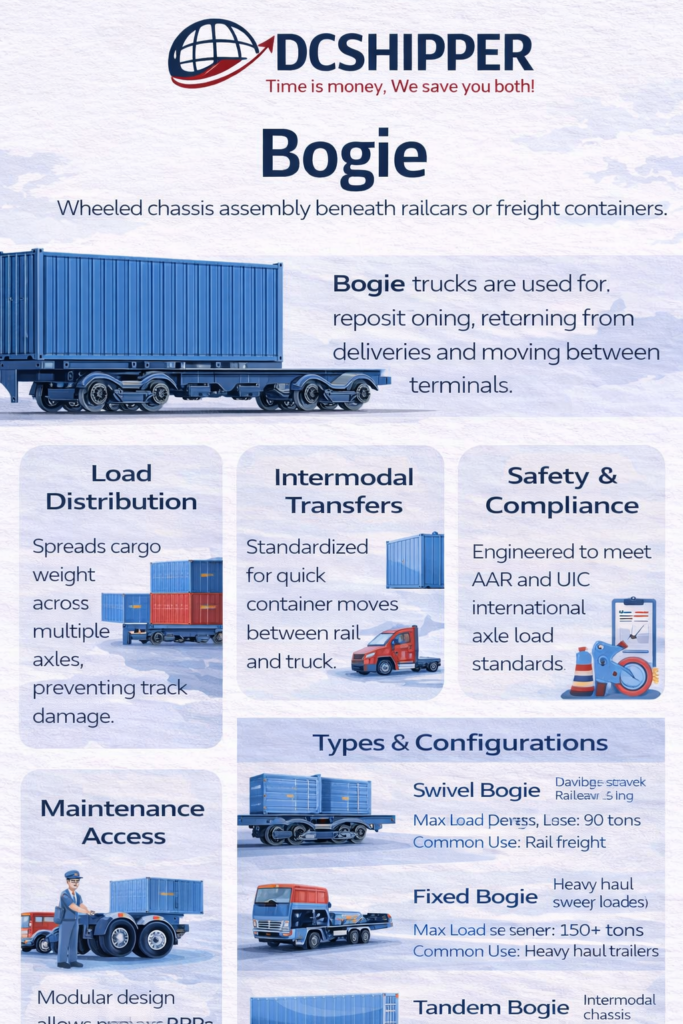
- Load distribution: Spreads cargo weight across multiple axles to prevent track or road damage
- Directional control: Swivel mechanisms enable tight cornering and route flexibility
- Intermodal compatibility: Standardized designs facilitate container transfers between rail, truck, and ship
- Maintenance accessibility: Modular construction allows quick component replacement without full vehicle disassembly
- Regulatory compliance: Engineered to meet international weight-per-axle standards (AAR, UIC norms)
Technical Design & Operational Role
The engineering of a bogie directly impacts freight efficiency. Modern designs incorporate suspension systems (coil springs, air cushions) that absorb vibrations during transit, protecting sensitive cargo. The wheelbase length—distance between axles—determines turning radius and track compatibility.
In rail logistics, swivel bogies allow freight cars to navigate curved tracks without derailment risk. Fixed bogies, common in straight-line heavy haul applications, offer superior stability for oversized loads exceeding 100 tons. The choice between configurations depends on route topography and cargo characteristics.
Regulatory frameworks govern bogie specifications. The Association of American Railroads (AAR) mandates specific axle load limits (typically 25-30 tons per axle in North America), while the European Union applies UIC standards for cross-border rail freight. Non-compliance results in route restrictions or fines.
Brake integration within bogie assemblies is critical for safety. Air brake systems, synchronized across all axles, ensure uniform stopping power for trains exceeding 1 kilometer in length. Electronic monitoring systems now detect wheel wear and bearing temperature anomalies in real-time, preventing catastrophic failures.
At DocShipper, we verify bogie condition reports during pre-shipment inspections for rail cargo, ensuring compliance with destination country standards. This prevents costly delays at border crossings where technical non-conformities trigger mandatory unloading and re-inspection procedures.
The intermodal advantage of standardized bogies cannot be overstated. ISO container chassis utilize universal bogie mounting points, enabling seamless transfers between rail flatcars and road trailers. This interoperability reduces dwell time at transshipment hubs by up to 40%, according to industry benchmarks.
Practical Applications & Industry Data
Real-world bogie applications demonstrate their versatility across freight modes. Consider a 40-foot high-cube container weighing 28 tons (gross). When loaded onto a rail flatcar with dual bogies (four axles total), each axle bears approximately 7 tons—well within AAR’s 30-ton threshold. The same container on a single-axle trailer would exceed road weight limits in most jurisdictions.
Comparative analysis reveals efficiency gains:
| Transport Mode | Bogie Configuration | Max Load Capacity | Fuel Efficiency |
|---|---|---|---|
| Rail Freight (Double-Stack) | 3-axle swivel bogie | 90 tons per wagon | 4x more efficient than trucking |
| Heavy Haul Trailer | 6-axle fixed bogie | 120 tons (with permits) | Baseline reference |
| Intermodal Chassis | 2-axle tandem bogie | 30 tons (ISO container) | Optimized for short-haul |
A case study from automotive logistics illustrates cost implications. A European manufacturer shipping 500 vehicles monthly via rail previously used single-bogie car carriers (8 vehicles per wagon). Upgrading to double-bogie articulated carriers (12 vehicles per wagon) reduced the required train length by 35%, cutting fuel costs by €180,000 annually while maintaining delivery schedules.
In mining operations, specialized 8-axle bogies transport ore hoppers exceeding 150 tons gross weight. These configurations distribute loads to meet Australia’s stringent axle load regulations (17 tons per axle on dedicated heavy haul lines), enabling economic viability of remote mine-to-port rail corridors spanning 1,000+ kilometers.
Key operational metrics for bogie performance include:
- Maintenance intervals: Modern designs achieve 250,000 km between overhauls (vs. 150,000 km for legacy systems)
- Derailment rates: Swivel bogies reduce incidents by 60% on curved track sections
- Energy consumption: Low-friction bearings cut rolling resistance by 15-20%
- Lifecycle cost: Modular bogies reduce replacement expenses by 40% compared to integrated chassis
- Intermodal transfer time: Standardized mounting reduces container swaps from 45 to 12 minutes
Conclusion
The bogie remains an unsung hero of global freight networks, enabling the safe, efficient movement of billions of tons annually. Its technical sophistication—from load distribution to regulatory compliance—directly impacts supply chain economics and environmental sustainability.
Need expert guidance on rail freight specifications or intermodal logistics? Contact DocShipper for tailored solutions that optimize your cargo handling operations.
DocShipper Platform
One platform. Your entire supply chain
Sourcing, freight, customs & documents — all centralised, all visible, 24/7.
📚 Quiz
Test Your Knowledge: Bogie
Q1 — What is a bogie in the context of freight transport?
Q2 — A logistics manager assumes that a swivel bogie and a fixed bogie are interchangeable for any rail route. Is this correct?
Q3 — A 40-foot container weighing 28 tons is loaded onto a rail flatcar with dual bogies (4 axles total). What is the approximate load per axle, and does it comply with AAR standards?
🎯 Your Result
📞 Free Quote in 24hFAQ | Bogie: Definition, Types & Practical Examples in Freight Transport
An axle is a single rotating shaft connecting two wheels, while a bogie is a complete wheeled chassis assembly containing one or more axles, suspension systems, and mounting framework. Bogies provide structural support and load distribution that isolated axles cannot achieve.
Standard freight rail bogies contain 2-3 axles. Intermodal container chassis typically use 2-axle tandem bogies, while heavy haul applications may employ 4-8 axle configurations to distribute extreme loads across regulatory weight limits.
While the fundamental principle applies to both modes, rail bogies and road trailer bogies differ significantly in design. Rail versions require wheel flanges for track guidance, whereas road bogies use pneumatic tires and steering mechanisms. Intermodal chassis bridge this gap with standardized mounting points.
Modern bogies use high-strength steel alloys for frames and cast steel for wheels. Advanced designs incorporate aluminum components to reduce weight (improving fuel efficiency) and composite materials for non-structural elements like covers and inspection panels.
Bogie design impacts rolling resistance, which accounts for 20-30% of rail freight energy use. Low-friction bearings, aerodynamic wheel profiles, and optimized suspension systems can reduce fuel consumption by 15-25% compared to older designs, translating to significant cost savings on long-haul routes.
Yes. The International Union of Railways (UIC) publishes European standards, while North America follows AAR specifications. ISO standards govern intermodal container chassis bogies. These frameworks ensure cross-border compatibility and safety compliance in international freight operations.
A swivel bogie pivots horizontally relative to the wagon frame, allowing freight cars to navigate curved tracks smoothly. It's essential for routes with tight radius curves (below 300 meters) and reduces wheel wear by 40-60% compared to fixed bogies on equivalent routes.
Inspection intervals vary by application. Rail freight bogies undergo visual checks every 5,000-10,000 km, with full overhauls at 250,000 km. Road trailer bogies require brake inspections every 20,000 km and bearing replacements at 100,000 km, depending on load conditions and terrain.
Absolutely. Bogie failures account for 12% of rail freight delays globally. Cracked frames, worn bearings, or brake malfunctions trigger mandatory safety inspections, potentially sidelining cargo for 24-72 hours. Preventive maintenance programs reduce this risk by identifying issues before critical failures occur.
Heavy-duty bogies (6+ axles) cost 3-5 times more than standard 2-axle configurations, ranging from $15,000 to $80,000 per unit. However, their ability to transport 100+ ton loads justifies the investment for mining, energy, and oversized cargo sectors where payload economics dominate.
Electric locomotives often use powered bogies with traction motors mounted directly on axles, whereas freight wagons use unpowered bogies. The core load-bearing principles remain identical, but powered versions integrate electrical components and require enhanced cooling systems for motor heat dissipation.
Advanced suspension systems within bogies automatically adjust to load imbalances. Air spring bogies can compensate for up to 15% weight variance between sides, maintaining level orientation. However, severe imbalances (exceeding 20%) require cargo repositioning to prevent premature wear and safety hazards.
Need Help with
Logistics or Sourcing ?
First, we secure the right products from the right suppliers at the right price by managing the sourcing process from start to finish. Then, we simplify your shipping experience - from pickup to final delivery - ensuring any product, anywhere, is delivered at highly competitive prices.


Fill the Form
Prefer email? Send us your inquiry, and we’ll get back to you as soon as possible.
Contact us




