



In short ⚡
The beneficiary is the party entitled to receive payment under a letter of credit or other trade finance instrument. In international logistics, the beneficiary is typically the exporter or seller who ships goods and presents compliant documents to claim funds from the issuing bank.
Introduction
Many exporters lose payment because they misunderstand their role as beneficiary in documentary credit transactions. A single document discrepancy can delay payment for weeks or result in outright rejection.
The beneficiary occupies a central position in international trade finance. This party bears responsibility for fulfilling contractual obligations and presenting documents that strictly comply with letter of credit terms.
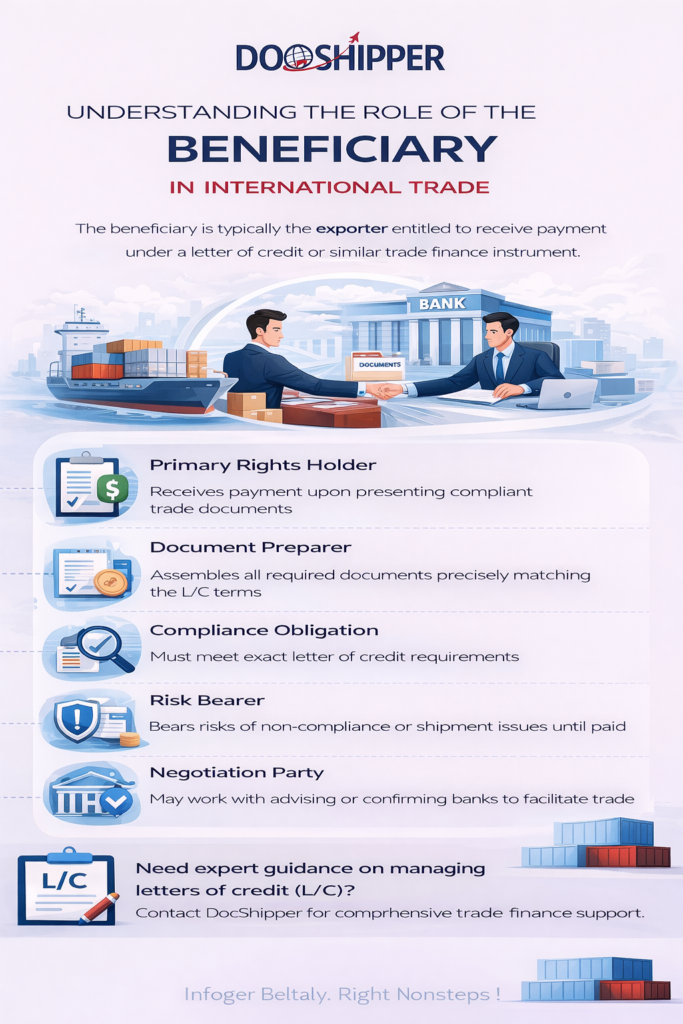
Key characteristics of the beneficiary include:
- Primary rights holder – entitled to receive payment upon document presentation
- Document preparer – responsible for assembling all required trade documents
- Compliance obligation – must meet all letter of credit stipulations exactly
- Risk bearer – assumes documentary and performance risks until payment
- Negotiation party – may negotiate documents through advising or confirming banks
Understanding Beneficiary Rights & Obligations
The beneficiary’s position derives from the documentary credit mechanism established under ICC Uniform Customs and Practice for Documentary Credits (UCP 600). This framework creates an autonomous payment obligation separate from the underlying sales contract.
Upon receiving letter of credit notification, the beneficiary must verify all terms are acceptable and achievable. The examination period typically allows 21 days after shipment to present documents. Banks have five banking days to examine documents for compliance.
The beneficiary’s presentation obligation requires strict documentary compliance. Banks examine documents on their face without reference to goods or services. Even minor discrepancies—misspelled company names, incorrect dates, or missing signatures—justify refusal.
Transfer and assignment rights allow beneficiaries flexibility. A transferable credit permits the first beneficiary to request the bank make the credit available to one or more second beneficiaries. This mechanism supports intermediary traders and supply chain financing.
The beneficiary also holds amendment rights. Any letter of credit modification requires beneficiary consent. At DocShipper, we systematically review amendment requests with clients to ensure commercial interests remain protected throughout the transaction lifecycle.
For authoritative guidance on beneficiary rights, consult the ICC UCP 600 official publication which establishes global documentary credit standards.
Practical Examples & Documentary Requirements
Understanding beneficiary obligations becomes clearer through concrete scenarios. Consider these typical situations exporters face when acting as beneficiaries.
Standard Documentary Requirements
| Document Type | Beneficiary Responsibility | Common Discrepancies |
|---|---|---|
| Commercial Invoice | Must match L/C description exactly; signed and dated | Amount exceeds credit, description variance |
| Bill of Lading | Obtain clean on-board B/L within shipment deadline | Late shipment date, wrong consignee |
| Insurance Certificate | Secure coverage for 110% CIF value minimum | Insufficient coverage, wrong beneficiary |
| Certificate of Origin | Obtain from authorized chamber within validity period | Expired certificate, unauthorized signatory |
| Packing List | Detail all packages with weights and measurements | Quantity mismatch with invoice |
Use Case: Electronics Export from China to Germany
Scenario: Chinese manufacturer (beneficiary) receives €150,000 irrevocable L/C from German buyer. Credit requires shipment within 30 days and document presentation within 21 days after shipment.
Beneficiary actions:
- Day 1-5: Verify L/C terms match sales contract; request amendments for any discrepancies
- Day 6-25: Manufacture goods; arrange pre-shipment inspection if required by L/C
- Day 26: Complete export customs clearance; obtain clean on-board bill of lading
- Day 27-30: Compile all documents; cross-check every detail against L/C stipulations
- Day 31: Present documents to negotiating bank before 21-day deadline
Result: Bank examination reveals one discrepancy—certificate of origin dated one day after B/L date. Beneficiary contacts applicant who accepts discrepancy. Payment released minus €200 discrepancy fee.
This case demonstrates why beneficiaries must maintain meticulous document control. At DocShipper, we conduct pre-presentation document audits to identify potential discrepancies before bank submission, significantly reducing rejection rates for our clients.
DocShipper Platform
Cut logistics costs. Not corners.
See exactly where your logistics costs are bleeding — and how to fix it. Book your expert demo.

Key Performance Indicators
- First presentation acceptance rate: Industry average 30-40%; best practice targets 85%+
- Average discrepancy resolution time: 7-14 days depending on applicant responsiveness
- Document preparation timeline: Professional beneficiaries allocate 5-7 days minimum
- Amendment frequency: 60% of L/Cs require at least one amendment during validity
- Payment delay cost: Discrepancies add €150-500 in bank fees plus financing costs
Conclusion
The beneficiary’s role demands precision, expertise, and proactive document management. Successful exporters treat documentary compliance as a core competency rather than administrative burden.
Need expert guidance on beneficiary obligations or documentary credit management? Contact DocShipper for comprehensive trade finance support.
📚 Quiz
Test Your Knowledge: Beneficiary
Q1 — In a letter of credit transaction, who is the beneficiary?
Q2 — A beneficiary presents documents to the bank with a minor spelling error in the company name. What is the most likely outcome?
Q3 — A Chinese manufacturer acting as beneficiary receives a €150,000 L/C. On Day 31, they discover their certificate of origin is dated one day after the bill of lading. What is the correct course of action?
🎯 Your Result
📞 Free Quote in 24hFAQ | Beneficiary: Definition, Role & Practical Examples in International Trade
Yes, but only if the letter of credit explicitly states it is "transferable." The first beneficiary can request the transferring bank make the credit available to second beneficiaries, though certain conditions and fees apply.
Late presentation constitutes a discrepancy. The bank will refuse documents unless the applicant waives this specific discrepancy. Payment becomes subject to applicant discretion rather than bank obligation.
Usually yes, but not always. The beneficiary receives payment while the shipper sends goods. In triangular trade arrangements, a middleman may be the beneficiary while a manufacturer acts as shipper.
Absolutely. If L/C terms differ from the sales contract or create unacceptable risks, the beneficiary should immediately request amendments or refuse the credit entirely before commencing performance.
The letter of credit itself provides primary protection—it represents a bank's independent payment undertaking. For additional security, beneficiaries can request confirmation from a bank in their own country.
No automatic right exists to correct discrepancies. The beneficiary must negotiate with the applicant for waiver or present entirely new compliant documents before the L/C expires, subject to presentation deadlines.
Generally no. Letters of credit name a single beneficiary. However, transferable credits allow the first beneficiary to designate second beneficiaries, and assignment of proceeds can direct payment to third parties.
The L/C stipulates required documents. Typical requirements include commercial invoice, transport document, and insurance document. Each credit specifies exact documents—there is no universal standard set.
No. Banks examine documents, not goods. The beneficiary must present documents that appear compliant on their face. Quality disputes relate to the sales contract, not documentary credit mechanics.
Common charges include advising fees, negotiation fees, discrepancy fees (if applicable), amendment fees, and transfer fees for transferable credits. Fee structures vary by bank and should be negotiated in advance.
Yes. Assignment of proceeds differs from transfer—it directs the paying bank to pay a third party after compliant presentation. The original beneficiary remains responsible for document presentation and compliance.
The beneficiary can challenge the rejection, potentially through legal action if the bank failed to follow UCP 600 examination standards. However, litigation is costly and time-consuming—prevention through meticulous preparation is preferable.
Need Help with
Logistics or Sourcing ?
First, we secure the right products from the right suppliers at the right price by managing the sourcing process from start to finish. Then, we simplify your shipping experience - from pickup to final delivery - ensuring any product, anywhere, is delivered at highly competitive prices.


Fill the Form
Prefer email? Send us your inquiry, and we’ll get back to you as soon as possible.
Contact us




