


In short ⚡
Beyond (B) is a shipping term indicating that cargo must be transported past the primary destination port to a final inland location. This designation appears on bills of lading and requires additional inland transportation arrangements beyond the initial ocean or air freight segment, impacting routing, costs, and delivery timelines.
Introduction
Many shippers assume ocean freight ends at the destination port. This misconception creates delays when cargo requires inland delivery. The Beyond (B) designation solves this coordination challenge by establishing clear responsibility for post-port transportation.
In international logistics, Beyond shipments represent a critical bridge between maritime/air transport and final delivery. This designation determines who arranges inland haulage, bears additional costs, and manages customs clearance at interior points.
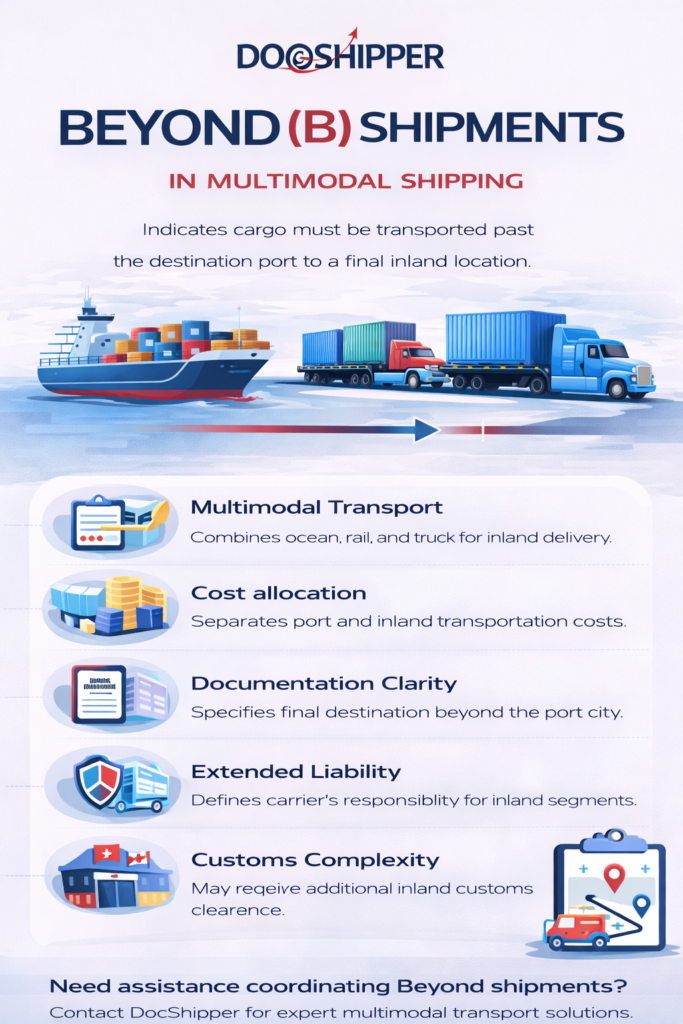
- Multimodal coordination: Combines ocean/air freight with rail or truck transport
- Cost allocation: Separates port charges from inland delivery expenses
- Documentation clarity: Specifies final destination beyond the port city
- Liability boundaries: Defines carrier responsibility across transport modes
- Customs implications: May require inland customs clearance procedures
Understanding Beyond Shipments: Mechanisms & Legal Framework
The Beyond designation activates when the bill of lading lists a final destination inland from the discharge port. This triggers specific contractual obligations between the ocean carrier and connecting inland carriers. The original carrier typically issues a through bill of lading covering the entire journey.
Under the Hague-Visby Rules and Hamburg Rules, carrier liability extends only to the port-to-port segment unless explicitly agreed otherwise. Beyond shipments require additional contractual arrangements, often governed by Incoterms® 2020 specifications that clarify risk transfer points.
Intermodal transport operators (ITOs) frequently manage Beyond shipments by coordinating multiple carriers. They issue a single contract covering ocean, rail, and trucking segments. This simplifies documentation but requires careful verification of each carrier’s insurance coverage and liability limits.
The Uniform Intermodal Interchange Agreement (UIIA) in North America standardizes container handoffs between ocean terminals and inland rail facilities. For Beyond shipments, this agreement defines equipment responsibility and damage liability during inland movement. At DocShipper, we verify UIIA compliance for all North American Beyond routes to prevent equipment-related disputes.
Customs territory considerations become complex with Beyond shipments. In the European Union, goods moving from Rotterdam to Munich remain within a single customs territory. However, shipments from Los Angeles to Toronto cross international borders, requiring separate customs entries. The Automated Commercial Environment (ACE) system manages U.S. customs clearance for Beyond shipments entering inland ports of entry.
Practical Applications & Cost Scenarios
Beyond shipments demonstrate significant cost variations depending on inland distance and transport mode. Consider three scenarios for a 40-foot container from Shanghai:
| Route | Ocean Freight | Inland Transport | Total Transit | Total Cost |
|---|---|---|---|---|
| Shanghai → Los Angeles (Port) | $2,800 | $0 | 18 days | $2,800 |
| Shanghai → Chicago (Beyond – Rail) | $2,800 | $1,200 | 25 days | $4,000 |
| Shanghai → Denver (Beyond – Truck) | $2,800 | $2,400 | 23 days | $5,200 |
Case Study: Electronics Importer — A Texas-based company imports LCD panels from Shenzhen to Dallas. The bill of lading specifies “Dallas, TX (B)” rather than “Houston, TX (Port).” The ocean carrier arranges rail transport from Houston to Dallas Union Pacific terminal. This Beyond designation adds 5 days transit but reduces warehousing costs by $800 per container compared to port pickup and separate trucking.
Cost breakdown analysis reveals Beyond shipments become economical when inland distance exceeds 200 miles. Rail-based Beyond routes offer 30-40% savings versus separate trucking arrangements. However, flexibility decreases—rail schedules operate on fixed timetables versus on-demand trucking.
Detention and demurrage risks multiply with Beyond shipments. Ocean carriers typically allow 5 free days at the port terminal. Beyond shipments consume 2-3 days in rail loading, reducing effective free time. At DocShipper, we coordinate Beyond movements to maximize free time utilization and avoid per-diem charges averaging $150 daily.
Seasonal capacity constraints affect Beyond routing. During peak agricultural harvest (September-November), Midwest rail capacity tightens, delaying Beyond shipments by 7-10 days. Alternative routing through Gulf Coast ports (Mobile, Savannah) with shorter inland legs can maintain schedule reliability.
Insurance considerations require verification that marine cargo policies extend to inland Beyond segments. Standard policies cover “warehouse to warehouse” but may exclude specific rail or truck carriers. Supplemental inland marine insurance costs approximately 0.15-0.25% of cargo value for Beyond routes.
Conclusion
Beyond shipments optimize logistics by consolidating ocean and inland transport under unified documentation. Understanding cost structures, transit times, and liability frameworks enables informed routing decisions that balance speed against economy.
Need assistance coordinating Beyond shipments or evaluating inland routing options? Contact DocShipper for expert guidance on multimodal transport solutions.
DocShipper Platform
Optimize Your Global Logistics with Cutting-Edge Solutions
Enhance efficiency, cut costs, and gain 24/7 visibility 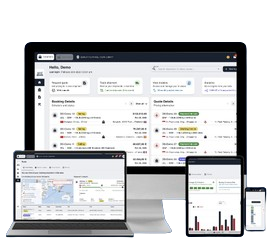 over your entire supply chain.
- Cut your shipping costs and maximize your margins
- Manage sourcing, freight, & customs on one platform
- Get real-time tracking and analytics
📚 Quiz
Test Your Knowledge: Beyond (B) in Shipping
Q1 — What does the "Beyond (B)" designation on a bill of lading indicate?
Q2 — A shipper assumes their marine cargo insurance automatically covers the full Beyond route, including the inland rail segment. Is this correct?
Q3 — A Texas importer ships LCD panels from Shenzhen. The bill of lading reads "Dallas, TX (B)" instead of "Houston, TX (Port)." What is the most accurate interpretation of this scenario?
🎯 Your Result
📞 Free Quote in 24hFAQ | Beyond (B) in Shipping: Definition, Application & Concrete Examples
IPI specifically refers to rail-based inland transport in North America, while Beyond (B) encompasses any inland movement past the port—rail, truck, or barge. IPI always involves containerized rail, whereas Beyond may use break-bulk trucking.
Payment responsibility depends on the Incoterm. Under DDP (Delivered Duty Paid), the seller covers Beyond costs. With FOB or CIF terms, the buyer arranges and pays for inland transport beyond the destination port.
Yes, U.S. Customs allows clearance at inland ports of entry for Beyond shipments. The Automated Commercial Environment (ACE) system processes entries at facilities like Chicago IIT or Dallas CFS, reducing port congestion.
Add 3-7 days for rail-based Beyond routes and 1-3 days for truck transport. Rail schedules operate weekly, so timing mismatches can extend delays. Ocean carriers publish Beyond transit matrices showing combined ocean-plus-inland durations.
A through bill of lading listing the final inland destination, commercial invoice, packing list, and any required inland customs entries. Rail carriers issue rail waybills as supplementary documentation for the inland segment.
Yes, especially for high-volume shippers. Carriers bundle ocean and inland rates into all-inclusive Beyond quotes. Negotiating annual contracts with minimum volume commitments yields 15-25% savings versus spot Beyond rates.
Liability depends on where damage occurred. Ocean carriers cover port-to-port, while inland carriers assume responsibility after container handoff. Inspect containers at interchange points and document damage immediately to establish liability.
Standard dry containers, refrigerated units, and open-top containers all support Beyond routing. However, overweight containers may face rail restrictions—most U.S. rail networks limit gross weight to 67,200 lbs for Beyond movements.
Severe congestion delays container release for inland transport. Beyond shipments waiting for rail loading can incur 5-10 day delays during peak congestion. Alternative routing through less congested ports maintains schedule reliability.
MLB routes move cargo from Asia to U.S. West Coast ports, then rail to East Coast destinations—faster than all-water Panama Canal routing. MLB Beyond shipments save 7-12 days versus traditional East Coast port discharge.
Most ocean carriers provide GPS tracking through the ocean segment. Rail carriers like Union Pacific and BNSF offer separate tracking for the inland Beyond portion. Integration platforms consolidate both segments into unified visibility dashboards.
Rail-based Beyond transport produces 75% less CO2 per ton-mile than trucking equivalent distances. For sustainability-focused supply chains, Beyond rail routes significantly reduce carbon footprint compared to port pickup plus long-haul trucking.
Need Help with
Logistics or Sourcing ?
First, we secure the right products from the right suppliers at the right price by managing the sourcing process from start to finish. Then, we simplify your shipping experience - from pickup to final delivery - ensuring any product, anywhere, is delivered at highly competitive prices.


Fill the Form
Prefer email? Send us your inquiry, and we’ll get back to you as soon as possible.
Contact us




%20Shipping:%20Definition%20&%20Guide%20for%202026)