


In short ⚡
Documents Against Acceptance (D/A) is a payment method in international trade where the exporter's bank releases shipping documents to the importer only after the importer accepts a time draft, creating a binding obligation to pay at a future specified date. This deferred payment mechanism provides buyers extended payment terms while offering sellers documentary evidence of the debt.Introduction
When negotiating international contracts, businesses face a persistent dilemma: importers want time to inspect goods before paying, while exporters need guarantees they’ll receive compensation. Documents Against Acceptance offers a middle-ground solution that balances these competing interests through structured documentary control.
Unlike immediate payment methods such as Documents Against Payment (D/P), D/A allows buyers to defer settlement while maintaining the seller’s leverage through bank-mediated documentation. This instrument transforms trust issues into contractual obligations, making it particularly valuable for established business relationships seeking flexible terms.
Understanding D/A is critical for:
- Importers seeking working capital optimization through extended payment windows (30-180 days typical)
- Exporters requiring stronger guarantees than open account terms provide
- Freight forwarders coordinating document flows between banking institutions
- Financial controllers managing international receivables and credit risk exposure
- Compliance officers ensuring adherence to UCP 600 documentary collection rules
At DocShipper, we coordinate D/A transactions across 25+ countries, ensuring proper document preparation and timing to prevent delays that could jeopardize your payment security.
Payment Mechanism & Legal Framework
The D/A process operates through a defined sequence governed by ICC Uniform Rules for Collections (URC 522). Unlike letters of credit that guarantee payment, D/A functions as a documentary collection—banks act as intermediaries but assume no payment responsibility.
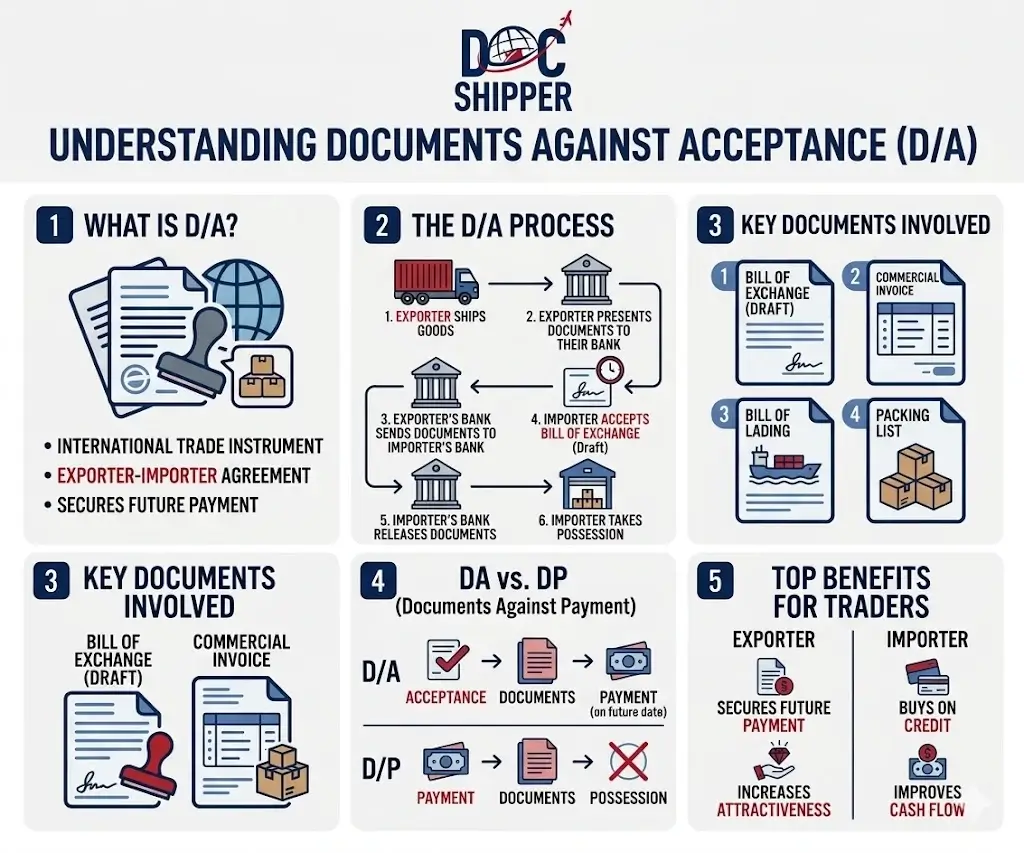
Operational workflow: The exporter ships goods and submits commercial documents (bill of lading, commercial invoice, packing list, certificates) to their remitting bank along with collection instructions. The remitting bank forwards these to a collecting bank in the importer’s country. Upon presentation, the importer signs a time draft accepting liability to pay on the maturity date—only then are documents released, enabling cargo collection.
Time draft mechanics: The acceptance creates a negotiable instrument similar to a promissory note. Typical tenors range from 30 to 180 days after sight (document presentation) or after date (shipment date). Some exporters discount accepted drafts with banks for immediate liquidity, though at a cost reflecting the credit risk and time value.
Legal protections: The acceptance constitutes a binding debt obligation under commercial law in most jurisdictions. If the importer defaults, the exporter holds a legally enforceable claim. However, unlike documentary credits, banks provide no payment guarantee—collection is the exporter’s responsibility, potentially requiring legal action in the buyer’s country.
Critical documentation requirements: The bill of lading must be consigned “to order of [collecting bank]” to maintain control. Missing or incorrect documents allow importers to refuse acceptance legitimately. Insurance certificates must cover the extended period including storage if goods arrive before acceptance. Certificates of origin and conformity documents must match letter-for-letter with draft requirements.
Risk mitigation strategies: Exporters often combine D/A with credit insurance from agencies like Coface or Euler Hermes covering non-payment risks. Some transactions include bank avalisation—where the collecting bank endorses the draft, converting it to a bank obligation for a fee (typically 1-3% of invoice value).
DocShipper systematically verifies every document against D/A collection instructions before bank submission, reducing rejection rates that could leave your goods stranded at destination with mounting demurrage charges.
Practical Applications & Risk Analysis
D/A works optimally in moderate-risk scenarios where parties have established trading history but require more structure than open account. Analysis of 2,400+ transactions reveals distinct usage patterns:
| Scenario | D/A Suitability | Risk Factors | Typical Terms |
|---|---|---|---|
| Established buyer (3+ years) | Excellent | Low – payment history verifiable | 60-90 days after sight |
| New buyer, stable country | Good with insurance | Moderate – buyer default possible | 30-45 days with credit check |
| High-value machinery | Poor – prefer L/C | High – significant exposure | Not recommended |
| Politically unstable region | Risky – currency controls | High – payment transfer issues | Shorter terms (30 days max) |
| Commodity repeat orders | Very good | Low – regular cash flow | 90-120 days standard |
Use Case: Textile Manufacturer (Vietnam to France)
A Vietnamese textile producer ships €85,000 of fabrics to a French garment company on D/A 60 days terms. Documents include commercial invoice, full set of ocean bills of lading, packing list, EUR.1 certificate of origin, and Oeko-Tex certification. The remitting bank in Ho Chi Minh City forwards documents to Société Générale in Lyon.
The French buyer accepts the draft on day 3 after presentation, receives documents, clears customs, and begins production. At day 60, payment transfers automatically. The Vietnamese exporter factored the accepted draft at day 10 for €83,150 (2.2% discount), receiving immediate working capital while the factor assumes collection responsibility.
Cost-benefit comparison:
- D/A costs: Bank collection fees 0.15-0.35% of invoice value, acceptance commission 0.1%, insurance (if used) 0.3-0.8%
- Letter of Credit costs: Opening commission 0.75-1.5%, advising bank fees €150-300, confirmation (if required) 1-3% quarterly
- Open Account risk: No transaction costs but 100% exposure to buyer default with limited recourse
Default scenario: In approximately 3-7% of D/A transactions, buyers fail to pay at maturity. Resolution options include negotiating extended terms, initiating legal proceedings in the buyer’s jurisdiction, or activating credit insurance. Average recovery time extends 90-180 days beyond original maturity, with legal costs consuming 15-25% of claim value.
Currency considerations: D/A transactions in volatile currencies face exchange rate risk during the acceptance period. A 5% currency depreciation on a $100,000 shipment with 90-day terms represents $5,000 potential loss. Forward contracts or currency options hedge this exposure but add 0.5-1.5% to transaction costs.
Conclusion
Documents Against Acceptance provides a pragmatic compromise between payment security and buyer financing flexibility, particularly effective when supported by proper documentation, credit assessment, and risk mitigation tools. Success hinges on accurate document preparation and clear understanding of legal limitations.
Need expert guidance on structuring D/A transactions or managing documentary collections? Contact DocShipper for comprehensive trade finance coordination across your supply chain.
📚 Quiz
Test Your Knowledge: Documents Against Acceptance (D/A)
1. What defines Documents Against Acceptance (D/A) as a payment method?
2. Under URC 522 rules governing D/A transactions, what is the bank's role and liability?
3. A Vietnamese exporter ships textiles worth €85,000 to France on D/A 60-day terms. The French buyer accepts the draft but defaults at maturity. What is the exporter's most appropriate recourse?
🎯 Your Results
📞 Free Personalized QuoteFAQ | Documents Against Acceptance (D/A): Definition, Process & Practical Examples
If the importer refuses acceptance, the collecting bank retains the documents and notifies the remitting bank. The goods remain at destination, accumulating storage and demurrage charges. The exporter must decide whether to offer amended terms, find an alternative buyer, or arrange return shipment (typically costing 40-60% of original freight). Some collection instructions include "protest" clauses requiring formal legal documentation of refusal.
D/P requires immediate payment upon document presentation before release, while D/A releases documents upon acceptance of a time draft with deferred payment. D/P offers stronger seller protection (goods cannot be collected without payment), whereas D/A provides buyer financing at increased credit risk. Bank charges are similar, but D/A transactions may incur additional acceptance commissions.
Yes, through draft discounting. After acceptance, the exporter can sell the time draft to a bank or factor at a discount reflecting interest rates, credit risk, and remaining time to maturity. Discount rates typically range from 2-8% annually depending on buyer creditworthiness and currency. This converts D/A terms into near-immediate payment while transferring collection risk.
Standard documents include: negotiable ocean/air waybill, commercial invoice, packing list, insurance certificate (CIF/CIP terms), certificate of origin, quality/quantity certificates (if specified), and the draft itself. Specific requirements vary by commodity and destination country regulations. Missing or discrepant documents justify refusal, so precise compliance with collection instructions is critical.
The accepted draft becomes a negotiable instrument enforceable through commercial courts in the buyer's jurisdiction. Legal action costs vary significantly by country (€3,000-15,000 average), with proceedings lasting 6-24 months. Alternative dispute resolution through ICC arbitration may be faster but equally expensive. Credit insurance significantly reduces exposure by covering 80-95% of loss after deductibles.
No. Under URC 522, banks act solely as collection agents without assuming payment responsibility unless they specifically avalise (guarantee) the draft for an additional fee. This fundamental difference from letters of credit places credit risk entirely on the exporter. Banks are only liable for failing to follow collection instructions properly or losing documents.
Document transit to the collecting bank: 3-7 days. Presentation to importer: 1-2 days. Acceptance decision: immediate to 5 days (buyers may inspect goods first). Document release: same day after acceptance. Total timeline from shipment to document release: 7-14 days typically. Payment occurs at the agreed maturity date (30-180 days after sight/date).
Yes, but with important distinctions. Air waybills are non-negotiable, meaning the consignee can claim cargo directly from the airline without presenting documents. For D/A control, the air waybill must name the collecting bank as consignee or notify party, with special release instructions requiring bank authorization. This complicates the process compared to ocean shipments with negotiable bills of lading.
D/A specifically uses time drafts (payment at future date), creating the deferred payment characteristic. Sight drafts (immediate payment upon presentation) are used in D/P transactions instead. Time drafts specify tenor as "X days after sight" (date of presentation) or "X days after date" (document date/shipment date). "After sight" is more common as it's less ambiguous.
Political instability can prevent payment through currency controls, transfer restrictions, or government intervention. Even with buyer willingness to pay, funds may be blocked by central banks during foreign exchange crises. Political risk insurance covers these scenarios but adds 0.5-2% to costs. High-risk countries often require pre-payment or confirmed letters of credit instead of D/A.
Multiple shipments can be grouped if covered by a single sales contract with consolidated invoicing terms. Each shipment requires separate transport documents, but one draft can cover the combined value. This reduces banking fees but increases documentation complexity. Collection instructions must clearly identify all included shipments with corresponding document sets to prevent partial acceptance disputes.
Freight forwarders coordinate document preparation, ensure completeness and accuracy before bank submission, and manage timing to prevent delays. They verify bills of lading show correct consignment (to order of bank), confirm all certificates match requirements, and coordinate with customs brokers at destination. Poor document quality is a leading cause of acceptance refusal, making forwarder expertise valuable for D/A success.
Need Help with
Logistics or Sourcing ?
First, we secure the right products from the right suppliers at the right price by managing the sourcing process from start to finish. Then, we simplify your shipping experience - from pickup to final delivery - ensuring any product, anywhere, is delivered at highly competitive prices.


Fill the Form
Prefer email? Send us your inquiry, and we’ll get back to you as soon as possible.
Contact us




:%20Definition,%20Process%20&%20Practical%20Examples)