


In short ⚡
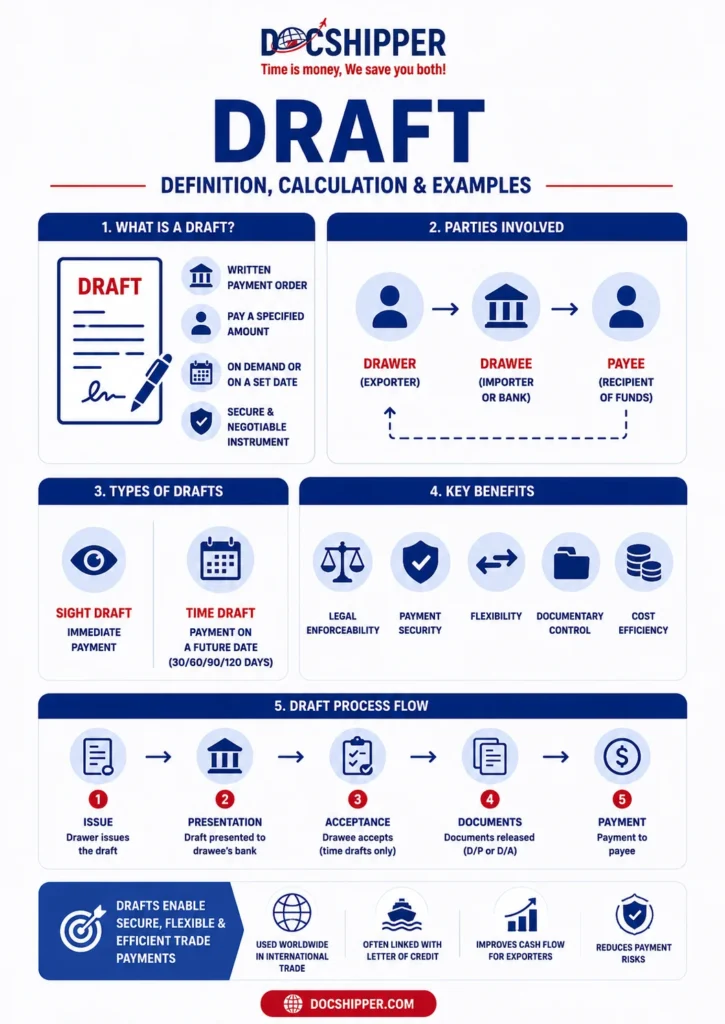
A draft is a written payment order issued by a drawer (exporter) instructing a drawee (typically the importer or their bank) to pay a specified amount to a payee at a determined time. In international trade, drafts serve as negotiable instruments facilitating secure transactions, often used with letters of credit to ensure payment compliance before goods are released.
Introduction
Confusion often arises between drafts, bills of exchange, and promissory notes in cross-border transactions. A single documentation error can delay cargo release for weeks, freezing capital and disrupting supply chains.
Drafts remain fundamental to international trade finance, providing structured payment mechanisms that balance risk between exporters and importers. They function as conditional payment instruments, particularly within documentary credit frameworks.
- Payment security: Drafts establish legally enforceable payment obligations between parties across jurisdictions
- Timing flexibility: Available as sight drafts (immediate payment) or time drafts (deferred payment after acceptance)
- Trade finance integration: Commonly paired with letters of credit, providing banks control over payment release
- Negotiability: Can be endorsed and transferred, enabling discounting and financing options before maturity
- Documentary control: Payment is contingent upon presentation of compliant shipping documents
Mechanisms & Trade Finance Expertise
Drafts operate within the Uniform Customs and Practice for Documentary Credits (UCP 600), the international standard governing letters of credit. Published by the International Chamber of Commerce, this framework defines how drafts must be presented, examined, and honored.
The essential parties to a draft include the drawer (exporter who creates the draft), the drawee (importer or their bank obligated to pay), and the payee (party receiving payment, often the drawer themselves or their financing bank). This triangular relationship creates enforceable obligations across borders.
Sight drafts require immediate payment upon presentation and verification of documents. Banks typically process these within 5-7 banking days after document submission. In contrast, time drafts (also called usance drafts) specify a future payment date, commonly 30, 60, 90, or 120 days after sight or after the bill of lading date.
The acceptance process is critical for time drafts. The drawee bank stamps “Accepted” on the draft with date and signature, transforming it into a banker’s acceptance—a highly secure financial instrument. This accepted draft becomes a marketable security that exporters can discount for immediate cash flow.
At DocShipper, we systematically verify draft compliance with letter of credit terms before document submission, preventing the 40% rejection rate that occurs from minor discrepancies like incorrect amounts, dates, or missing endorsements.
The discounting mechanism allows exporters to receive immediate payment by selling accepted time drafts to banks or financial institutions at a discount. The discount rate depends on the drawee bank’s creditworthiness, prevailing interest rates, and remaining time until maturity. According to ICC Banking Commission data, typical discounting rates range from 2-8% annually above the base rate.
Practical Examples & Comparative Data
Understanding how drafts function in real transactions clarifies their practical value. Consider a French electronics exporter shipping €500,000 of components to a Brazilian importer under a 90-day time draft backed by an irrevocable letter of credit.
| Draft Type | Payment Timing | Exporter Cash Flow | Importer Advantage | Typical Use Case |
|---|---|---|---|---|
| Sight Draft | 5-7 days after presentation | Immediate upon document compliance | None—payment required before goods release | High-value shipments, new trade relationships |
| 30-Day Time Draft | 30 days after acceptance | Can discount at ~96-98% of face value | Short working capital extension | Perishable goods, fast-moving inventory |
| 90-Day Time Draft | 90 days after acceptance | Can discount at ~92-95% of face value | Extended payment terms for resale | Capital equipment, manufacturing inputs |
| 180-Day Time Draft | 180 days after acceptance | Can discount at ~88-92% of face value | Maximum flexibility for downstream sales | Large industrial projects, seasonal goods |
Case Study: Electronics Export with Draft Discounting
Transaction details: €500,000 shipment with 90-day time draft. After shipping and document presentation, the Brazilian importer’s bank accepts the draft. The French exporter needs immediate cash flow rather than waiting 90 days.
The exporter approaches their bank to discount the accepted draft. With a 4.5% annual discount rate, the calculation is: Discount = €500,000 × 0.045 × (90/365) = €5,548. The exporter receives €494,452 immediately, sacrificing €5,548 for instant liquidity.
This mechanism proves invaluable for exporters with tight working capital. Industry data shows 68% of SME exporters utilize draft discounting to maintain operational cash flow, particularly when dealing with emerging market buyers requiring extended payment terms.
Comparative analysis reveals that sight drafts eliminate financing costs but may reduce competitiveness against suppliers offering terms. Time drafts increase sales opportunities but require credit assessment capabilities. At DocShipper, we help clients balance these considerations based on buyer creditworthiness and their own financial capacity.
The regulatory landscape also impacts draft usage. Under EU regulations and the Basel III banking standards, banks must maintain capital reserves against trade finance exposures. This influences the costs and availability of draft acceptance and discounting services.
Conclusion
Drafts remain essential instruments in international trade, providing structured payment mechanisms that balance security with flexibility. Their integration with letters of credit and discounting options enables businesses to optimize both risk management and cash flow across global supply chains.
Need guidance on implementing draft-based payment terms in your import/export operations? Contact DocShipper for expert trade finance consultation.
📚 Quiz
Test Your Knowledge: Draft
A draft is best defined as:
What is the primary difference between a sight draft and a time draft?
A French exporter has a 90-day time draft worth €500,000 that has been accepted by the importer's bank. The exporter needs immediate cash flow. What is their best option?
🎯 Your Result
📞 Free Quote in 24hFAQ | Draft: Definition, Calculation & Practical Examples
These terms are functionally synonymous in international trade. "Draft" is predominantly used in North American practice, while "bill of exchange" is the traditional term in British and European commerce. Both refer to the same instrument: a written order directing payment from one party to another. The UCP 600 uses "draft" as the standard terminology.
Yes, but with significantly higher risk. Clean drafts (those not accompanied by a letter of credit) rely solely on the importer's creditworthiness and willingness to pay. Banks typically charge higher fees for handling clean drafts and may refuse to discount them without additional guarantees. Documentary collections using drafts without L/Cs offer moderate security through bank involvement in document exchange.
When an importer's bank accepts a time draft, it creates a contingent liability on the importer's balance sheet. This acceptance typically consumes credit facility limits, reducing available financing for other transactions. Most banks require collateral or maintain reserve requirements against outstanding accepted drafts, making it crucial for importers to plan their credit capacity across multiple shipments.
Refusal triggers dishonor proceedings. For drafts under letters of credit, the issuing bank must still honor payment if documents comply with L/C terms, regardless of the applicant's (importer's) willingness. For clean drafts or those outside L/C frameworks, the exporter must pursue legal remedies, potentially initiating arbitration or litigation. Dishonored drafts must be protested—a formal notarial act documenting nonpayment—to preserve legal rights against all liable parties.
Yes, increasingly so. The UNCITRAL Model Law on Electronic Transferable Records (MLETR) provides a framework for digital equivalents of paper-based instruments including drafts. Several jurisdictions have implemented this framework, allowing eUCP-compliant electronic presentations. However, adoption remains uneven globally, and many banks still require paper originals for certain transactions, particularly in markets with less developed digital infrastructure.
Currency mismatches introduce exchange rate risk. If a draft is denominated in USD but the underlying commercial invoice is in EUR, fluctuations between document preparation and payment can create gains or losses. Letters of credit typically specify the draft currency, which must match L/C terms. Hedging instruments like forward contracts can mitigate this risk, though they add transaction costs of 0.5-2% depending on currency pair volatility.
Required documents depend on the governing trade finance instrument. Under letters of credit, drafts must be accompanied by documents specified in the L/C: typically commercial invoice, bill of lading or air waybill, packing list, certificate of origin, and insurance certificate. For documentary collections, the collection instruction specifies required documents. Missing or non-compliant documents lead to rejection, delaying payment by weeks while corrections are made.
Yes, drafts are negotiable instruments under the Bills of Exchange Act and equivalent legislation globally. Endorsement transfers rights to subsequent holders. "Order" drafts (payable "to the order of" a named party) require endorsement for transfer. "Bearer" drafts transfer by simple delivery. This negotiability enables secondary markets for accepted drafts, though transfers must comply with anti-money-laundering regulations requiring documentation of all endorsers.
Draft discounting typically costs less than unsecured working capital loans but more than asset-based lending secured by inventory. Rates depend on the accepting bank's credit rating—drafts accepted by major international banks discount at LIBOR/SOFR plus 1-3%, while regional bank acceptances may incur 4-8% spreads. This compares favorably to supply chain finance platforms (3-6%) and factoring services (5-12%), making discounted drafts competitive for exporters with strong banking relationships.
This varies by jurisdiction. Under the Uniform Commercial Code (United States), actions on drafts must be initiated within six years for demand instruments and within six years after due date for time instruments. The UK Bills of Exchange Act specifies six years. However, international transactions may involve multiple jurisdictions, and choice of law provisions in the underlying contract determine which statute applies. Timely protest and notification of dishonor are essential to preserve claims.
Protection depends on the draft structure. Sight drafts under confirmed letters of credit provide maximum protection—the confirming bank guarantees payment regardless of applicant insolvency. Time drafts carry exposure during the acceptance period; if the importer declares bankruptcy after goods ship but before acceptance, the exporter may become an unsecured creditor. Bank-accepted drafts shift this risk to the financial institution, making them more secure than trade acceptances where the importer directly accepts the obligation.
Tariff changes can create disputes over payment amounts. If duties increase between contract signing and goods arrival, importers may resist paying the draft's face value, arguing for price adjustments. Well-drafted Incoterms clauses and L/C provisions should specify who bears duty changes and establish amendment procedures. Recent Section 301 tariffs on Chinese goods created numerous L/C amendment requests, delaying payments by 15-30 days on average while parties negotiated cost allocation.
Need Help with
Logistics or Sourcing ?
First, we secure the right products from the right suppliers at the right price by managing the sourcing process from start to finish. Then, we simplify your shipping experience - from pickup to final delivery - ensuring any product, anywhere, is delivered at highly competitive prices.


Fill the Form
Prefer email? Send us your inquiry, and we’ll get back to you as soon as possible.
Contact us




