


In short ⚡
A draft at sight is a negotiable payment instrument requiring immediate settlement upon presentation to the drawee. Unlike time drafts offering deferred payment terms, sight drafts obligate the payer to remit funds instantly, making them essential for securing transactions in international trade where credit risk must be minimized.
Introduction
Imagine shipping $50,000 worth of machinery to a new client overseas. How do you guarantee payment without extending credit? Many exporters face this dilemma when trading with unfamiliar partners.
The sight draft emerged as a solution to balance commercial relationships with financial security. This payment instrument bridges the gap between trust and risk management in cross-border transactions.
Key characteristics of sight drafts include:
- Immediate payment obligation – Settlement required upon presentation
- Documentary control – Often paired with shipping documents via banks
- Legal enforceability – Governed by international commercial law
- Risk mitigation – Reduces seller’s exposure to non-payment
- Trade facilitation – Enables transactions between unknown parties
Payment Mechanisms & Legal Framework
A sight draft operates through a structured documentary process. The exporter (drawer) prepares the draft instructing the importer (drawee) to pay a specified amount to a designated payee—typically the exporter or their bank.
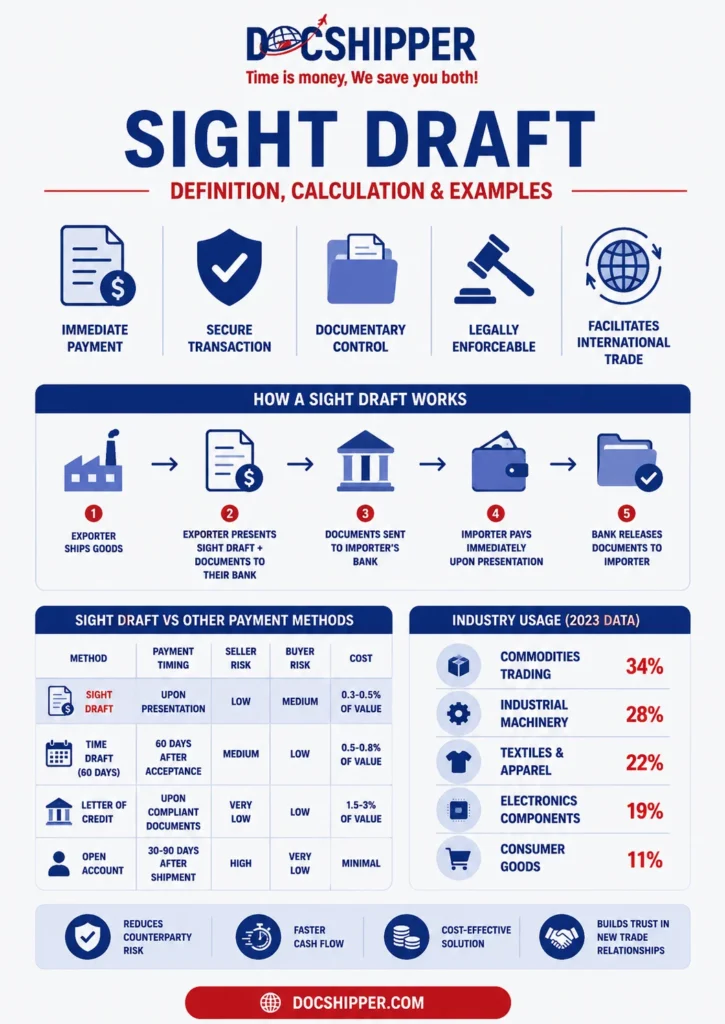
The presentation mechanism follows a precise sequence. Upon shipment, the exporter submits the draft alongside commercial documents to their bank. These documents travel through banking channels to the importer’s bank, which notifies the buyer. Payment must occur before the importer receives title documents.
Legal foundations rest on the Uniform Customs and Practice for Documentary Credits (UCP 600), published by the International Chamber of Commerce. This framework standardizes documentary credit operations across 175+ countries.
The documentary collection process distinguishes sight drafts from other payment methods. Banks act as intermediaries, not guarantors. The collecting bank releases documents only against payment (D/P terms) or acceptance (D/A terms). With sight drafts under D/P terms, release occurs instantly upon payment.
Payment finality represents a critical advantage. Once the drawee honors the sight draft, the transaction completes irreversibly. This contrasts with open account terms where disputes can delay payment for months.
At DocShipper, we structure documentary collections to match your risk tolerance. Our trade finance specialists verify draft language and document conformity before submission, preventing the rejections that delay 23% of first-time collections.
The regulatory landscape varies by jurisdiction. European transactions follow EU Payment Services Directive standards, while U.S. drafts comply with Uniform Commercial Code Article 3. These frameworks ensure enforceability while protecting both parties’ interests.
Practical Examples & Data
Real-world applications demonstrate how sight drafts function across industries and transaction values. The following scenarios illustrate typical use cases.
Use Case: Electronics Export from South Korea to Brazil
A Seoul-based manufacturer ships $180,000 in smartphone components to a São Paulo distributor. Having no prior relationship, both parties agree on documentary collection terms with a sight draft.
Transaction flow:
- Day 0 – Exporter ships goods via ocean freight, obtains bill of lading
- Day 2 – Exporter presents sight draft ($180,000) plus documents to Korea Exchange Bank
- Day 8 – Documents arrive at Banco do Brasil in São Paulo
- Day 9 – Importer receives payment notification, remits funds immediately
- Day 9 – Bank releases bill of lading; importer clears customs
Total settlement time: 9 days versus 45-60 days typical for open account terms. The exporter’s cash flow improved by 83% compared to standard credit terms.
Comparative Payment Methods
| Payment Method | Payment Timing | Seller Risk | Buyer Risk | Cost |
|---|---|---|---|---|
| Sight Draft | Upon presentation | Low | Medium | 0.3-0.5% of value |
| Time Draft (60 days) | 60 days after acceptance | Medium | Low | 0.5-0.8% of value |
| Letter of Credit | Upon compliant documents | Very Low | Low | 1.5-3% of value |
| Open Account | 30-90 days after shipment | High | Very Low | Minimal |
Industry Application Data
According to 2023 trade finance surveys, sight drafts represent 18% of payment methods in emerging market transactions. Adoption varies significantly by sector:
- Commodities trading – 34% usage rate due to high transaction values
- Industrial machinery – 28% adoption for capital equipment exports
- Textiles and apparel – 22% usage in Asia-Europe trade lanes
- Electronics components – 19% preference for B2B transactions
- Consumer goods – 11% utilization in established relationships
DocShipper processes documentary collections across 40+ countries, ensuring compliance with local banking regulations and reducing document discrepancies by 67% through pre-submission verification.
Conclusion
Sight drafts provide exporters with immediate payment security while maintaining competitive positioning. Their documentary structure reduces counterparty risk without the cost burden of letters of credit.
Need guidance structuring your international payment terms? Contact DocShipper’s trade finance team for customized solutions.
📚 Quiz
Test Your Knowledge: Draft at Sight
What is the primary defining characteristic of a draft at sight?
In a documentary collection using a sight draft under D/P (Documents against Payment) terms, what is the bank's role?
A European machinery exporter is shipping €85,000 worth of equipment to a new distributor in Morocco. The exporter wants to minimize credit risk but finds letters of credit too expensive. Which scenario correctly applies a sight draft?
🎯 Your Result
📞 Free Quote in 24hFAQ | Draft at Sight: Definition, Calculation & Practical Examples
A sight draft requires immediate payment upon presentation, while a time draft allows deferred payment (e.g., 30, 60, or 90 days after acceptance). Sight drafts eliminate credit risk but require the buyer to have immediate liquidity. Time drafts function as short-term financing instruments, with the seller accepting delayed payment in exchange for the buyer's formal acceptance obligation.
Standard processing ranges from 7-14 business days from shipment to payment, depending on banking channels and document accuracy. The timeline includes document preparation (1-2 days), courier transit between banks (3-7 days), buyer notification and payment (1-3 days), and fund settlement (1-2 days). Electronic document presentation through platforms like Bolero can reduce this to 5-7 days.
Yes, but with significant consequences. Refusal typically stems from document discrepancies or disputes over goods quality. If the buyer refuses payment without valid grounds, they cannot obtain shipping documents or take possession of goods. The seller retains title and can pursue legal remedies. Banks document all refusals, impacting the buyer's commercial credit profile.
Standard document sets include the commercial invoice, packing list, bill of lading or airway bill, insurance certificate (if CIF terms), certificate of origin, and any required inspection certificates. Industry-specific documents may include phytosanitary certificates for agricultural products or material safety data sheets for chemicals. The sight draft itself lists all accompanying documents.
Yes, under international conventions including the Geneva Convention on Bills of Exchange and the UN Convention on International Bills of Exchange. Most countries recognize sight drafts as negotiable instruments under their commercial codes. Enforcement mechanisms vary by jurisdiction, but the draft's documentary nature provides stronger legal standing than open account invoices in cross-border disputes.
Typical costs include remitting bank charges ($75-150), collecting bank fees ($100-200), document courier expenses ($50-100), and optional trade finance insurance (0.3-0.8% of invoice value). Total costs usually range from 0.5-1.2% of the transaction value. These fees are lower than letter of credit charges but higher than wire transfer costs for open account payments.
A sight draft involves banks as document handlers only, not payment guarantors. The buyer's bank has no obligation to pay if the buyer refuses. Letters of credit create bank payment commitments independent of the buyer's willingness or ability to pay, providing sellers with bank-guaranteed security. This fundamental difference makes letters of credit more expensive but substantially safer for exporters.
While technically possible, sight drafts become cost-prohibitive for shipments below $10,000 due to fixed banking fees. For smaller transactions, alternative methods like wire transfers with advance payment or online payment platforms (PayPal, TransferWise) offer better cost efficiency. Sight drafts typically make economic sense for transactions exceeding $15,000-20,000 where the security benefit justifies the processing costs.
Banks notify both parties of any discrepancies between draft instructions and presented documents. The collecting bank contacts the remitting bank, which consults the exporter. Options include correcting documents, requesting the buyer accept documents "as is," or shipping replacement documents. Approximately 60% of first presentations contain minor discrepancies. This delays payment by 5-10 additional days on average.
No, sight drafts require payment, not acceptance. The concept of "acceptance" applies to time drafts where the drawee formally acknowledges the obligation to pay at a future date. With sight drafts, the drawee must pay immediately upon presentation. The presenting bank releases shipping documents only after receiving payment, eliminating the acceptance step entirely.
Yes, increasingly through platforms complying with the eUCP (Electronic Supplement to UCP 600). Digital trade platforms like ICC's Digital Standards Initiative and SWIFT's Trade Innovation program enable electronic sight draft presentation. Adoption rates remain low (estimated 12% of global trade) due to regulatory inconsistencies and bank technology limitations, but growth accelerates as digitalization mandates expand.
Risk allocation depends on Incoterms, not the payment method. Under CIF terms, the seller arranges insurance, but risk transfers to the buyer once goods cross the ship's rail. The sight draft payment obligation remains regardless of goods condition—the buyer must pay to obtain documents, then file insurance claims separately. This makes cargo insurance essential when using sight drafts under FOB or CFR terms.
Need Help with
Logistics or Sourcing ?
First, we secure the right products from the right suppliers at the right price by managing the sourcing process from start to finish. Then, we simplify your shipping experience - from pickup to final delivery - ensuring any product, anywhere, is delivered at highly competitive prices.


Fill the Form
Prefer email? Send us your inquiry, and we’ll get back to you as soon as possible.
Contact us




