


In short ⚡
Dynamic Process Control (DPC) is an advanced logistics methodology that enables real-time monitoring, analysis, and adjustment of supply chain operations. By leveraging IoT sensors, AI algorithms, and automated decision-making systems, DPC continuously optimizes processes such as inventory management, shipment tracking, and warehouse operations, ensuring maximum efficiency and rapid response to disruptions.Introduction
Traditional supply chain management relies on periodic reviews and manual interventions, creating delays that cost businesses millions annually. When shipments face unexpected customs holds or warehouse congestion, static systems cannot adapt quickly enough to prevent cascading failures.
Dynamic Process Control transforms logistics from reactive firefighting into proactive optimization. This approach integrates real-time data streams with predictive analytics, enabling businesses to adjust operations before problems escalate. In international trade, where variables multiply across borders, currencies, and regulations, DPC becomes essential for maintaining competitive advantage.
Key characteristics of effective Dynamic Process Control systems include:
- Continuous monitoring of all supply chain touchpoints through connected sensors and tracking devices
- Automated decision-making based on predefined rules and machine learning algorithms
- Real-time visibility across multiple stakeholders, from suppliers to end customers
- Adaptive workflows that automatically recalibrate based on changing conditions
- Predictive analytics that anticipate disruptions before they occur
Companies implementing DPC report significant improvements in delivery accuracy, inventory turnover, and customer satisfaction. The technology represents a fundamental shift from scheduled interventions to intelligent, self-adjusting logistics networks.
Technical Framework & Expert Insights
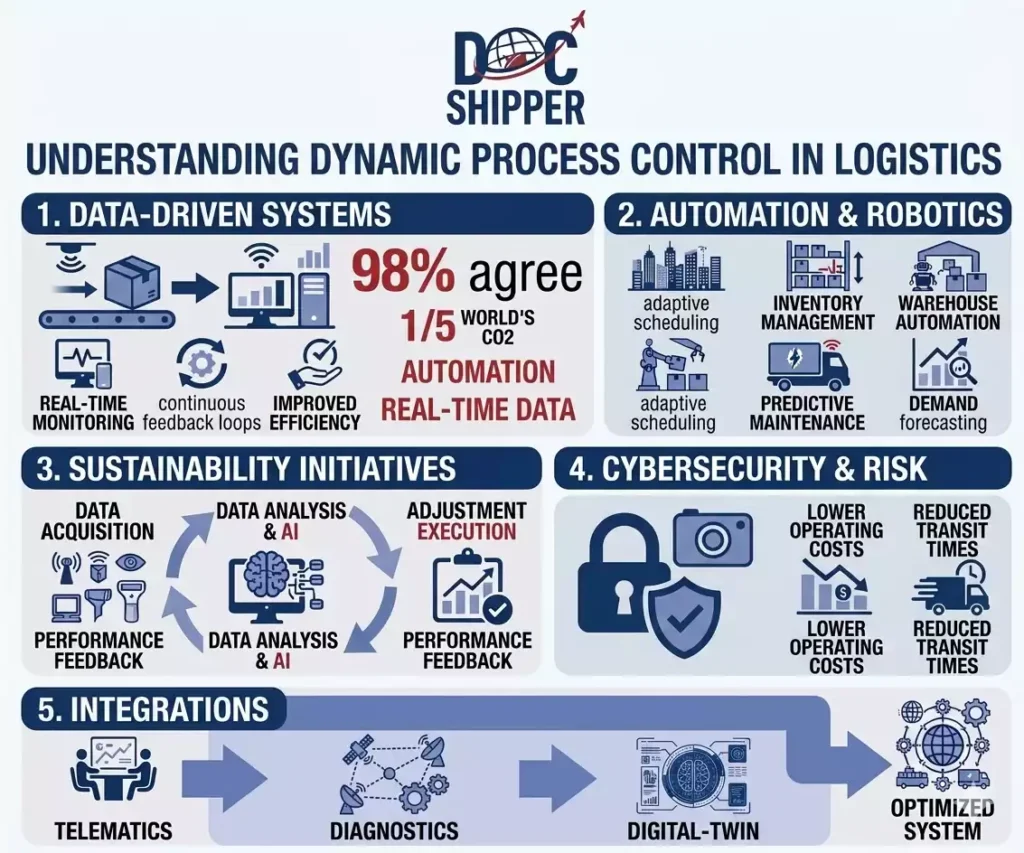
Dynamic Process Control operates through interconnected layers that collect data, analyze patterns, and execute corrective actions. The foundation consists of IoT sensor networks deployed across warehouses, transport vehicles, and production facilities. These devices continuously transmit temperature readings, location coordinates, humidity levels, and handling events to centralized control systems.
The analytical layer employs machine learning algorithms trained on historical logistics data. These systems identify normal operational patterns and flag anomalies requiring intervention. For customs clearance, DPC monitors documentation status, regulatory changes, and port congestion levels to predict potential delays weeks in advance.
Integration with Enterprise Resource Planning (ERP) systems enables DPC to automatically adjust procurement schedules, reroute shipments, or trigger emergency sourcing when disruptions are detected. According to the World Economic Forum’s Supply Chain 4.0 report, companies utilizing these integrated systems reduce supply chain costs by 30% while improving delivery performance by 40%.
The control interface presents decision-makers with actionable intelligence through dashboards displaying risk scores, alternative routing options, and cost-benefit analyses. At DocShipper, we implement DPC frameworks that monitor every shipment across our global network, automatically alerting clients when documentation requires updates or when alternative carriers offer better transit times. This proactive approach eliminates the traditional gap between problem detection and resolution.
Advanced DPC implementations incorporate digital twin technology, creating virtual replicas of physical supply chains. These simulations test potential disruptions and optimization strategies without risking actual operations. When a port announces capacity restrictions, the digital twin immediately calculates which shipments to reroute and identifies alternative consolidation points.
The regulatory dimension cannot be overlooked. Compliance monitoring modules within DPC systems track changing import/export regulations across jurisdictions, automatically updating documentation requirements and alerting stakeholders to licensing renewals or restricted party list additions. This automated vigilance prevents costly shipment detentions and ensures continuous trade compliance.
Practical Applications & Performance Data
Real-world implementation reveals DPC’s transformative impact across various logistics scenarios. Consider a European electronics importer receiving components from Southeast Asia. Traditional systems would check shipment status daily, reacting only when delays become visible. A DPC-enabled supply chain monitors vessel schedules, weather patterns, port congestion metrics, and customs processing times simultaneously.
Use Case: Pharmaceutical Cold Chain Management
A pharmaceutical distributor ships temperature-sensitive vaccines requiring constant refrigeration between 2°C and 8°C. DPC sensors monitor container temperatures every 30 seconds. When readings approach 7.5°C during transit through Dubai, the system automatically:
- Alerts the carrier to adjust refrigeration settings
- Notifies the quality assurance team for potential batch evaluation
- Generates compliance documentation for regulatory review
- Calculates insurance claim parameters if temperature limits are breached
This automated response occurred 43 minutes faster than manual monitoring would have detected the issue, preventing $280,000 in product losses.
Performance data from enterprise implementations demonstrates measurable advantages:
| Metric | Traditional Systems | DPC-Enabled Systems | Improvement |
|---|---|---|---|
| Average Response Time to Disruptions | 4.2 hours | 18 minutes | 93% faster |
| On-Time Delivery Rate | 87% | 96% | +9 percentage points |
| Inventory Holding Costs | 22% of product value | 14% of product value | 36% reduction |
| Documentation Error Rate | 3.8% | 0.4% | 89% reduction |
| Customer Satisfaction Score | 7.3/10 | 9.1/10 | +25% increase |
Warehouse Automation Integration
DPC extends beyond transportation into facility operations. An automotive parts distributor integrated DPC with robotic picking systems. When inbound shipments arrive late, the system automatically reprioritizes warehouse tasks, reallocating labor and equipment to process urgent orders first. This adaptive scheduling reduced order fulfillment times from 48 hours to 22 hours during peak periods.
At DocShipper, our DPC infrastructure monitors over 15,000 active shipments simultaneously across 89 countries. When regulatory changes occur—such as the recent updates to EU CBAM requirements—our system automatically identifies affected shipments and generates compliance documentation within minutes, ensuring uninterrupted customs clearance for our clients.
The financial impact proves substantial. A textile importer reduced demurrage charges by $127,000 annually through DPC-driven container release optimization. By predicting port congestion and adjusting pickup schedules dynamically, they minimized storage fees while maintaining production schedules.
Conclusion
Dynamic Process Control represents the evolution from reactive logistics management to intelligent, self-optimizing supply chains. By continuously monitoring operations and automatically adjusting to changing conditions, DPC eliminates costly delays while improving service reliability across international trade networks.
Need expert guidance implementing Dynamic Process Control in your supply chain? Contact DocShipper for a customized assessment of your logistics optimization opportunities.
📚 Quiz
Test Your Knowledge: Dynamic Process Control
What is the primary characteristic that distinguishes Dynamic Process Control from traditional supply chain management systems?
A logistics manager believes DPC only tracks shipment locations. What critical misconception does this reveal?
Your pharmaceutical shipment's temperature sensors detect readings approaching the upper threshold. Which response demonstrates proper DPC application?
🎯 Your Result
📞 Free Quote in 24hFAQ | Dynamic Process Control (DPC): Definition, Implementation & Real-World Applications
DPC implementation requires IoT sensors for data collection, cloud-based analytics platforms for processing, API integrations with existing ERP and WMS systems, and automated workflow engines. Most modern logistics operations already possess foundational infrastructure, requiring primarily software integration rather than complete system replacement. Initial deployment typically takes 8-12 weeks depending on supply chain complexity.
Traditional systems operate on scheduled data updates and require manual intervention for decision-making. DPC continuously streams real-time data and executes automated responses based on predefined rules and AI algorithms. Where conventional platforms show what happened yesterday, DPC predicts what will happen tomorrow and adjusts operations accordingly. The system learns from historical patterns to improve decision accuracy over time.
Absolutely. Cloud-based DPC platforms offer scalable pricing models that make the technology accessible to businesses managing even 50-100 shipments monthly. SMEs often see proportionally greater benefits because manual monitoring consumes limited staff resources. Many providers offer modular implementations, allowing companies to start with core tracking features and expand capabilities as operations grow.
DPC delivers end-to-end visibility from supplier manufacturing facilities through final delivery. Systems track not just location, but also environmental conditions, handling events, customs status, and carrier performance metrics. Stakeholders access real-time dashboards showing shipment positions, predicted arrival times with confidence intervals, and automated alerts for exceptions requiring attention. This transparency extends to all parties—suppliers, freight forwarders, customs brokers, and customers.
DPC systems integrate with customs databases and regulatory information systems to track changing requirements across jurisdictions. The platform monitors license expiration dates, restricted party lists, tariff code modifications, and documentation standards. When regulations change, the system automatically flags affected shipments, generates required documentation updates, and alerts compliance teams. This proactive monitoring prevents detention and ensures continuous regulatory adherence.
Industry data shows average ROI periods of 12-18 months for comprehensive DPC deployments. Cost savings stem from reduced inventory carrying costs, lower detention and demurrage charges, decreased expedited shipping expenses, and improved labor productivity. Revenue benefits include higher customer retention rates and the ability to offer premium service guarantees. Most enterprises report total logistics cost reductions of 15-25% within the first two years of operation.
Modern DPC platforms utilize RESTful APIs and standard data exchange protocols (EDI, XML, JSON) to connect with WMS, TMS, and ERP systems. Integration typically involves configuring data mappings rather than custom coding. The DPC layer sits above existing systems, aggregating data and pushing optimized instructions back to operational platforms. This architecture preserves existing investments while adding intelligent control capabilities.
Enterprise DPC platforms employ multi-layered security including end-to-end encryption for data transmission, role-based access controls, multi-factor authentication, and continuous intrusion detection. Data residency options ensure compliance with regional regulations like GDPR. Regular penetration testing and SOC 2 Type II certifications validate security postures. Cloud providers offering DPC solutions typically maintain ISO 27001 certification and provide detailed audit trails for all system activities.
Predictive capabilities constitute DPC's core advantage. Machine learning algorithms analyze patterns in weather data, geopolitical events, port congestion metrics, carrier performance history, and seasonal demand fluctuations. The system generates risk scores for individual shipments and suggests preemptive actions—alternative routing, expedited customs clearance, or early inventory replenishment. While not preventing external events, DPC minimizes their operational impact through early warning and automated mitigation strategies.
When sensors detect deviations from normal parameters—a temperature spike, unexpected route deviation, or customs hold—DPC triggers predefined response protocols. For minor issues, automated corrections occur without human intervention: adjusting refrigeration settings, notifying carriers, or generating corrective documentation. Significant disruptions escalate to human decision-makers with recommended action plans and impact analyses. The system continuously monitors resolution effectiveness and refines future responses based on outcomes.
Most DPC platforms feature intuitive dashboards requiring minimal technical training. Initial orientation typically involves 2-4 hours covering dashboard navigation, alert interpretation, and exception handling procedures. Advanced users managing system configurations and rule definitions need 3-5 days of training. Ongoing learning occurs naturally as staff interact with the system, with contextual help and automated suggestions guiding decision-making. Many providers offer continuous support through dedicated customer success teams.
DPC optimizes routing to minimize empty miles and fuel consumption while monitoring carrier environmental performance. The system calculates carbon footprints for individual shipments and suggests lower-emission alternatives when feasible. Improved inventory accuracy reduces waste from obsolescence and spoilage. Real-time visibility enables mode shifting—transferring suitable cargo from air to ocean freight when schedules permit. Companies using DPC for sustainability reporting access comprehensive emissions data across their entire logistics network, supporting ESG compliance and certification requirements.
Need Help with
Logistics or Sourcing ?
First, we secure the right products from the right suppliers at the right price by managing the sourcing process from start to finish. Then, we simplify your shipping experience - from pickup to final delivery - ensuring any product, anywhere, is delivered at highly competitive prices.


Fill the Form
Prefer email? Send us your inquiry, and we’ll get back to you as soon as possible.
Contact us




:%20Definition,%20Implementation%20&%20Real-World%20Applications)