


In short ⚡
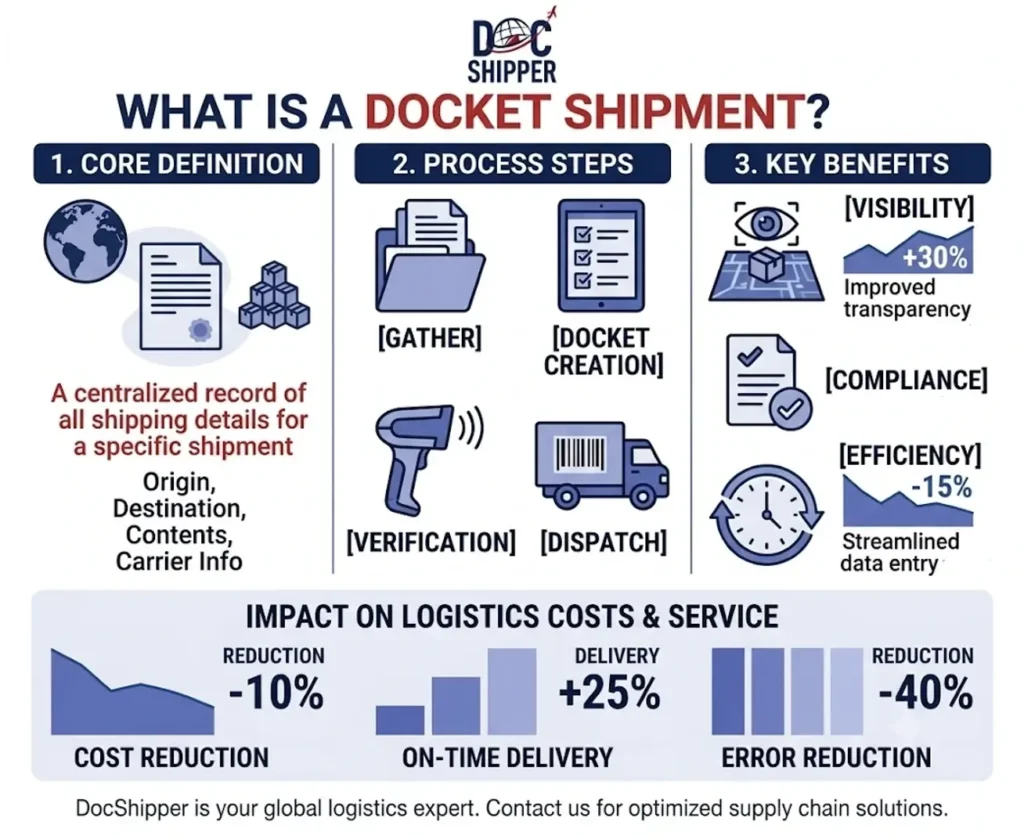
A docket is a logistical document or register that records shipment details, delivery instructions, and transaction information throughout the supply chain. In international trade, it serves as a tracking and verification tool for goods movement, customs clearance, and proof of delivery.
Introduction
Many businesses struggle to differentiate between various shipping documents. The term “docket” often creates confusion with bills of lading, packing lists, or delivery notes.
In reality, the docket functions as a master reference that consolidates critical shipment information. It bridges operational gaps between warehouses, carriers, customs authorities, and final recipients.
Understanding dockets is essential for:
- Shipment verification: Confirming goods match order specifications
- Customs compliance: Providing evidence for duty calculations and inspections
- Proof of delivery: Establishing legal accountability in transit disputes
- Operational tracking: Maintaining visibility across multi-modal transport networks
- Financial reconciliation: Matching invoices with physical deliveries
Docket Mechanisms & Types in Global Trade
Dockets vary by industry and jurisdiction. In freight forwarding, the term encompasses several document categories that serve distinct regulatory and operational functions.
The most common types include:
Shipping dockets contain consignor and consignee details, commodity descriptions, weight specifications, and handling instructions. They accompany goods from origin to destination, often requiring signatures at multiple checkpoints.
Customs dockets (sometimes called entry dockets) compile all documentation required for border clearance. This includes commercial invoices, certificates of origin, tariff classifications, and valuation declarations. Authorities use these to assess duties and verify compliance with import regulations.
Delivery dockets serve as proof-of-service records. Recipients sign these upon accepting goods, creating a legal timestamp that triggers payment terms and warranty periods. In B2B transactions, unsigned dockets can delay invoice processing by weeks.
According to World Trade Organization standards, proper docket management reduces clearance times by up to 40%. Electronic docket systems now dominate developed markets, replacing paper-based processes with blockchain-verified digital records.
Court dockets also exist in logistics, particularly when shipments face legal disputes. These register claims, hearing dates, and judgments related to cargo damage, contract breaches, or regulatory violations.
At DocShipper, we systematically verify docket accuracy before submitting customs declarations, preventing costly delays caused by documentation errors or missing information.
Practical Applications & Data
Real-world docket usage demonstrates how documentation impacts supply chain efficiency. Consider these scenarios:
Case Study: Electronics Import from China to Germany
A German retailer orders 5,000 smartphones from Shenzhen. The shipping docket includes:
- HS code 8517.12.00 (duty rate: 0% under GSP)
- Commercial invoice value: €187,500
- Total gross weight: 1,240 kg
- Incoterms: DDP Hamburg
- Required certifications: CE, RoHS, WEEE
The customs docket consolidates these elements with transport documents (AWB, packing list). Without a complete docket, German customs would hold the shipment for additional verification, costing approximately €450 per day in storage fees.
Comparative Analysis: Paper vs. Digital Dockets
| Aspect | Paper Dockets | Digital Dockets |
|---|---|---|
| Processing Time | 3-7 days | 30 minutes – 4 hours |
| Error Rate | 12-18% | 2-4% |
| Storage Cost | €0.15/page/year | €0.01/record/year |
| Audit Retrieval | 2-5 hours | Instant |
| Environmental Impact | High (50kg CO₂/1000 pages) | Minimal |
Industry data shows that 73% of Fortune 500 logistics providers now mandate electronic dockets for cross-border shipments, driven by EU customs modernization programs and US CBP’s ACE portal requirements.
Key Docket Management Principles
- Version control: Always timestamp revisions to prevent disputes over outdated information
- Multi-language support: Include translations for destination country authorities (mandatory in China, Japan, and UAE)
- Backup systems: Maintain duplicate records across cloud and local servers
- Signature authentication: Use biometric or digital certificates for high-value cargo
- Integration capabilities: Ensure docket systems sync with ERP, TMS, and customs platforms
Conclusion
Mastering docket management directly impacts customs clearance speed, operational costs, and legal protection. Whether paper-based or digital, accurate docket preparation remains non-negotiable for compliant international trade.
Need expert assistance with docket preparation and customs documentation? Contact DocShipper for tailored logistics solutions that ensure your shipments move smoothly across borders.
📚 Quiz
Test Your Knowledge: Docket
What is the primary function of a docket in international logistics?
According to the article, what is a common misconception about bills of lading and dockets?
A German retailer imports electronics from China. The customs docket contains an incorrect HS code. What is the most likely consequence?
🎯 Your Result
📞 Free Quote in 24hFAQ | Docket: Definition, Types & Practical Examples in Logistics
A bill of lading (B/L) is a specific legal document issued by carriers as a receipt and contract for transport. A docket is a broader term encompassing various shipment records, including but not limited to B/Ls. While all bills of lading serve as dockets, not all dockets are bills of lading. Dockets may include internal tracking sheets, delivery receipts, or customs compilation files that lack the legal weight of a B/L.
Most air freight now operates under e-AWB (electronic air waybills), eliminating paper dockets for 85% of global air cargo. However, certain destinations like India, Brazil, and some African nations still require physical copies stamped by authorities. Always verify destination country requirements with your freight forwarder before assuming digital-only documentation suffices.
Retention periods vary by jurisdiction. The EU mandates 5-7 years for customs-related dockets under VAT regulations. US businesses must keep import dockets for 5 years per CBP rules. Tax authorities may require longer retention (up to 10 years in Germany for corporate records). Always consult local accounting standards and industry-specific regulations like ITAR or pharmaceutical compliance frameworks.
Yes, significantly. Incomplete dockets trigger manual inspections, documentation requests, and shipment holds. Average delays range from 3-14 days depending on port congestion and customs workload. High-risk commodities (electronics, pharmaceuticals, chemicals) face stricter scrutiny. Missing documents may also incur penalty fees averaging €200-€800 per incident in EU ports.
Essential elements include: shipper and consignee names/addresses, shipment reference number, itemized goods description with quantities, delivery date/time, recipient signature, and vehicle/driver identification. Additional fields may include special handling instructions, temperature records for perishables, or photographic proof of condition. Commercial deliveries often require purchase order numbers for invoice matching.
In most jurisdictions, yes. The EU's eIDAS regulation and US ESIGN Act recognize qualified electronic signatures as equivalent to handwritten ones. However, acceptance varies: China requires government-issued digital certificates for customs dockets, while some Middle Eastern countries still mandate wet signatures. Blockchain-based signatures are gaining traction in Singapore and UAE for enhanced security.
Dockets establish the declared value at time of dispatch, forming the baseline for loss or damage claims. Insurers cross-reference commercial invoices, packing lists, and signed delivery dockets to verify claim legitimacy. Discrepancies between documents can invalidate coverage. Always ensure docket values match invoice amounts and include itemized descriptions to prevent disputes during claims processing.
Incorrect Harmonized System codes trigger duty recalculations, penalties, and potential seizures. Underpaid duties result in back-payments plus interest (typically 3-5% annually). Overpaid duties require lengthy refund processes. Repeated errors may flag companies for increased customs scrutiny. Professional classification services or customs brokers should verify HS codes before docket submission to avoid these complications.
Yes, but with limitations. Pre-clearance amendments are straightforward through most electronic systems. Post-clearance changes require formal "entry adjustments" within specific timeframes (30-90 days in most countries). Major modifications may trigger re-inspection. Some errors (like classification changes) allow retroactive correction up to 4 years in the EU, while others face strict deadlines.
Yes. Less-than-container-load (LCL) freight involves multiple shippers sharing container space. Each consignee receives an individual docket detailing their specific goods, weights, and customs declarations. The consolidator maintains a master docket listing all parties. This separation prevents clearance issues where one party's documentation problems delay others' cargo release.
Blockchain-based dockets create immutable records verified by multiple parties. Each transaction (loading, transit, inspection, delivery) generates a timestamped block linked to previous entries. This eliminates document fraud, reduces administrative reconciliation time by 60-80%, and enables real-time tracking for all stakeholders. Major ports in Rotterdam, Singapore, and Dubai now pilot blockchain customs dockets for high-value trade lanes.
Modern docket systems employ AES-256 encryption for data at rest and TLS 1.3 for transmission. Access controls limit viewing rights based on user roles. Audit trails log all document access and modifications. Cloud platforms use geo-redundant backups with 99.9% uptime guarantees. Sensitive fields (pricing, supplier identities) can be redacted for third-party viewing while maintaining regulatory compliance for full-access authorities.
Need Help with
Logistics or Sourcing ?
First, we secure the right products from the right suppliers at the right price by managing the sourcing process from start to finish. Then, we simplify your shipping experience - from pickup to final delivery - ensuring any product, anywhere, is delivered at highly competitive prices.


Fill the Form
Prefer email? Send us your inquiry, and we’ll get back to you as soon as possible.
Contact us




