


In short ⚡
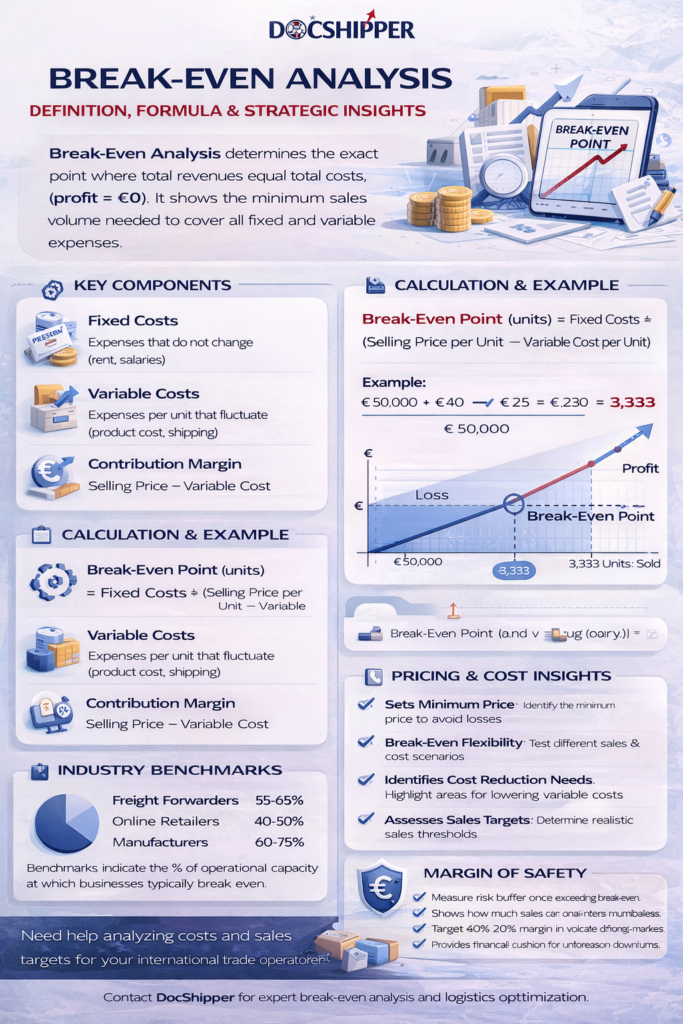
Break-Even Analysis is a financial calculation that determines the exact point where total revenues equal total costs, resulting in neither profit nor loss. This critical metric helps businesses identify the minimum sales volume required to cover all fixed and variable expenses, enabling informed pricing, production, and investment decisions in international trade operations.
Introduction
Many importers and exporters struggle to determine whether their international operations will be profitable before committing significant capital. Without understanding the break-even point, businesses risk underpricing products, overestimating market potential, or misjudging the viability of new trade routes.
In global logistics, break-even analysis becomes even more critical due to complex cost structures involving customs duties, freight charges, warehousing fees, and currency fluctuations. This tool provides clarity on the minimum performance threshold necessary to justify market entry or expansion.
- Cost visibility: Separates fixed costs (rent, salaries) from variable costs (materials, shipping per unit)
- Pricing strategy: Establishes minimum selling prices to maintain profitability margins
- Risk assessment: Quantifies the sales volume needed before generating returns
- Scenario planning: Tests different pricing, cost, and volume assumptions before market commitment
- Investment justification: Demonstrates financial feasibility to stakeholders and lenders
Understanding Break-Even Components & Strategic Applications
The break-even calculation relies on three fundamental elements that every international trader must accurately identify. Fixed costs remain constant regardless of production volume—warehouse leases, administrative salaries, insurance premiums, and licensing fees. These expenses persist even when no goods are sold.
Variable costs fluctuate directly with production or sales volume. In import/export contexts, these include raw materials, per-unit shipping charges, customs duties calculated per item, packaging materials, and sales commissions. Understanding this distinction prevents miscalculation of the break-even threshold.
The contribution margin represents the difference between selling price and variable cost per unit. This metric indicates how much each sale contributes toward covering fixed costs. Once total contribution margin equals fixed costs, the business reaches break-even. Beyond this point, each additional sale generates pure profit.
The standard formula is: Break-Even Point (units) = Fixed Costs ÷ (Selling Price per Unit − Variable Cost per Unit). For revenue-based calculations: Break-Even Point (revenue) = Fixed Costs ÷ Contribution Margin Ratio, where the ratio equals contribution margin divided by selling price.
In international trade, currency exchange rates introduce additional complexity. A strengthening local currency against the currency of sale can reduce effective revenues, pushing the break-even point higher. At DocShipper, we incorporate multi-currency scenarios into break-even models for clients expanding into new markets, ensuring realistic profitability projections despite forex volatility.
Regulatory compliance costs also affect break-even calculations. Product certifications, quality inspections, and documentation fees represent fixed costs that must be amortized across expected sales volumes. According to the World Trade Organization, compliance costs can represent 2-15% of transaction values depending on product category and destination market.
Practical Calculations & Industry Benchmarks
Consider a European electronics importer sourcing smartphones from Asia for resale. The company faces €50,000 in monthly fixed costs (warehouse, staff, utilities) and variable costs of €200 per unit (product cost, shipping, duties). They plan to sell each phone for €350.
Calculation: Contribution margin = €350 − €200 = €150 per unit. Break-even point = €50,000 ÷ €150 = 334 units per month. The business must sell at least 334 smartphones monthly to cover all costs. At 335 units, they begin generating profit.
| Scenario | Selling Price | Variable Cost | Contribution Margin | Break-Even Units |
|---|---|---|---|---|
| Base Case | €350 | €200 | €150 | 334 |
| Price Reduction (10%) | €315 | €200 | €115 | 435 |
| Cost Increase (15%) | €350 | €230 | €120 | 417 |
| Optimized Operations | €350 | €180 | €170 | 294 |
The table demonstrates how sensitive break-even points are to price and cost changes. A 10% price reduction requires 30% more sales to break even. Conversely, reducing variable costs by just €20 per unit lowers the threshold by 40 units—illustrating why cost optimization matters.
Industry benchmark data: Manufacturing exporters typically achieve break-even at 60-75% capacity utilization. E-commerce importers average 40-50% due to higher fixed marketing costs. Freight forwarders operate at 55-65% utilization to cover infrastructure investments. These figures vary significantly by sector, product lifecycle stage, and market maturity.
Multi-product break-even: Companies selling diverse product lines must calculate weighted average contribution margins. If Product A contributes €100 per unit at 60% of sales volume, and Product B contributes €200 at 40% volume, the weighted margin is (€100 × 0.6) + (€200 × 0.4) = €140. This becomes the denominator in the break-even formula.
Time-to-break-even: Beyond unit calculations, importers should project monthly sales ramp-up. If the break-even point is 334 units but initial monthly sales are only 150, reaching profitability takes time. Cash flow planning must account for cumulative losses during this period. At DocShipper, we model realistic sales curves based on market entry strategies and historical data from similar product launches.
Margin of safety: Once break-even is reached, calculate the margin of safety: (Actual Sales − Break-Even Sales) ÷ Actual Sales. A 30% margin means sales could drop 30% before losses occur. International traders targeting volatile markets should aim for margins above 25% to buffer against demand fluctuations.
Conclusion
Break-even analysis transforms abstract financial projections into concrete sales targets, enabling import/export businesses to make evidence-based decisions about pricing, market entry, and operational scaling. Mastering this tool reduces risk and accelerates path to profitability in competitive global markets.
Need expert guidance on financial modeling for your international trade operations? Contact DocShipper for customized break-even analysis and logistics optimization strategies.
📚 Quiz
Test Your Knowledge: Break-Even Analysis
Q1 — What does the break-even point represent in a business context?
Q2 — A common misconception about break-even analysis is that sunk costs (e.g., past market research expenses) should be included in the calculation. Is this correct?
Q3 — A European importer has €50,000 in monthly fixed costs, a variable cost of €200 per unit, and a selling price of €350. How many units must be sold monthly to break even?
🎯 Your Result
📞 Free Quote in 24hFAQ | Break-Even Analysis: Definition, Calculation & Practical Examples
The break-even point is the specific sales volume or revenue level where costs equal revenues. Break-even analysis is the broader process of calculating this point, testing scenarios, and interpreting implications for business strategy.
Customs duties are variable costs that increase with import volume. Higher duty rates raise the variable cost per unit, which reduces contribution margin and increases the break-even threshold. Accurate HS code classification is essential for precise calculations.
Yes, though cost structures differ. Fixed costs include office space and permanent staff, while variable costs involve subcontracted services per shipment. The formula remains identical, but identifying cost categories requires careful analysis of operational models.
Quarterly reviews are standard, but recalculate immediately when significant changes occur: supplier price adjustments, currency fluctuations exceeding 5%, regulatory changes affecting duties, or major shifts in fixed cost structure like warehouse relocations.
No universal benchmark exists, but reaching break-even within 6-12 months is typical for well-capitalized ventures. The key metric is margin of safety—aim for actual sales 30-40% above break-even to ensure sustainability through market volatility.
Standard calculations assume consistent monthly performance. For seasonal businesses, calculate separate break-even points for peak and off-peak periods, or use weighted annual averages. Cash flow modeling should reflect seasonal revenue patterns explicitly.
As volume increases, per-unit variable costs often decrease through bulk purchasing and freight consolidation. This lowers the break-even point over time. Advanced analysis should model tiered cost structures reflecting volume discounts from suppliers.
Yes. Calculate break-even using each shipping method's cost structure. Air freight has higher variable costs but lower fixed inventory holding costs. Sea freight reverses this. The optimal choice depends on sales velocity and working capital constraints.
Early lifecycle stages have higher marketing costs (fixed) and lower volumes, raising break-even points. Mature products benefit from established demand and optimized costs. Model break-even trajectories across anticipated lifecycle phases for realistic profitability timelines.
Currency movements alter effective selling prices or costs when revenues and expenses occur in different currencies. A 10% currency depreciation can shift break-even points significantly. Use hedging strategies or build forex buffers into contribution margin assumptions.
No. Sunk costs like past market research or prototype development are irrelevant to forward-looking break-even calculations. Include only ongoing fixed costs and variable costs per unit that will actually be incurred going forward.
B2B models typically have higher fixed costs (sales teams, credit terms) but larger order sizes, potentially lowering per-unit variable costs. B2C requires higher marketing spend but benefits from direct pricing control. Calculate separately for each channel if operating both models.
Need Help with
Logistics or Sourcing ?
First, we secure the right products from the right suppliers at the right price by managing the sourcing process from start to finish. Then, we simplify your shipping experience - from pickup to final delivery - ensuring any product, anywhere, is delivered at highly competitive prices.


Fill the Form
Prefer email? Send us your inquiry, and we’ll get back to you as soon as possible.
Contact us




