


In short ⚡
Brokerage fees are charges levied by customs brokers or freight forwarders for facilitating customs clearance and regulatory compliance. These fees cover documentation preparation, duty calculation, and communication with customs authorities on behalf of importers and exporters.
Introduction
Many businesses underestimate the complexity of customs clearance until they face unexpected delays and additional charges. Brokerage fees represent a critical cost component in international shipping that directly impacts landed costs and delivery timelines.
In cross-border trade, customs brokers act as intermediaries between shippers and government authorities. Their expertise ensures compliance with import/export regulations while minimizing the risk of penalties or shipment holds.
Key characteristics of brokerage fees include:
- Service-based pricing – Fees vary depending on shipment complexity and value
- Regulatory compliance – Covers classification, valuation, and documentation verification
- Time-sensitive processing – Expedited services often carry premium charges
- Country-specific variations – Regulations differ significantly across jurisdictions
- Transparency requirements – Legitimate brokers provide detailed fee breakdowns
Understanding Brokerage Fees: Components & Regulations
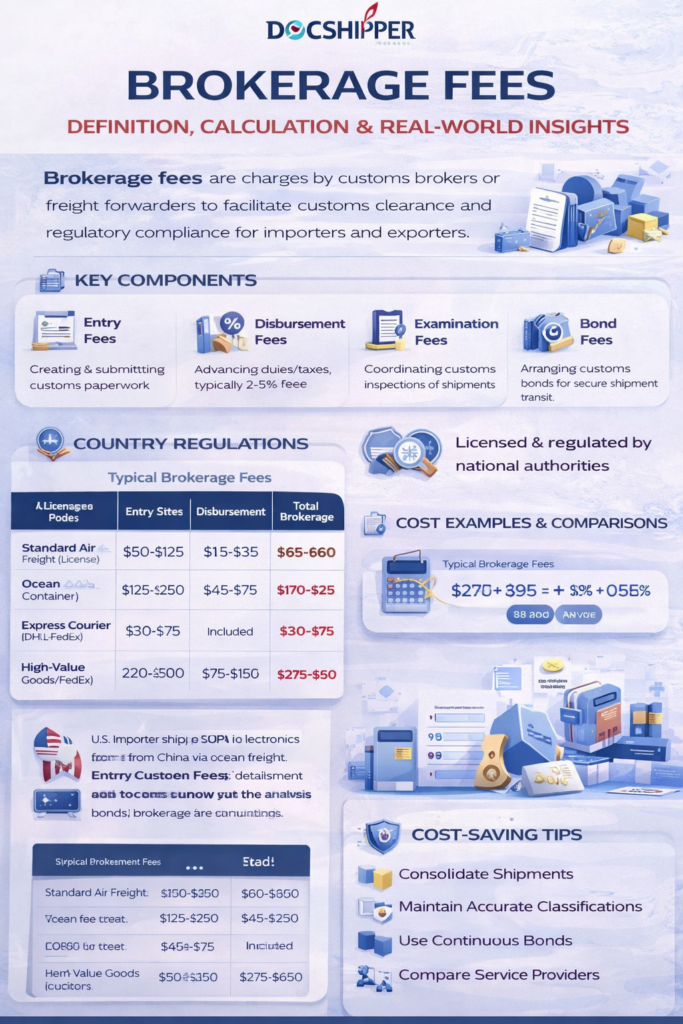
Brokerage fees encompass multiple service layers beyond basic customs clearance. The entry preparation fee covers the creation and submission of customs entry documents required by authorities. This includes HS code classification, origin determination, and duty calculation.
The disbursement fee reimburses brokers for advancing duties and taxes on behalf of clients. While technically a pass-through cost, brokers typically charge 2-5% of the advanced amount for this service. Some providers include this in their base fee structure.
Bond fees ensure compliance with customs regulations. Continuous bonds cover multiple shipments over a year, while single-entry bonds apply to individual transactions. U.S. Customs and Border Protection requires bonds valued at least 10% of duties, taxes, and fees owed annually.
The examination fee applies when customs authorities physically inspect cargo. Brokers coordinate these inspections, arrange container movement, and manage documentation updates. This fee varies based on inspection complexity and location.
Regulatory oversight varies by jurisdiction. In the European Union, the Union Customs Code standardizes broker licensing requirements across member states. The U.S. requires federal licensing through CBP, while Canada mandates certification by the Canada Border Services Agency. For detailed regulations, consult the U.S. Customs and Border Protection broker guidelines.
At DocShipper, we maintain transparent fee structures and provide detailed breakdowns before shipment processing. Our licensed brokers ensure compliance while optimizing cost efficiency for every transaction.
Practical Examples & Cost Comparisons
Understanding actual cost structures helps businesses budget accurately for international shipments. The following comparison illustrates typical fee variations across shipment types:
| Shipment Type | Entry Fee | Disbursement | Total Brokerage |
|---|---|---|---|
| Standard air freight (≤$2,500) | $50-$125 | $15-$35 | $65-$160 |
| Ocean container (FCL) | $125-$250 | $45-$75 | $170-$325 |
| Express courier (DHL/FedEx) | $30-$75 | Included | $30-$75 |
| High-value goods (>$25,000) | $200-$500 | $75-$150 | $275-$650 |
Real-world scenario: A U.S. electronics retailer imports 500 smartphones from China valued at $150,000. The shipment arrives via ocean freight in Los Angeles.
- Entry preparation fee: $275 (complex electronics classification)
- Disbursement fee: $95 (advancing $9,000 in duties)
- Continuous bond: $450 annually (covers multiple shipments)
- ISF filing: $75 (Importer Security Filing requirement)
- Total brokerage cost: $895 (0.6% of shipment value)
Key cost-saving strategies include consolidating shipments to spread fixed fees across larger volumes, maintaining accurate product classifications to avoid rework charges, and establishing annual bond arrangements for regular importers.
DocShipper analyzes your shipping patterns to recommend optimal brokerage solutions. Our volume-based pricing and streamlined processes reduce per-shipment costs while maintaining full regulatory compliance.
Conclusion
Brokerage fees represent essential investments in compliant, efficient customs clearance. Understanding their components enables accurate cost forecasting and strategic vendor selection in international logistics.
Need expert guidance on optimizing your customs clearance costs? Contact DocShipper for a comprehensive analysis of your shipping requirements.
📚 Quizz
Test Your Knowledge: Brokerage Fee
Q1 — What do brokerage fees primarily cover in international shipping?
Q2 — A disbursement fee charged by a customs broker is best described as:
Q3 — A U.S. retailer imports high-value electronics regularly throughout the year. Which bond arrangement is most cost-effective for managing their brokerage costs?
🎯 Your Result
📞 Free Quote in 24hFAQ | Brokerage Fee: Definition, Calculation & Real-World Examples
Customs brokers prepare and submit entry documentation, calculate duties and taxes, classify goods under HS codes, communicate with customs authorities, and ensure compliance with import/export regulations on behalf of shippers.
Yes, particularly for high-volume shippers. Many brokers offer tiered pricing based on shipment frequency and complexity. Annual contracts typically provide better rates than per-transaction arrangements.
Technically yes, but impractical for most businesses. Self-clearance requires extensive regulatory knowledge, direct customs authority access, and significant time investment. Errors can result in penalties exceeding broker fees.
Companies like FedEx and DHL include basic brokerage in their shipping rates for low-value shipments. However, they charge additional fees for complex clearances or high-value goods, often at premium rates.
A continuous bond covers all import entries for one year, typically costing $450-$500 annually. It's required for importers with shipments exceeding $2,500 or regulated products, replacing single-entry bonds for each transaction.
Variations reflect service scope, technology platforms, expertise levels, and volume discounts. Some brokers offer basic clearance only, while others provide comprehensive trade compliance consulting and supply chain integration.
Brokers coordinate the examination, arrange container access, and manage documentation updates. Examination fees typically range from $75-$300 depending on location and inspection complexity, plus potential storage charges during the process.
Brokers calculate duties based on HS classification, country of origin, and shipment value. They advance these payments to customs authorities, then invoice clients with a disbursement fee (typically 2-5% of advanced amounts).
Not necessarily. Global brokers like DocShipper maintain licensed agents in multiple countries, providing consistent service across jurisdictions. However, country-specific expertise remains crucial for complex regulatory environments.
Essential documents include commercial invoices, packing lists, bills of lading, certificates of origin, and product specifications. Additional documentation may be required for regulated goods like food, pharmaceuticals, or electronics.
Absolutely. Errors in classification, valuation, or documentation trigger customs holds, examinations, and potential penalties. Professional brokers verify all information before submission to minimize delay risks.
Standard clearance takes 24-48 hours for complete, accurate documentation. Expedited services reduce this to 4-12 hours but carry premium fees. Clearance times vary significantly by port, product type, and customs workload.
Need Help with
Logistics or Sourcing ?
First, we secure the right products from the right suppliers at the right price by managing the sourcing process from start to finish. Then, we simplify your shipping experience - from pickup to final delivery - ensuring any product, anywhere, is delivered at highly competitive prices.


Fill the Form
Prefer email? Send us your inquiry, and we’ll get back to you as soon as possible.
Contact us




