


In short ⚡
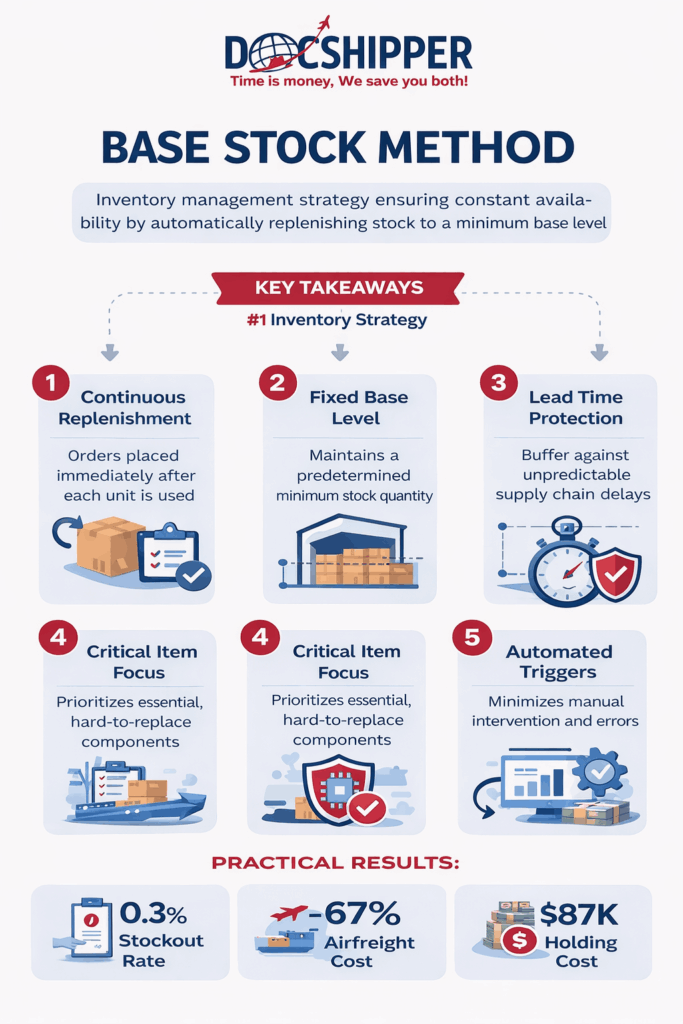
The Base Stock Method is an inventory management strategy where stock levels are continuously replenished to maintain a predetermined minimum quantity. Each unit withdrawn triggers an immediate reorder, ensuring constant availability for critical components in international supply chains and manufacturing operations.
Introduction
Many importers struggle with stockouts of essential components, leading to production halts and missed delivery deadlines. The Base Stock Method addresses this challenge by maintaining a safety buffer that automatically regenerates.
In international logistics, this approach proves invaluable for high-value, low-volume items with unpredictable lead times. It transforms reactive ordering into proactive inventory control.
Key characteristics of this method include:
- Continuous replenishment: Orders placed immediately after each withdrawal
- Fixed base level: Predetermined minimum quantity always maintained
- Lead time protection: Buffer against supply chain variability
- Critical item focus: Typically applied to essential, non-substitutable components
- Automated triggers: Reduces manual intervention and human error
In-Depth Analysis & Strategic Implementation
The Base Stock Method operates on a simple yet powerful principle: base stock level = average demand during lead time + safety stock. This calculation ensures sufficient inventory coverage while orders are in transit.
Understanding lead time variability is crucial. International shipments face customs delays, port congestion, and carrier scheduling changes. The safety stock component compensates for these uncertainties, typically calculated using standard deviation of demand and desired service level.
Implementation requires robust demand forecasting. Historical consumption patterns, seasonality factors, and production schedules inform the base level determination. Inaccurate forecasts lead to either excess inventory costs or stockout risks.
The method differs fundamentally from Economic Order Quantity (EOQ) systems. While EOQ optimizes order size to minimize total costs, Base Stock prioritizes availability. This makes it ideal for critical components where stockout costs far exceed holding costs.
From a customs and compliance perspective, maintaining base stock requires careful documentation. According to World Customs Organization guidelines, importers must justify inventory levels during audits, particularly when claiming duty drawback or utilizing bonded warehouses.
At DocShipper, we help clients establish optimal base stock levels by analyzing their specific supply chain characteristics, including supplier reliability, transit times, and demand patterns across multiple markets.
Practical Examples & Data-Driven Insights
Consider a European electronics manufacturer sourcing specialized microprocessors from Taiwan. Analysis reveals the following operational parameters:
| Parameter | Value | Impact |
|---|---|---|
| Average daily demand | 50 units | Consumption baseline |
| Lead time (sea freight) | 35 days | Transit + customs clearance |
| Demand standard deviation | 12 units/day | Variability measure |
| Target service level | 98% | Z-score = 2.05 |
| Base stock level | 2,196 units | 1,750 + 446 safety stock |
Calculation breakdown: Average demand during lead time = 50 units/day × 35 days = 1,750 units. Safety stock = 2.05 × 12 × √35 = 146 units. Total base stock = 1,896 units (rounded to 2,196 for practical ordering).
A comparative analysis shows significant differences across inventory methods:
- Base Stock Method: 2,196 units maintained, 0.3% stockout rate, $87,840 annual holding cost
- Periodic Review (monthly): Average 1,650 units, 4.2% stockout rate, $66,000 holding cost but $124,000 lost production
- Min-Max System: 1,200-2,400 range, 1.8% stockout rate, $72,000 holding cost
- Just-in-Time (attempted): 400 units average, 12% stockout rate, production halts costing $380,000 annually
Real-world data from automotive supply chains demonstrates that Base Stock Method reduces emergency airfreight costs by 67% compared to reactive ordering systems. The predictable reorder pattern enables consolidated ocean shipments rather than expensive air cargo corrections.
For pharmaceutical importers, regulatory compliance adds complexity. FDA-regulated items require batch traceability, making the one-for-one replenishment particularly advantageous for audit trails and expiration date management.
Conclusion
The Base Stock Method transforms inventory management from reactive to strategic, particularly for critical imported components with long lead times. Its automated replenishment ensures operational continuity while maintaining predictable cash flow patterns.
Need expert guidance on optimizing your international inventory strategy? Contact DocShipper for a customized supply chain assessment.
📚 Quiz
Test Your Knowledge: Base Stock Method
Q1 — What is the core principle of the Base Stock Method?
Q2 — A logistics manager argues that the Base Stock Method is essentially the same as an Economic Order Quantity (EOQ) system since both aim to reduce inventory costs. Is this correct?
Q3 — A European manufacturer sources microprocessors from Taiwan with a 35-day sea freight lead time and an average daily demand of 50 units. Which scenario correctly applies the Base Stock Method?
🎯 Your Result
📞 Free Quote in 24hFAQ | Base Stock Method: Definition, Calculation & Practical Examples
Critical components with predictable demand, high stockout costs, and relatively stable lead times. Examples include specialized machinery parts, pharmaceutical ingredients, and essential electronic components where production cannot tolerate interruptions.
Reorder point triggers orders when inventory drops to a specific level, often ordering in batches. Base Stock replenishes every single unit withdrawn, maintaining a constant target level. This creates more frequent, smaller orders.
Yes, but safety stock calculations must account for lead time variability. Use combined standard deviation of both demand and lead time to determine appropriate buffer levels for international shipments.
Higher holding costs due to maintained inventory levels, but significantly lower stockout costs and emergency freight expenses. Total cost effectiveness depends on the ratio between holding costs and shortage costs.
Quarterly reviews are standard, with immediate adjustments for significant demand pattern changes, supplier lead time shifts, or production schedule modifications. Seasonal businesses may require monthly recalculation.
Limited application due to expiration concerns. It can work for items with shelf life exceeding twice the lead time, using FIFO rotation. Pharmaceutical and food importers must balance availability against waste.
Inventory management systems with automated reorder triggers, real-time stock tracking, and supplier integration capabilities. Cloud-based WMS platforms offer the most flexibility for international operations.
Customs delays extend effective lead time. Include average clearance duration plus one standard deviation in your lead time calculation. Countries with unpredictable customs processes require larger safety stocks.
Yes, calculate separate base stock levels for each supplier based on their specific lead times and reliability. Aggregate demand but maintain distinct reorder triggers to optimize supplier relationships.
Temporary spikes consume safety stock, triggering additional orders. Sustained changes require base level recalculation. Implement demand sensing systems to distinguish temporary fluctuations from permanent shifts.
Creates predictable, consistent cash outflows rather than large periodic payments. This smooths working capital requirements but increases average invested inventory value compared to batch ordering systems.
Feasible for critical items even with limited budgets. Start with highest-priority SKUs where stockout costs justify higher inventory investment. Scale gradually as cash flow permits expansion to additional items.
Need Help with
Logistics or Sourcing ?
First, we secure the right products from the right suppliers at the right price by managing the sourcing process from start to finish. Then, we simplify your shipping experience - from pickup to final delivery - ensuring any product, anywhere, is delivered at highly competitive prices.


Fill the Form
Prefer email? Send us your inquiry, and we’ll get back to you as soon as possible.
Contact us




