


In short ⚡
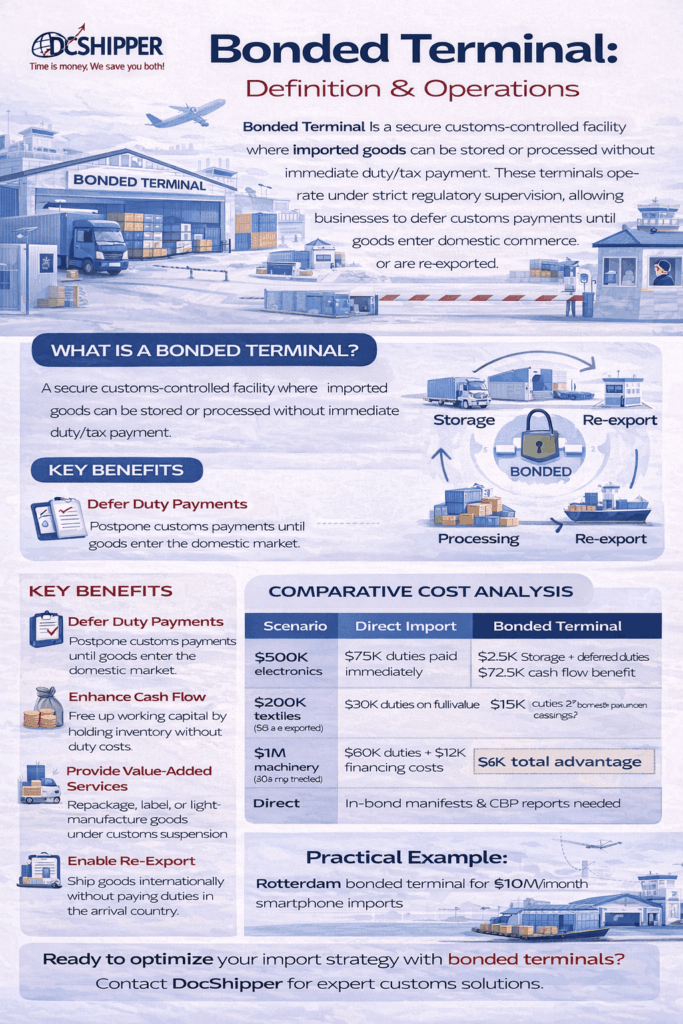
A bonded terminal is a secure customs-controlled facility where imported goods can be stored, handled, or processed without immediate payment of duties and taxes. These terminals operate under strict regulatory supervision, allowing businesses to defer customs payments until goods enter domestic commerce or are re-exported.
Introduction
International traders frequently face a critical challenge: managing cash flow while awaiting final distribution of imported goods. Paying customs duties immediately upon arrival can create significant financial strain, especially for high-value shipments or goods destined for multiple markets.
Bonded terminals solve this problem by creating a suspended customs zone where goods remain “in-bond” until their final destination is determined. This mechanism is essential for optimizing supply chain efficiency in global trade.
Key characteristics of bonded terminals include:
- Duty deferral: No immediate payment of import taxes or customs duties required
- Customs supervision: Facilities operate under direct government oversight with strict security protocols
- Value-added services: Authorized activities like repackaging, labeling, or light manufacturing permitted
- Re-export flexibility: Goods can leave without ever entering domestic commerce, avoiding duties entirely
- Time limitations: Storage periods typically range from 90 days to 5 years depending on jurisdiction
Bonded Terminal Operations & Regulatory Framework
Bonded terminals function as extraterritorial customs zones where normal import regulations are temporarily suspended. The facility operator must obtain special licensing from customs authorities and maintain comprehensive inventory tracking systems.
The legal framework governing bonded terminals varies by country but follows international standards established by the World Customs Organization’s Revised Kyoto Convention. In the United States, these facilities operate under 19 CFR Part 146, while European Union bonded warehouses follow Union Customs Code regulations (EU Customs Warehouses).
Authorized activities within bonded terminals extend beyond simple storage. Operators can perform quality inspections, sort goods for different destinations, apply country-specific labeling, and conduct minor assembly operations. These value-added services enable businesses to postpone final configuration decisions until market demand becomes clear.
The security requirements for bonded terminal operation are substantial. Facilities must implement 24/7 surveillance systems, controlled access points, detailed inventory management software, and regular customs audits. Any discrepancies between declared and physical inventory can result in license suspension and financial penalties.
At DocShipper, we guide clients through the bonded terminal selection process, ensuring compliance with all regulatory requirements while maximizing the financial and operational benefits of duty deferral programs.
Practical Examples & Industry Data
Understanding bonded terminal benefits becomes clearer through real-world scenarios and comparative data. The financial impact varies significantly based on shipment value, storage duration, and final destination.
Comparative Cost Analysis
| Scenario | Direct Import | Bonded Terminal | Savings |
|---|---|---|---|
| $500K electronics shipment (90-day storage) | $75K duties paid immediately | $2.5K storage + deferred duties | $72.5K cash flow benefit |
| $200K textiles (50% re-exported) | $30K duties on full value | $15K duties on domestic portion only | $15K permanent savings |
| $1M machinery (180-day storage) | $80K duties + $12K financing costs | $6K storage + deferred duties | $86K total advantage |
Use Case: Electronics Distribution Hub
A multinational electronics company imports $10 million in smartphones monthly through a bonded terminal in Rotterdam. The strategy delivers multiple benefits:
- Duty optimization: 40% of goods re-exported to non-EU markets avoid €1.2M in monthly VAT payments
- Market flexibility: Final destination decisions delayed until sales data confirms demand patterns
- Labeling efficiency: Country-specific packaging applied only when distribution confirmed, reducing waste by 15%
- Cash flow improvement: €800K monthly working capital freed for other business operations
- Compliance simplification: Single customs entry point for multiple EU countries reduces administrative burden
According to World Bank trade facilitation data, businesses using bonded facilities report average cash flow improvements of 18-25% and supply chain cost reductions of 8-12% compared to direct import models.
Conclusion
Bonded terminals represent a strategic tool for international traders seeking to optimize cash flow, maintain supply chain flexibility, and reduce overall import costs. The combination of duty deferral, value-added service capabilities, and re-export options creates significant competitive advantages in global commerce.
Need expert guidance on leveraging bonded terminal facilities for your import operations? Contact DocShipper for personalized consultation on customs optimization strategies.
📚 Quiz
Test Your Knowledge: Bonded Terminal
Q1 — What is the primary purpose of a bonded terminal?
Q2 — A company imports $200K worth of textiles through a bonded terminal and re-exports 50% to foreign markets. What happens to the customs duties on the re-exported portion?
Q3 — Which of the following activities is authorized within a bonded terminal?
🎯 Your Result
📞 Free Quote in 24hFAQ | Bonded Terminal: Definition, Operations & Practical Examples
Storage periods vary by jurisdiction. US bonded warehouses allow 5 years, EU facilities typically permit 3 years, while many Asian countries limit storage to 2 years. Extensions may be granted with proper justification.
Yes, but customs duties and taxes must be paid before goods enter domestic commerce. The sale triggers the customs clearance process, with the buyer or seller responsible for duty payment depending on agreed Incoterms.
Restrictions vary by country but commonly exclude perishable foods, hazardous materials requiring special permits, explosives, and goods subject to import prohibitions. Some facilities have temperature-controlled zones for specific product categories.
Bonded terminals focus on temporary storage with duty suspension, while free trade zones often permit manufacturing and indefinite storage. Free zones may offer additional tax incentives and less restrictive operational rules depending on location.
Essential documents include commercial invoice, bill of lading, packing list, customs bond, and terminal operator's receipt. Additional certificates may be needed for regulated products like pharmaceuticals or agricultural goods.
Yes, cargo insurance is typically mandatory. The terminal operator's liability is usually limited, so importers should maintain comprehensive coverage for the full value of stored goods plus potential duty obligations.
Limited manufacturing is permitted in some jurisdictions under "manufacturing in bond" programs. Activities typically include assembly, testing, labeling, and quality control. Substantial transformation may trigger different duty classifications.
Damaged goods must be reported to customs authorities immediately. Depending on circumstances, duties may be waived on destroyed merchandise. Proper documentation and insurance claims processes must be followed to avoid penalty assessments.
Fees usually combine storage charges (per pallet/cubic meter/day), handling fees (receiving/dispatch), and value-added service costs. Monthly rates range from $5-15 per pallet depending on location, security level, and services required.
Yes, consolidation is a primary bonded terminal advantage. Multiple shipments can be received, stored separately by ownership, then combined for final distribution. This reduces transportation costs and simplifies customs processing for the final destination.
Violations can result in immediate duty assessment, financial penalties up to the shipment value, facility license suspension, and potential criminal charges for intentional fraud. Maintaining accurate inventory records is critical to avoid compliance issues.
E-commerce sellers can store inventory in bonded status, paying duties only when individual orders ship to customers. This model works particularly well for cross-border sellers managing inventory for multiple markets from a single distribution point.
Need Help with
Logistics or Sourcing ?
First, we secure the right products from the right suppliers at the right price by managing the sourcing process from start to finish. Then, we simplify your shipping experience - from pickup to final delivery - ensuring any product, anywhere, is delivered at highly competitive prices.


Fill the Form
Prefer email? Send us your inquiry, and we’ll get back to you as soon as possible.
Contact us




