


In short ⚡
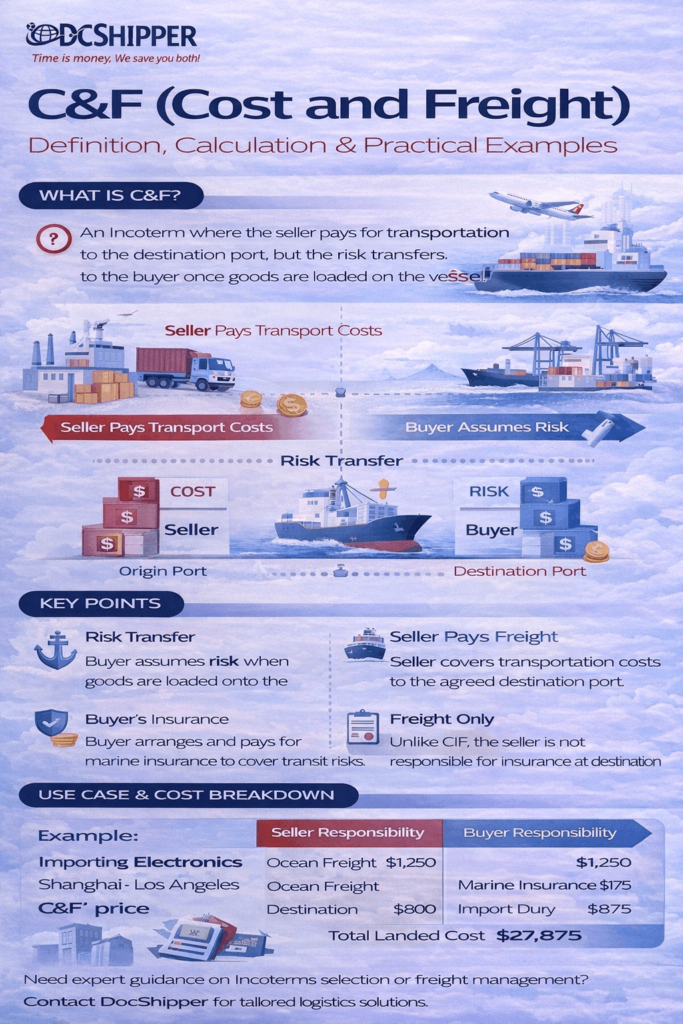
C&F (Cost and Freight) is an Incoterm where the seller pays transportation costs to the destination port, but risk transfers to the buyer once goods are loaded on the vessel. The buyer assumes responsibility for insurance, unloading, and customs clearance at destination.Introduction
Many importers confuse C&F with CIF, leading to unexpected insurance gaps and financial exposure. Understanding Cost and Freight is critical for properly allocating responsibilities in international shipping contracts.
This Incoterm plays a vital role in maritime trade, particularly for bulk commodities and containerized cargo. It defines a clear split between seller obligations (freight payment) and buyer risks (cargo insurance).
- Risk transfer: Occurs at ship’s rail at origin port
- Cost responsibility: Seller pays main carriage to destination
- Insurance obligation: Buyer must arrange cargo insurance
- Applicability: Sea and inland waterway transport only
- Documentation: Seller provides clean bill of lading
Understanding C&F Mechanics & Legal Framework
Under C&F terms, the seller fulfills delivery when goods pass the ship’s rail at the port of shipment. This creates a critical distinction: the seller pays for transportation but doesn’t bear the risk during transit.
The risk-cost dichotomy is C&F’s defining characteristic. While the seller contracts and pays for freight to the named destination port, the buyer assumes all risks from the moment of loading. This arrangement requires buyers to secure marine cargo insurance independently.
From a legal perspective, the seller must provide a clean on-board bill of lading indicating goods were loaded in apparent good condition. This document serves as proof of delivery and enables the buyer to claim goods at destination. According to ICC Incoterms® 2020, C&F is now designated as CFR to avoid confusion with trade terms.
The seller’s obligations include export clearance, loading costs, and main freight charges. The buyer handles import customs duties, destination port charges, unloading fees, and inland transportation. At DocShipper, we systematically clarify these cost allocations during contract negotiation to prevent disputes.
Critical documentation requirements include the commercial invoice, packing list, certificate of origin, and transport document. The seller must deliver these to enable customs clearance, even though the buyer manages the import process.
Practical Examples & Cost Calculations
Understanding C&F through real scenarios clarifies cost distribution and risk management strategies. Consider these comparative situations across different cargo types and routes.
| Cost Element | Seller Responsibility | Buyer Responsibility |
|---|---|---|
| Export customs clearance | ✓ | — |
| Loading at origin port | ✓ | — |
| Ocean freight | ✓ | — |
| Marine insurance | — | ✓ |
| Unloading at destination | — | ✓ |
| Import customs & duties | — | ✓ |
Use Case: Electronics Import from China to USA
- Product value (FOB): $50,000
- Ocean freight Shanghai-Los Angeles: $3,500 (seller pays)
- C&F price: $53,500
- Marine insurance (buyer): $350 (0.7% of cargo value)
- Destination charges (buyer): $800
- Import duty 3.5% (buyer): $1,872
- Total landed cost for buyer: $56,522
The insurance gap represents C&F’s primary risk. If cargo is damaged during transit, the buyer must file claims with their insurer. Without proper coverage, losses fall entirely on the buyer despite the seller arranging transportation.
For bulk commodities like grains or minerals, C&F is common because buyers often have established insurance programs. A 20,000-ton grain shipment at $300/ton CFR includes approximately $15,000 in freight costs paid by the seller, while the buyer secures insurance for the $6 million cargo value.
At DocShipper, we recommend buyers immediately arrange contingency insurance upon C&F contract signature to avoid coverage gaps between contract signing and policy activation.
Conclusion
C&F creates a clear division: sellers handle logistics costs while buyers manage risk through insurance. Understanding this split prevents costly misunderstandings in international trade contracts.
Need expert guidance on Incoterms selection or freight management? Contact DocShipper for tailored logistics solutions.
📚 Quiz
Test Your Knowledge: C&F (Cost and Freight)
Q1 — Under C&F (Cost and Freight) terms, who is responsible for arranging marine cargo insurance during transit?
Q2 — A common misconception about C&F is that the seller bears all risks until the goods arrive at the destination port, since they pay the freight. Is this correct?
Q3 — A US importer is sourcing electronics from China under C&F terms. The FOB price is $50,000 and the seller quotes $3,500 in ocean freight. The shipment is damaged at sea. Which scenario correctly describes the situation?
🎯 Your Result
📞 Free Quote in 24hFAQ | C&F (Cost and Freight): Definition, Calculation & Practical Examples
C&F requires the buyer to arrange insurance, while CIF includes insurance paid by the seller. CIF provides more protection for buyers but typically costs 0.5-1% more than C&F pricing.
Risk transfers when goods pass the ship's rail at the origin port during loading. From that moment, the buyer bears all risks despite the seller paying for transportation.
No. C&F applies only to sea and inland waterway transport. For air shipments, use CPT (Carriage Paid To) or CIP (Carriage and Insurance Paid To) instead.
The buyer pays all destination charges including unloading, unless the freight contract specifies "liner terms" where unloading is included in the freight rate paid by the seller.
Yes. The seller must handle and pay for all export customs formalities, documentation, and clearance fees at the origin country.
Minimum Institute Cargo Clauses (C) coverage, though Institute Cargo Clauses (A) providing all-risk coverage is recommended for valuable or fragile goods.
C&F price = FOB price + ocean freight cost to destination port. It excludes insurance, destination charges, and import duties which the buyer pays separately.
No. C&F specifies delivery to a seaport or inland waterway port only. For inland destinations, use CPT or DAP Incoterms instead.
The seller must provide a clean bill of lading, commercial invoice, packing list, and any documents required for export clearance or specified in the sales contract.
While technically applicable, CPT or CIP are preferred for containers since risk transfer "on vessel" is impractical with container handling. C&F works better for bulk or break-bulk cargo.
If damage occurs before goods cross the ship's rail, the seller remains responsible. Once loaded, the buyer's insurance must cover any damage during transit.
No. Terminal handling charges (THC), documentation fees, and port charges at destination are the buyer's responsibility unless explicitly stated otherwise in the contract.
Need Help with
Logistics or Sourcing ?
First, we secure the right products from the right suppliers at the right price by managing the sourcing process from start to finish. Then, we simplify your shipping experience - from pickup to final delivery - ensuring any product, anywhere, is delivered at highly competitive prices.


Fill the Form
Prefer email? Send us your inquiry, and we’ll get back to you as soon as possible.
Contact us




:%20Definition%20&%20Guide%20for%202026)