


In short ⚡
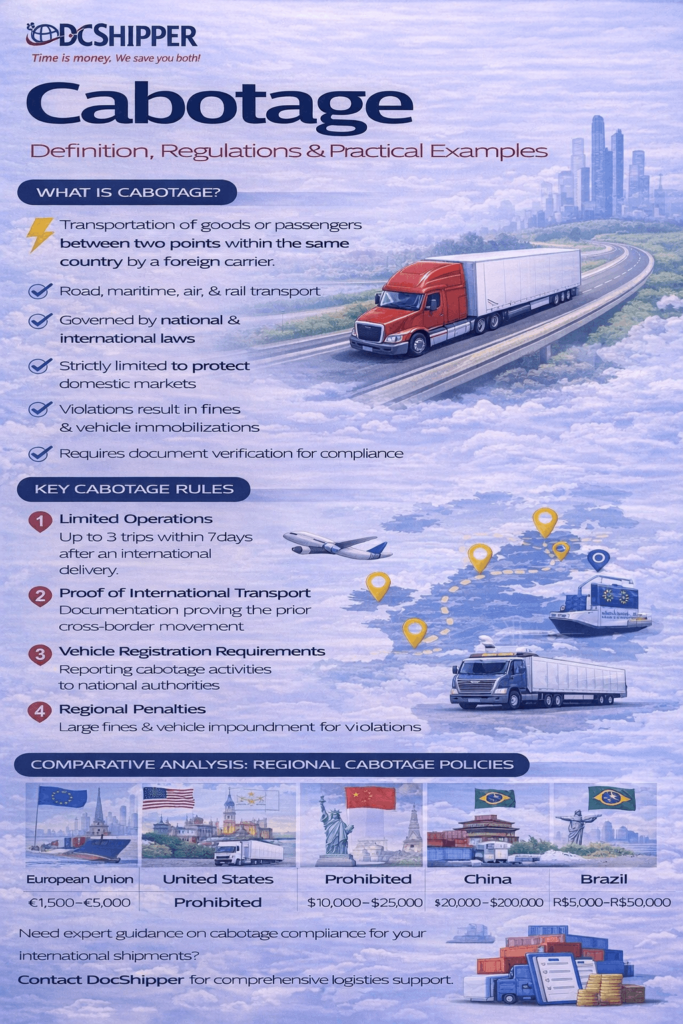
Cabotage refers to the transportation of goods or passengers between two points within the same country by a foreign carrier. This practice is strictly regulated in most jurisdictions to protect domestic transport markets while facilitating international trade operations.
Introduction
Many international carriers face unexpected fines or operational delays because they misunderstand cabotage restrictions. A truck delivering goods from Germany to France cannot simply pick up another load in Lyon and deliver it to Paris without specific authorization.
Cabotage regulations exist to balance free trade principles with protection of domestic transport industries. Understanding these rules is critical for logistics providers operating cross-border routes.
- Applies to road, maritime, air, and rail transport
- Governed by national laws and international agreements
- Limited permissions granted under specific conditions
- Violations result in substantial penalties and vehicle immobilization
- Requires precise documentation and compliance tracking
Regulatory Framework & Expertise
Cabotage regulations vary significantly by region and transport mode. In the European Union, road cabotage is permitted under strict conditions following an international transport operation. A non-resident carrier can perform up to three cabotage operations within seven days after completing an international delivery.
The United States prohibits cabotage entirely for most transport modes under the Jones Act (maritime) and similar legislation for trucking and aviation. Foreign vessels cannot transport goods between U.S. ports, and foreign trucks cannot operate domestic routes without specific exemptions.
In maritime transport, cabotage restrictions protect national shipping industries. Countries like Brazil, Indonesia, and India maintain strict cabotage regimes requiring domestic-flagged vessels for coastal shipping. The UNCTAD Review of Maritime Transport provides comprehensive analysis of these regulations globally.
Air cabotage remains heavily restricted worldwide despite liberalization efforts. Most countries reserve domestic passenger and cargo flights exclusively for national carriers, though bilateral agreements occasionally grant limited exceptions.
At DocShipper, we systematically verify cabotage compliance for all cross-border shipments to prevent costly violations and ensure seamless delivery execution.
Key compliance requirements include:
- Proof of international transport: CMR documents showing cross-border movement
- Time limitations: Strict windows for completing domestic operations
- Quantity restrictions: Maximum number of permitted cabotage movements
- Registration requirements: Advance notification to national authorities
- Vehicle specifications: Compliance with domestic technical standards
Practical Examples & Data
Understanding cabotage through real-world scenarios clarifies the practical implications of these regulations.
Use Case: EU Road Transport
A Polish trucking company delivers machinery from Warsaw to Barcelona. After unloading, the driver can legally perform cabotage operations within Spain:
- Day 1: Delivers international shipment in Barcelona
- Day 2: Picks up domestic load in Barcelona, delivers to Madrid (Cabotage 1)
- Day 3: Picks up in Madrid, delivers to Valencia (Cabotage 2)
- Day 5: Picks up in Valencia, delivers to Seville (Cabotage 3)
- Day 7: Must exit Spain or remain empty until day 8
Violation of the seven-day rule results in fines ranging from €1,500 to €5,000 per infraction.
Comparative Analysis: Regional Approaches
| Region/Country | Road Cabotage | Maritime Cabotage | Penalty Range |
|---|---|---|---|
| European Union | Limited (3 operations/7 days) | Unrestricted within EU | €1,500–€5,000 |
| United States | Prohibited | Prohibited (Jones Act) | $10,000–$25,000 |
| China | Prohibited | Restricted (gradual opening) | ¥20,000–¥200,000 |
| Australia | Limited permits | Restricted (coastal licensing) | AUD $6,600–$66,000 |
| Brazil | Prohibited | Strictly prohibited | R$5,000–R$50,000 |
Industry Impact Data
According to European Commission studies, approximately 12% of all road freight movements in the EU involve cabotage operations. This represents significant efficiency gains for international carriers while maintaining domestic market protection.
Enforcement has intensified with digital tachograph monitoring and automated border systems. In 2023, French authorities issued over 3,200 cabotage violations, with German and Italian enforcement agencies reporting similar increases.
Conclusion
Cabotage regulations represent a complex balance between trade facilitation and domestic market protection. Compliance requires detailed knowledge of jurisdiction-specific rules, precise timing, and meticulous documentation. Violations carry substantial financial and operational consequences that can disrupt supply chains.
Need expert guidance on cabotage compliance for your international shipments? Contact DocShipper for comprehensive logistics support.
📚 Quiz
Test Your Knowledge: Cabotage
Q1 — What does "cabotage" mean in international logistics?
Q2 — Under EU regulations, how many cabotage operations can a non-resident carrier perform after completing an international delivery, and within what timeframe?
Q3 — A German trucking company delivers goods from Berlin to Chicago. On the return leg, the driver picks up a domestic load in New York and delivers it to Los Angeles. Is this permitted under U.S. law?
🎯 Your Result
📞 Free Quote in 24hFAQ | Cabotage: Definition, Regulations & Practical Examples
Cabotage involves domestic transport within a foreign country, while cross-trade refers to international shipments where neither origin nor destination is the carrier's home country. Both require specific authorizations but operate under different regulatory frameworks.
Yes, under USMCA (formerly NAFTA) provisions, U.S. carriers can perform limited cabotage operations in Canada after completing an international delivery, subject to provincial regulations and specific conditions similar to EU rules.
Enforcement agencies use digital tachographs, GPS tracking, CMR document verification, border crossing records, and roadside inspections. Automated systems increasingly cross-reference international delivery data with subsequent domestic movements to detect violations.
Rail cabotage regulations exist but vary widely. The EU generally allows unrestricted rail cabotage for licensed operators, while countries like Russia and China maintain strict domestic market protections requiring special permissions for foreign rail operators.
Essential documents include the international CMR showing cross-border transport, domestic waybills for cabotage operations, driver tachograph records, vehicle registration, operator license, and timestamps proving compliance with time restrictions.
Generally no. Cabotage permissions are vehicle-specific and tied to the carrier that performed the international transport. Subcontracting domestic legs to local operators would constitute normal domestic transport requiring appropriate local licensing.
Post-Brexit, UK carriers lost automatic cabotage rights in EU countries and vice versa. Current arrangements allow limited cabotage (2 operations within 7 days) under bilateral agreements, with ongoing negotiations potentially modifying these terms.
Empty repositioning generally does not constitute cabotage since no goods are transported. However, authorities may scrutinize patterns suggesting systematic use of "empty" movements to circumvent regulations, particularly if combined with undocumented cargo.
Repeat offenders face escalating sanctions including higher fines, temporary operating license suspension, vehicle immobilization, permanent market access bans, and potential criminal charges for systematic regulatory evasion in some jurisdictions.
Yes, though enforcement varies. Express carriers operating integrated networks often hold specific licenses permitting domestic operations. Small parcel movements may receive less scrutiny, but regulations technically apply regardless of shipment size.
Cabotage restrictions typically increase transport costs by preventing optimal vehicle utilization. Carriers cannot freely combine international and domestic loads, leading to empty return trips and reduced efficiency that translates into higher freight rates.
No global harmonization exists. Regional agreements like the EU create uniform frameworks within their territories, but worldwide approaches vary dramatically from complete prohibition to limited permissions, reflecting different economic priorities and market protection strategies.
Need Help with
Logistics or Sourcing ?
First, we secure the right products from the right suppliers at the right price by managing the sourcing process from start to finish. Then, we simplify your shipping experience - from pickup to final delivery - ensuring any product, anywhere, is delivered at highly competitive prices.


Fill the Form
Prefer email? Send us your inquiry, and we’ll get back to you as soon as possible.
Contact us




