


In short ⚡
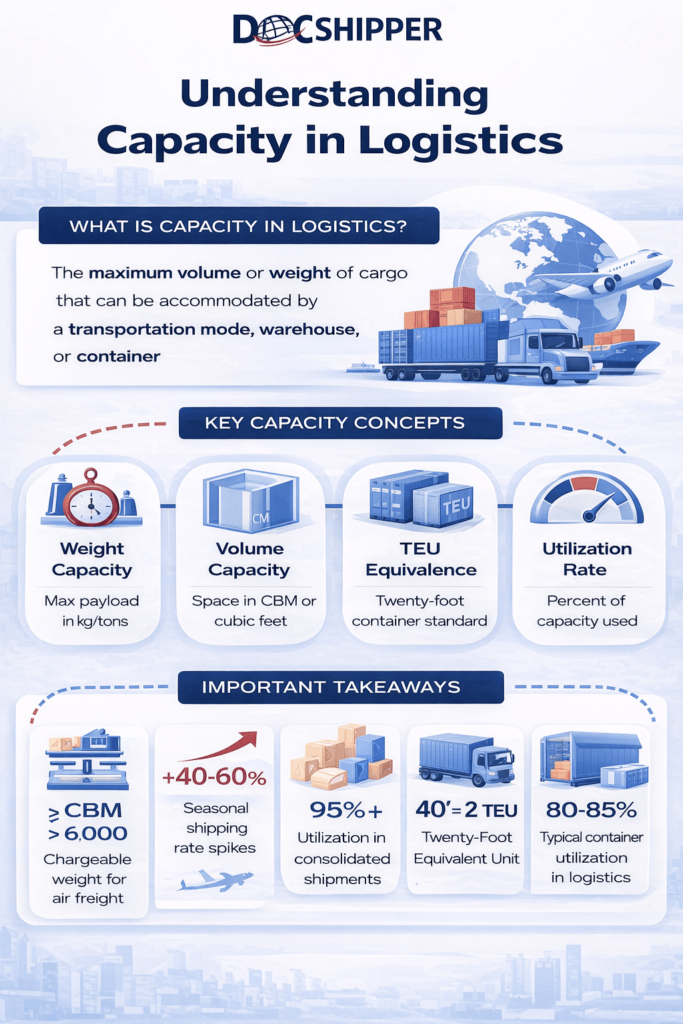
Capacity refers to the maximum volume or weight of cargo that a transportation mode, warehouse, or container can physically accommodate. In international logistics, capacity determines shipping costs, route selection, and consolidation strategies, directly impacting transit times and profitability for import/export operations.Introduction
Shippers frequently confuse capacity with available space, leading to unexpected surcharges or rejected bookings. Understanding capacity constraints prevents costly demurrage fees and route delays.
In global trade, capacity governs every logistics decision—from container selection to warehouse allocation. Accurate capacity planning ensures optimal load utilization and cost efficiency.
- Weight capacity: Maximum payload measured in kilograms or metric tons
- Volume capacity: Cubic meters (CBM) or cubic feet available for cargo
- TEU equivalence: Twenty-foot Equivalent Unit standardizes container measurements
- Payload vs. tare weight: Distinction between cargo weight and vehicle/container weight
- Utilization rate: Percentage of capacity actually used in shipments
Capacity Fundamentals & Expert Insights
Transportation capacity operates under dual constraints: volumetric limits and weight restrictions. Carriers apply whichever threshold is reached first, making dimensional weight calculations critical for air freight.
Standard containers follow ISO specifications. A 20-foot container (1 TEU) offers approximately 33 cubic meters and supports 21,750 kg maximum gross weight. A 40-foot container (2 TEU) provides 67 cubic meters with similar weight limits per axle regulations.
Maritime capacity faces additional complexities. Slot allocation on vessels depends on booking classes, with premium rates securing guaranteed space during peak seasons. Port congestion can reduce effective capacity by 15-30% during high-volume periods.
Warehouse capacity calculations must account for pallet positions, aisle requirements, and vertical clearance. A facility with 10,000 square meters may only achieve 6,500 usable pallet positions due to operational constraints.
Regulatory frameworks impact capacity utilization. The European Union’s weight directives limit truck loads to 44 tonnes gross vehicle weight, while U.S. federal limits reach 36 tonnes without special permits.
At DocShipper, we optimize capacity planning by analyzing cargo density, selecting appropriate equipment, and negotiating slot guarantees with carriers to prevent space allocation failures during your critical shipping windows.
Practical Calculations & Real-World Data
Capacity planning requires precise calculations to avoid underutilization penalties or overweight surcharges. Air freight applies volumetric weight formulas: (Length × Width × Height in cm) ÷ 6,000 = chargeable weight in kg.
| Transport Mode | Standard Capacity | Weight Limit | Typical Utilization |
|---|---|---|---|
| 20′ Container (TEU) | 33 m³ | 21,750 kg | 85-92% |
| 40′ High Cube | 76 m³ | 26,580 kg | 80-88% |
| Air Freight (B747-400F) | 600 m³ | 124,000 kg | 70-75% |
| Standard Pallet (EUR) | 1.2 m³ | 1,500 kg | 90-95% |
| FTL Truck (EU) | 90 m³ | 24,000 kg | 82-87% |
Case Study: A textile importer ships 500 cartons (each 60×40×40 cm, 12 kg) from Bangladesh to France. Volume = 500 × 0.096 m³ = 48 m³. Weight = 6,000 kg. A 40′ container (67 m³ capacity) appears suitable, but stacking limitations reduce usable space to 52 m³, requiring careful loading to achieve 92% utilization.
Warehouse capacity planning follows the 80/20 rule: maintain 20% buffer capacity to accommodate demand fluctuations. A facility handling 5,000 pallets should design for 6,250 positions to prevent overflow during peak periods.
Seasonal capacity constraints affect pricing. Ocean freight rates increase 40-60% during Q4 as retailers secure container slots for holiday inventory. Advanced booking guarantees capacity at negotiated rates.
Consolidation maximizes capacity efficiency. LCL (Less than Container Load) shipments combine multiple consignees’ cargo, achieving 95%+ container utilization compared to 70-80% for single-shipper loads.
Conclusion
Mastering capacity calculations prevents costly logistics errors and ensures optimal resource allocation. Accurate planning transforms capacity from a constraint into a competitive advantage in international trade.
Need expert guidance on capacity optimization for your shipments? Contact DocShipper for tailored logistics solutions.
📚 Quiz
Test Your Knowledge: Capacity
Q1 — What does "capacity" refer to in international logistics?
Q2 — A shipper has a cargo that fills a container volumetrically but is still well under the weight limit. Which constraint does the carrier apply?
Q3 — A textile importer needs to ship 48 m³ of cargo. A 40' container has a nominal capacity of 67 m³. Can the importer assume the full 67 m³ is usable?
🎯 Your Result
📞 Free Quote in 24hFAQ | Capacity: Definition, Calculation & Practical Examples
Weight capacity measures maximum payload in kilograms or tons, while volume capacity refers to cubic space available. Carriers charge based on whichever limit is reached first.
Multiply length × width × height in centimeters, then divide by 6,000. Compare this to actual weight—the higher value determines your chargeable weight.
TEU (Twenty-foot Equivalent Unit) standardizes container measurements. A 40-foot container equals 2 TEU, simplifying capacity planning and vessel slot allocation across global shipping routes.
No. Exceeding weight limits violates safety regulations and carrier terms. Overweight containers face rejection at ports or additional surcharges, potentially delaying your entire shipment.
Low-density cargo (e.g., textiles) reaches volume limits before weight limits. High-density goods (e.g., metals) hit weight thresholds first, requiring smaller containers despite available space.
Effective capacity accounts for operational space—aisles, loading docks, equipment zones. Actual usable capacity is typically 60-70% of total square footage in modern facilities.
Q4 demand reduces available container slots by 30-40%, increasing rates and requiring advance bookings. Capacity guarantees through long-term carrier contracts mitigate peak-season constraints.
EU trucks limit gross vehicle weight to 44 tonnes, with payload around 24 tonnes after tare weight. U.S. federal limits reach 36 tonnes, varying by state regulations and axle configurations.
LCL consolidation combines multiple shipments, achieving 95%+ container utilization versus 70-80% for single loads. This reduces per-unit shipping costs while maintaining service levels.
Underestimation causes split shipments, increased handling fees, and extended transit times. Accurate capacity planning prevents these costs through proper container selection and load optimization.
Vessels measure capacity in TEU (containers) and deadweight tonnage (total cargo weight). Modern mega-ships carry 20,000+ TEU, but port infrastructure and draft restrictions limit effective capacity.
No. Capacity is fixed at booking. Last-minute changes require rebooking, often at premium rates with no space guarantees. Accurate forecasting and buffer planning prevent capacity shortfalls.
Need Help with
Logistics or Sourcing ?
First, we secure the right products from the right suppliers at the right price by managing the sourcing process from start to finish. Then, we simplify your shipping experience - from pickup to final delivery - ensuring any product, anywhere, is delivered at highly competitive prices.


Fill the Form
Prefer email? Send us your inquiry, and we’ll get back to you as soon as possible.
Contact us




