


In short ⚡
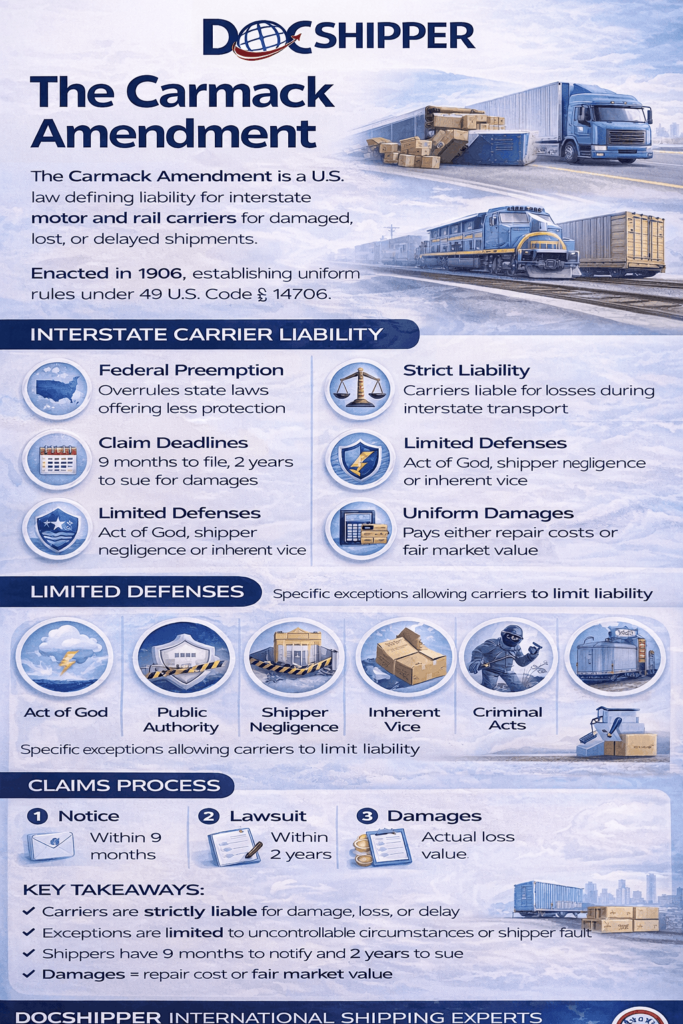
The Carmack Amendment is a U.S. federal law establishing uniform liability standards for interstate motor and rail carriers when goods are lost, damaged, or delayed in transit. Enacted in 1906 and codified under 49 U.S.C. § 14706, it preempts state laws and limits carrier defenses, ensuring shippers can recover damages without proving negligence.
Introduction
When goods disappear or arrive damaged during interstate shipment, determining who pays becomes complex. Many importers and exporters mistakenly believe they must prove carrier negligence to recover losses. The Carmack Amendment eliminates this burden by imposing strict liability on carriers, streamlining claims and protecting shippers’ rights.
This federal statute governs virtually all interstate freight movements by truck and rail in the United States. It establishes clear rules for filing claims, calculating damages, and limiting carrier defenses. Understanding Carmack’s scope is essential for businesses managing cross-border logistics or domestic distribution networks.
Key characteristics of the Carmack Amendment include:
- Federal preemption of conflicting state cargo liability laws
- Strict liability standard requiring carriers to deliver goods in original condition
- Mandatory claim procedures with specific notice and filing deadlines
- Uniform damage calculations based on actual loss or diminished value
- Limited defenses available only for acts of God, shipper negligence, or inherent vice
Legal Framework & Carrier Obligations
The Carmack Amendment creates a presumption of carrier liability once a shipper demonstrates three elements: delivery of goods in good condition to the carrier, arrival in damaged condition, and the amount of damages. This shifts the burden to the carrier to prove an exception applies.
Strict liability standard means carriers cannot escape responsibility by showing they exercised reasonable care. The law treats carriers as virtual insurers of cargo, responsible regardless of fault. This applies to both motor carriers under 49 U.S.C. § 14706 and rail carriers under 49 U.S.C. § 11706.
Federal preemption prevents shippers from pursuing state-law claims for breach of contract, negligence, or conversion when Carmack applies. Courts consistently dismiss such parallel claims, requiring exclusive reliance on Carmack’s remedies. This ensures nationwide uniformity but limits recovery options.
Claim filing requirements mandate written notice within nine months and lawsuit filing within two years from delivery date (or reasonable delivery date for lost goods). Carriers may contractually shorten these periods to nine months for lawsuits, but cannot eliminate the notice requirement entirely.
Limitation of liability provisions allow carriers to cap damages at declared values if they offer shippers the choice between higher liability at increased rates or lower liability at reduced rates. This option must be clearly disclosed in the bill of lading. At DocShipper, we carefully review these provisions to ensure clients understand their coverage options before shipment.
The statute recognizes only narrow defenses: Act of God (unforeseeable natural disasters), public enemy (wartime actions), shipper’s fault (improper packaging), inherent vice (natural deterioration), and public authority (government seizure). Carriers bear the burden of proving these exceptions apply, as detailed in guidance from the Federal Motor Carrier Safety Administration.
Practical Examples & Case Studies
Understanding Carmack’s application requires examining real-world scenarios. The following examples illustrate how courts interpret carrier liability and damage calculations in different contexts.
Comparative Liability Scenarios
| Scenario | Carrier Defense | Court Outcome | Shipper Recovery |
|---|---|---|---|
| Electronics damaged by forklift during unloading | Warehouse contractor negligence | Carrier liable (agent relationship) | Full replacement cost: $45,000 |
| Perishable goods spoiled in transit | Refrigeration unit failure (mechanical) | Carrier liable (equipment maintenance duty) | Market value at destination: $22,000 |
| Machinery rust damage after delivery | Inadequate shipper packaging | Carrier not liable (shipper fault proven) | $0 (claim denied) |
| Cargo theft from locked trailer | Criminal act (third party) | Carrier liable (strict liability applies) | Invoice value minus salvage: $78,000 |
| Hurricane-related delay causing spoilage | Act of God (Category 4 storm) | Carrier not liable (defense established) | $0 (force majeure accepted) |
Use Case: Electronics Importer Claim
Situation: A California-based electronics distributor shipped 500 laptops valued at $400,000 from Texas to New York via interstate motor carrier. Upon delivery, 120 units showed water damage from roof leakage during a rainstorm.
Carrier’s Defense: The carrier argued the storm constituted an Act of God, exempting them from liability. They provided weather reports showing severe conditions along the route.
Resolution: The court ruled against the carrier. While the storm was unforeseeable, the carrier failed to prove the trailer roof was properly maintained. Carmack’s strict liability meant the carrier should have ensured weatherproof equipment. The shipper recovered $96,000 (120 units × $800 wholesale value), minus $4,000 salvage value for damaged units sold as refurbished.
Key Takeaways:
- Act of God defense requires proof the event was both unforeseeable and the sole cause
- Equipment maintenance failures negate natural disaster defenses
- Damages equal replacement cost at destination, not original purchase price
- Salvage values reduce net recovery amounts
- Timely documentation (photos, inspection reports) strengthens claims significantly
At DocShipper, we systematically document cargo conditions at origin and destination, ensuring clients have the evidence needed to support Carmack claims when transit damage occurs.
Conclusion
The Carmack Amendment provides essential protection for shippers by imposing strict liability on interstate carriers, eliminating the need to prove negligence. Mastering its claim procedures, damage calculations, and limited defenses ensures effective recovery when cargo losses occur.
Need expert guidance on carrier liability or freight claims management? Contact DocShipper for comprehensive logistics support tailored to your international shipping needs.
📚 Quiz
Test Your Knowledge: Carmack Amendment
Q1 — What does the Carmack Amendment primarily establish for interstate carriers in the U.S.?
Q2 — A carrier's trailer roof leaks during a rainstorm, damaging a shipper's electronics. The carrier claims "Act of God." Under the Carmack Amendment, what is the most likely outcome?
Q3 — A U.S. importer's goods are damaged during a shipment from Los Angeles to Chicago. Which legal approach is correct under the Carmack Amendment?
🎯 Your Result
📞 Free Quote in 24hFAQ | Carmack Amendment: Definition, Liability & Practical Examples
No. Carmack only governs interstate movements within the United States. International shipments fall under the Hague-Visby Rules, Warsaw Convention, or CMR Convention depending on transport mode and countries involved.
Generally no. Brokers arranging transportation without assuming carrier responsibilities are not liable. However, if a broker holds itself out as a carrier or fails to disclose its broker status, courts may impose Carmack liability.
Shippers must file written claims within nine months of delivery and initiate lawsuits within two years. Carriers may contractually reduce the lawsuit period to nine months if properly disclosed in the bill of lading.
Damages equal the market value of goods at destination on the scheduled delivery date, minus salvage value. Courts may award replacement cost if market value cannot be determined, but consequential damages (lost profits) are generally excluded.
Yes, but only if they offer shippers a choice between full liability at higher rates and limited liability at lower rates. The limitation must be clearly stated, and shippers must have a reasonable opportunity to declare higher values.
Written notice must identify the shipment, describe the loss or damage, and state a claim amount. While formal claim forms are preferable, courts accept emails or letters meeting these requirements as sufficient notice.
No. The amendment addresses loss, damage, or injury to goods, but not purely economic losses from late delivery unless the delay directly causes physical damage (e.g., perishable goods spoiling).
Yes. Carmack imposes joint and several liability on all carriers in the transportation chain. Shippers may sue any participating carrier, which can then seek contribution from other carriers through separate proceedings.
Three elements: (1) delivery to carrier in good condition, (2) arrival in damaged condition or non-delivery, and (3) amount of damages. Bills of lading, delivery receipts, photos, and repair estimates typically satisfy this burden.
Very limited. Courts allow state-law claims for conduct independent of the transportation contract, such as fraud or intentional conversion. However, claims merely relabeling Carmack violations as state torts are consistently dismissed.
Insurance provides additional protection but does not replace Carmack rights. Insurers paying claims typically subrogate to the shipper's Carmack claim against the carrier, pursuing recovery through the same federal liability framework.
No. Carmack's strict liability applies even when damage is not apparent at delivery. However, shippers must provide timely notice once damage is discovered, and delayed reporting may weaken the causal connection to transit.
Need Help with
Logistics or Sourcing ?
First, we secure the right products from the right suppliers at the right price by managing the sourcing process from start to finish. Then, we simplify your shipping experience - from pickup to final delivery - ensuring any product, anywhere, is delivered at highly competitive prices.


Fill the Form
Prefer email? Send us your inquiry, and we’ll get back to you as soon as possible.
Contact us




