



In short ⚡
Final Assembly Schedule (FAS) is a production timetable that defines when and how finished products will be assembled from component parts and subassemblies. This schedule translates the Master Production Schedule (MPS) into specific build instructions, coordinating labor, machinery, and materials to meet customer delivery commitments while optimizing manufacturing capacity.
Introduction
Manufacturing delays cost businesses an average of 23% in potential revenue, often stemming from poor coordination between production planning and actual assembly execution. The Final Assembly Schedule bridges this gap by converting strategic production plans into actionable shop floor directives.
In global supply chains, where components arrive from multiple suppliers across continents, the FAS becomes the critical control point. It determines when Vietnamese electronics meet German precision components on an assembly line in Mexico, ensuring synchronization without excess inventory.
Key characteristics of effective FAS implementation include:
- Time-phased scheduling: Allocates assembly tasks to specific time periods (hours, shifts, days)
- Resource allocation: Assigns workstations, tooling, and personnel to each assembly operation
- Component availability verification: Confirms all parts are present before initiating builds
- Customer order linkage: Traces each assembly back to specific sales orders or forecasts
- Capacity constraint management: Balances demand against realistic production capabilities
FAS Mechanics & Strategic Implementation
The Final Assembly Schedule operates as the operational translation layer between high-level production planning and physical manufacturing execution. Unlike the Master Production Schedule which forecasts overall production volumes, the FAS specifies exact configurations, sequences, and timing.
This schedule typically covers a planning horizon of 1-4 weeks, with daily or shift-level granularity. In industries with high product customization like automotive or aerospace, the FAS must accommodate thousands of configuration permutations while maintaining assembly line flow.
Three critical inputs feed FAS generation:
- Customer orders: Confirmed sales with specific delivery dates and product specifications
- Bill of Materials (BOM): Complete component lists defining what parts comprise each finished product
- Routing data: Sequential assembly steps with standard work times for each operation
Modern FAS systems integrate with Manufacturing Execution Systems (MES) to provide real-time visibility. According to APICS research, companies using integrated FAS-MES platforms reduce assembly errors by 34% compared to manual scheduling approaches.
The schedule must balance level loading (maintaining consistent workstation utilization) against sequence flexibility (accommodating urgent orders). Advanced algorithms evaluate multiple scenarios to optimize metrics like setup time reduction, material handling efficiency, and on-time delivery performance.
At DocShipper, we coordinate FAS requirements with international component shipments, ensuring customs clearance and final-mile delivery align with your assembly deadlines. This synchronization prevents costly production stoppages caused by missing imported parts.
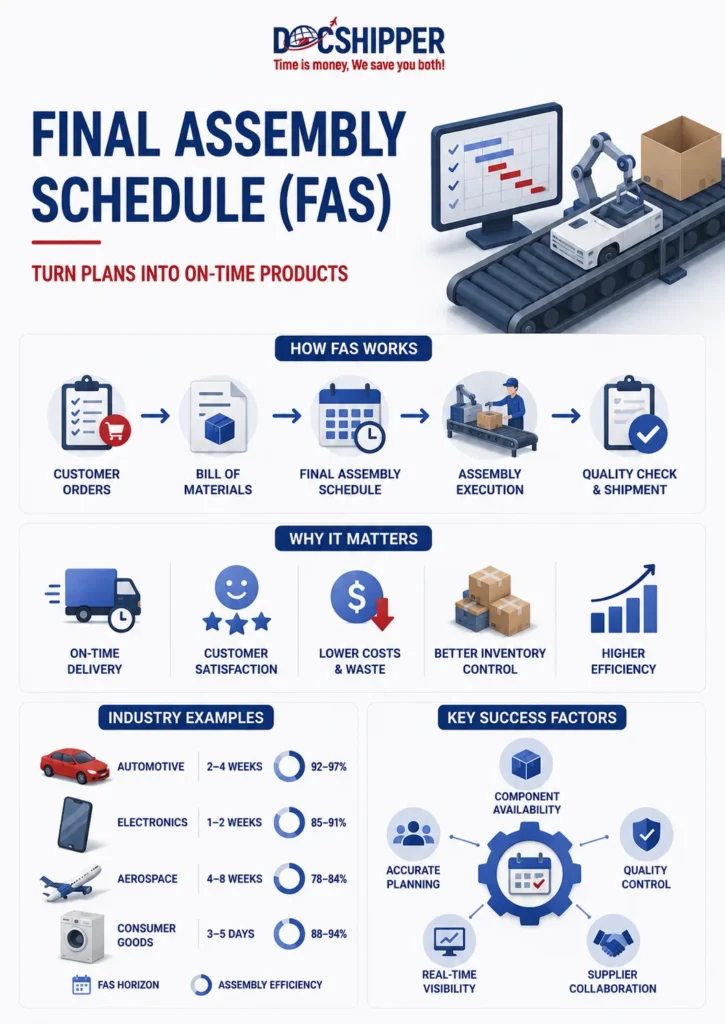
Industry Applications & Performance Data
FAS application varies dramatically across manufacturing sectors, with automotive and electronics demonstrating the most sophisticated implementations. Industry-specific scheduling logic accounts for unique constraints like paint curing times, cleanroom protocols, or regulatory testing requirements.
Automotive Sector Use Case
A European car manufacturer produces 1,200 vehicles daily across 47 model variants. Their FAS sequences assembly based on:
- Paint color grouping: Minimizes changeover waste between similar colors
- Option complexity: Distributes high-option vehicles throughout the schedule to prevent line congestion
- Supplier JIT delivery windows: Sequences builds to match component arrival from 280+ tier-one suppliers
This approach achieved 98.7% on-time completion with inventory turns increasing from 18 to 34 annually.
Comparative Performance Metrics
| Industry | FAS Horizon | Schedule Changes/Week | Assembly Efficiency |
|---|---|---|---|
| Automotive | 2-4 weeks | 12-18 | 92-97% |
| Electronics | 1-2 weeks | 25-40 | 85-91% |
| Aerospace | 4-8 weeks | 3-7 | 78-84% |
| Consumer Goods | 3-5 days | 8-15 | 88-94% |
Electronics manufacturing shows higher schedule volatility due to rapid demand shifts and shorter product lifecycles. Companies like Foxconn adjust their FAS up to 40 times weekly, responding to customer forecast revisions and component availability changes.
Critical Success Factors
Analysis of 180 manufacturing facilities identified five elements distinguishing top FAS performers:
- Component buffer accuracy: Maintaining safety stock at ±5% of calculated requirements
- Sequence adherence: Completing builds within 15 minutes of scheduled start times
- Cross-functional visibility: Real-time FAS access for procurement, logistics, and quality teams
- Exception handling protocols: Defined escalation paths when components are delayed or defective
- Frozen zone discipline: Preventing changes to the schedule within the immediate 24-48 hour window
Companies achieving above 95% schedule attainment share common practices: they update FAS parameters weekly based on actual performance data, conduct daily constraint reviews, and maintain collaborative relationships with key suppliers to anticipate disruptions.
Conclusion
The Final Assembly Schedule transforms production strategy into executable manufacturing reality, directly impacting delivery performance and operational costs. Effective FAS management requires balancing precision planning with adaptive flexibility as market conditions and supply chain realities evolve.
Need assistance coordinating international component flows with your assembly schedule? Contact DocShipper to ensure your global supply chain supports, rather than disrupts, your production commitments.
📚 Quiz
Test Your Knowledge: Final Assembly Schedule (FAS)
What is the primary purpose of a Final Assembly Schedule (FAS)?
How does FAS typically balance production efficiency with schedule flexibility?
A European automotive manufacturer needs to integrate 280+ supplier deliveries with their assembly line producing 1,200 vehicles daily. Which FAS application best addresses this challenge?
🎯 Your Results
📞 Free Personalized QuoteFAQ | Final Assembly Schedule (FAS): Definition, Process & Industry Examples
The Master Production Schedule defines what products to build and in what quantities over a medium-term horizon (typically 3-18 months). The Final Assembly Schedule translates those volumes into specific build sequences with exact timing, configurations, and resource assignments for the immediate production period (days to weeks). MPS focuses on aggregate capacity planning, while FAS manages operational execution.
Update frequency depends on industry volatility and product complexity. High-volume automotive plants typically update daily with minor adjustments, maintaining a frozen period of 2-5 days where no changes are permitted. Electronics manufacturers may update twice daily due to rapid demand shifts. Aerospace companies often work with weekly updates given longer lead times and stability requirements. The key is balancing responsiveness against manufacturing stability.
Yes, through reserved capacity slots and priority sequencing logic. Effective FAS systems allocate 5-15% capacity for expedited orders, inserting them at designated points without cascading delays. This requires real-time component availability verification and may involve shifting lower-priority builds. Companies handling frequent rush orders often maintain dedicated fast-track assembly lines to isolate disruption from standard production flows.
Enterprise Resource Planning (ERP) systems like SAP, Oracle, and Microsoft Dynamics contain FAS modules integrated with materials management and shop floor control. Specialized Manufacturing Execution Systems (MES) from Siemens, Rockwell, and Dassault provide advanced scheduling algorithms with real-time production feedback. Many manufacturers use Advanced Planning and Scheduling (APS) tools like Preactor or Asprova for complex optimization scenarios involving multiple constraints and objectives.
Modern FAS systems incorporate exception management workflows that automatically identify impacted builds when components are unavailable or rejected. The system evaluates alternative sequencing options, substituting similar products that use available materials or rescheduling affected units to later time slots. Critical shortages trigger alerts to procurement and supply chain teams for expedited resolution. Quality defects may require FAS adjustments if rework delays subsequent operations.
Planning horizons balance visibility needs against forecast accuracy. Short horizons (3-7 days) maintain high accuracy but limit suppliers' preparation time. Extended horizons (4+ weeks) provide better supplier coordination but increase schedule change frequency as forecasts deteriorate. Best practice establishes a firm frozen zone (1-3 days), a slushy zone allowing limited changes (4-10 days), and a liquid zone for planning purposes (11+ days). Horizon length should match cumulative component lead times.
FAS enables JIT by providing suppliers with precise build schedules, allowing them to deliver components hours before assembly rather than days or weeks. The schedule signals exact quantities and timing, eliminating guesswork and reducing inventory holding costs. Effective JIT-FAS integration requires reliable suppliers, robust communication systems, and geographic proximity to minimize transportation variability. Companies typically start with high-value or bulky components before expanding JIT to smaller items.
Key performance indicators include schedule attainment rate (percentage of planned builds completed on time), assembly line utilization percentage, changeover frequency and duration, component stockout incidents, finished goods inventory turns, and on-time delivery to customers. Leading manufacturers track schedule stability by measuring changes made within frozen periods and average time between schedule generation and execution. Benchmark targets vary by industry but top performers achieve 95%+ schedule attainment.
Each additional option multiplies potential product configurations, exponentially increasing scheduling complexity. A product line with 20 optional features creates over 1 million possible variants. FAS systems address this through modular scheduling, grouping similar configurations to minimize changeovers, and constraint-based sequencing that evaluates assembly line capabilities. Companies with extreme customization often use configured-to-order production strategies where FAS is generated only after receiving customer specifications.
FAS serves as the pacemaker for lean production flows, setting the rhythm for upstream component manufacturing and downstream distribution. By stabilizing assembly sequences, FAS enables kanban systems, reduces work-in-process inventory, and highlights process bottlenecks. Lean practitioners use FAS to implement heijunka (production leveling), distributing different product types evenly across the schedule to smooth demand on suppliers and internal operations. Schedule stability is fundamental to achieving lean's waste reduction objectives.
New product introductions require phased FAS approaches starting with pilot builds at reduced volumes to validate processes and identify issues. Initial schedules incorporate extended cycle times and buffer capacity to accommodate learning curves. As production stabilizes, FAS gradually increases volumes and tightens timing. Successful launches maintain parallel scheduling for existing products while ring-fencing resources for new items. Companies typically freeze design changes 60-90 days before launch to allow FAS finalization and supplier preparation.
Yes, through multiple mechanisms. Optimized sequencing reduces setup times by grouping similar products, potentially saving 15-30% of changeover-related downtime. Improved material synchronization decreases expediting costs and inventory carrying expenses by 20-40%. Better capacity utilization increases throughput without capital investment. Schedule stability reduces quality defects associated with rushed production. Companies implementing advanced FAS optimization typically achieve 8-15% total manufacturing cost reductions within the first year.
Need Help with
Logistics or Sourcing ?
First, we secure the right products from the right suppliers at the right price by managing the sourcing process from start to finish. Then, we simplify your shipping experience - from pickup to final delivery - ensuring any product, anywhere, is delivered at highly competitive prices.


Fill the Form
Prefer email? Send us your inquiry, and we’ll get back to you as soon as possible.
Contact us




:%20Definition%20&%20Guide%20for%202026)