


In short ⚡
Final Assembly is the concluding stage of manufacturing where all pre-fabricated components, sub-assemblies, and parts are integrated into a complete, functional product ready for quality testing, packaging, and shipment. This critical phase bridges production and distribution, directly impacting delivery timelines and customer satisfaction.Introduction
Many businesses underestimate the complexity of final assembly, treating it as a simple “putting pieces together” task. This misconception leads to costly delays, quality issues, and customer dissatisfaction. In reality, final assembly represents a strategic node where supply chain efficiency meets product quality standards.
In international trade and manufacturing logistics, this phase determines whether products ship on time or remain stuck in production facilities. Understanding its mechanics helps businesses optimize inventory management, reduce lead times, and maintain competitive advantage.
Key characteristics of effective final assembly include:
- Component synchronization – ensuring all parts arrive simultaneously to avoid production bottlenecks
- Quality control integration – implementing inspection checkpoints throughout the assembly line
- Workstation ergonomics – optimizing worker efficiency and reducing assembly errors
- Documentation compliance – maintaining traceability for regulatory requirements and warranty claims
- Packaging readiness – coordinating with logistics teams for immediate post-assembly handling
Process & Strategic Importance
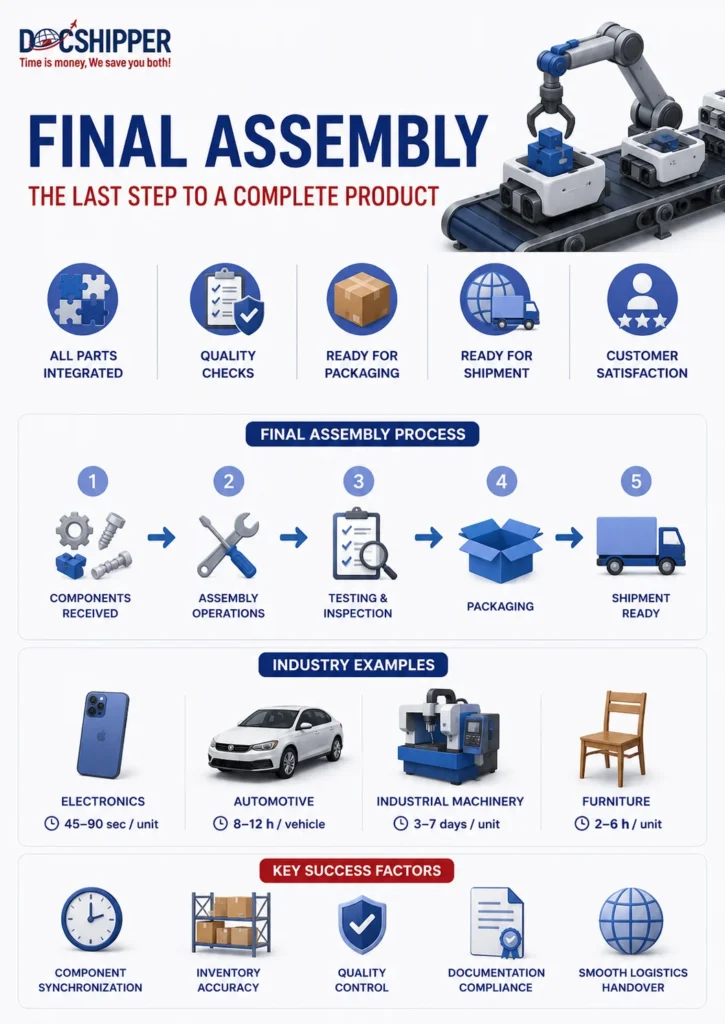
Final assembly operates as a convergence point where component sourcing, inventory management, and quality assurance intersect. The process typically follows a sequential or modular approach, depending on product complexity and production volume.
In sequential assembly, products move through fixed stations where workers perform specific tasks. This method suits high-volume, standardized products like electronics or appliances. Conversely, modular assembly allows flexible configuration, ideal for customized orders in automotive or industrial equipment sectors.
The Bill of Materials (BOM) serves as the blueprint for final assembly, listing every component, quantity, and specification. Accurate BOM management prevents assembly delays caused by missing parts. According to ISO 9001:2015 standards, manufacturers must maintain documented procedures for material verification and assembly sequencing.
Critical considerations during final assembly include torque specifications for fasteners, electrical connectivity testing, and cosmetic inspections. Each checkpoint reduces the risk of field failures and warranty claims. For international shipments, assembly teams must also verify that products meet destination country certifications (CE marking, FCC compliance, etc.).
At DocShipper, we coordinate with manufacturers to ensure final assembly aligns with shipping schedules. Our quality control teams conduct pre-shipment inspections at this stage, verifying that products meet contractual specifications before entering the logistics chain. This proactive approach prevents costly returns and customs rejections.
Concrete Examples & Industry Data
Final assembly practices vary significantly across industries. Understanding these differences helps businesses benchmark their processes and identify improvement opportunities.
Industry Comparison
| Industry | Assembly Cycle Time | Defect Rate | Primary Challenge |
|---|---|---|---|
| Consumer Electronics | 45-90 seconds/unit | 0.5-1.2% | Component miniaturization |
| Automotive | 8-12 hours/vehicle | 2-4% | Multi-supplier coordination |
| Industrial Machinery | 3-7 days/unit | 1-3% | Customization complexity |
| Furniture | 2-6 hours/unit | 3-6% | Material handling damage |
Use Case: Electronics Manufacturing
A tablet manufacturer producing 50,000 units monthly faces the challenge of synchronizing components from seven different suppliers. Their final assembly line includes:
- Station 1: LCD screen installation and electrical connection testing (90 seconds)
- Station 2: Battery integration and power-on verification (60 seconds)
- Station 3: Housing assembly with precision torque tools (75 seconds)
- Station 4: Software installation and functional testing (120 seconds)
- Station 5: Cosmetic inspection and packaging (45 seconds)
By implementing just-in-time component delivery, the manufacturer reduced inventory holding costs by 23% while maintaining a 6-hour assembly buffer. Quality control checkpoints at each station decreased field failure rates from 2.1% to 0.7% within six months.
For international shipments, final assembly documentation must include serial numbers, test certificates, and compliance declarations. DocShipper assists clients in preparing these documents simultaneously with assembly completion, eliminating delays at customs clearance.
Conclusion
Final assembly represents far more than mechanical integration—it’s a strategic operation that determines product quality, delivery punctuality, and customer satisfaction. Mastering this phase requires coordinating suppliers, optimizing workflows, and maintaining rigorous quality standards.
Need expert guidance on optimizing your final assembly process for international shipments? Contact DocShipper for tailored logistics solutions that align production with global distribution.
📚 Quiz
Test Your Knowledge: Final Assembly
What is the primary purpose of final assembly in manufacturing?
A manufacturer claims their product was "final assembled" in Country A, but 90% of components were made in Country B. For customs purposes, what is the likely implication?
An electronics company experiences frequent delays because components arrive at different times. Which final assembly principle would best address this issue?
🎯 Your Result
📞 Free Quote in 24hFAQ | Final Assembly: Definition, Process & Concrete Examples
Sub-assembly involves creating intermediate components (like circuit boards or engine blocks), while final assembly integrates all sub-assemblies into the finished product. Final assembly is the last manufacturing step before quality inspection and packaging, whereas sub-assemblies may be produced weeks in advance and stored as inventory.
Products undergoing final assembly in a specific country may qualify for preferential tariff treatment under trade agreements. The assembly location determines the product's "country of origin" for customs purposes, affecting duties and compliance requirements. Detailed assembly records help prove origin claims during customs audits.
Standard checkpoints include dimensional verification, functional testing, electrical safety checks, torque validation for fasteners, cosmetic inspections, and software validation. High-reliability industries like aerospace add traceability verification, ensuring every component's serial number is recorded and linked to certification documents.
Line speed balances production volume targets against quality requirements and worker fatigue. The calculation considers takt time (available production time divided by customer demand), defect rates at various speeds, and workstation capacity. Most facilities target 85-90% of theoretical maximum speed to maintain quality without excessive worker stress.
In JIT systems, final assembly acts as the pull signal for component production. Rather than building inventory, manufacturers assemble products only when customer orders arrive. This approach minimizes storage costs but requires exceptional coordination with suppliers to ensure components arrive precisely when needed.
Yes, many companies outsource final assembly to contract manufacturers in low-cost regions. However, this introduces logistics complexity, quality control challenges, and intellectual property risks. Successful outsourcing requires detailed assembly instructions, regular audits, and clear contractual terms regarding defect responsibility and delivery timelines.
Robotic automation excels at repetitive, high-precision tasks like screw driving, adhesive application, and component placement. However, complex assemblies requiring flexibility or handling delicate materials often still need human workers. Hybrid approaches combining robots for repetitive tasks and humans for judgment-based operations deliver optimal results.
Essential documents include the assembly traveler (recording each completed step), test results, compliance certificates, serial number logs, and packing lists. For international shipments, add commercial invoices, certificates of origin, and product-specific certifications required by destination countries. Incomplete documentation causes costly customs delays.
Manufacturers address seasonal peaks through temporary workforce expansion, overtime scheduling, or inventory pre-building during slow periods. Some industries use flexible assembly lines that can switch between product types, maintaining steady utilization year-round. Advanced planning and demand forecasting minimize the need for emergency capacity adjustments.
Key performance indicators include first-pass yield (percentage of units completing assembly without rework), cycle time per unit, labor hours per unit, defect rate, and on-time completion rate. Leading manufacturers also track mean time between failures (MTBF) of assembled products to validate assembly quality effectiveness over time.
Assembly location influences labor costs, tariffs, logistics expenses, and lead times. While offshore assembly may reduce labor costs by 40-60%, it adds shipping time, inventory carrying costs, and potential quality risks. Total landed cost analysis must include all these factors, not just direct assembly expenses, to determine the optimal location.
Workers need product-specific training on assembly sequences, quality standards, and safety procedures. Typical programs last 1-4 weeks depending on complexity. Critical skills include reading technical drawings, using precision tools, identifying defects, and following standardized work procedures. Cross-training on multiple products improves workforce flexibility during demand fluctuations.
Need Help with
Logistics or Sourcing ?
First, we secure the right products from the right suppliers at the right price by managing the sourcing process from start to finish. Then, we simplify your shipping experience - from pickup to final delivery - ensuring any product, anywhere, is delivered at highly competitive prices.


Fill the Form
Prefer email? Send us your inquiry, and we’ll get back to you as soon as possible.
Contact us




