


In short ⚡
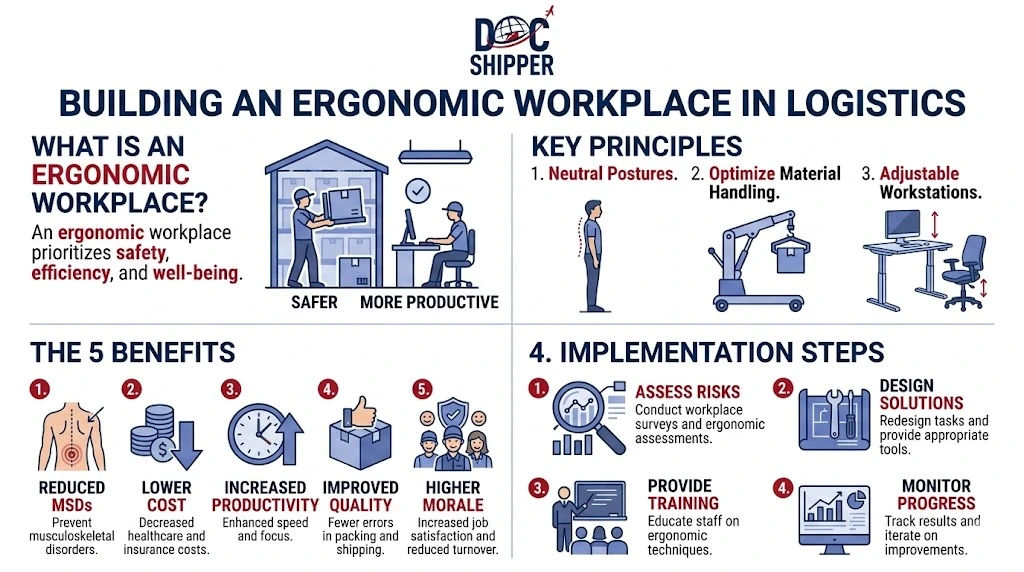
Ergonomic refers to the science of designing workspaces, equipment, and processes to fit human capabilities and limitations, maximizing safety, efficiency, and comfort. In logistics, ergonomic principles reduce workplace injuries, optimize material handling, and enhance productivity across warehousing, transportation, and supply chain operations.
Introduction
Why do warehouse workers experience injury rates three times higher than office employees? The answer lies in poor ergonomic design. Manual handling, repetitive motions, and inadequate workspace configuration create preventable health risks that cost the logistics industry billions annually.
In international trade and supply chain management, ergonomic optimization directly impacts operational efficiency, employee retention, and regulatory compliance. From container unloading to order picking, every physical interaction requires careful design consideration.
Key characteristics of ergonomic logistics operations include:
- Injury prevention through proper equipment design and workflow organization
- Productivity enhancement by reducing physical strain and fatigue
- Regulatory compliance with occupational health and safety standards
- Cost reduction through decreased absenteeism and workers’ compensation claims
- Employee satisfaction leading to lower turnover and higher morale
Ergonomic Principles & Expertise in Logistics
The biomechanical approach forms the foundation of logistics ergonomics. This methodology analyzes forces, postures, and repetitive movements to identify risk factors. Warehouses must consider spine compression limits (3,400 N for most adults), shoulder elevation angles (above 60° increases injury risk), and repetitive strain thresholds.
Material handling equipment represents the primary ergonomic intervention in logistics. Adjustable-height pallet jacks, powered lift assists, and scissor lift tables eliminate high-risk manual lifting. The NIOSH Lifting Equation provides scientific guidelines: loads exceeding 23 kg require mechanical assistance or team lifting protocols.
Workplace layout optimization applies ergonomic zoning principles. The golden zone (between knuckle and shoulder height) should contain 80% of frequently accessed items. Reach distances beyond 50 cm increase musculoskeletal disorder risk. Proper aisle width (minimum 1.2 meters for pedestrian traffic) prevents awkward postures during picking operations.
Cognitive ergonomics addresses mental workload in logistics operations. Order picking systems with visual cues, voice-directed technology, and intuitive warehouse management interfaces reduce decision fatigue. Information overload decreases accuracy by up to 35% during peak operational periods.
According to the Occupational Safety and Health Administration, implementing comprehensive ergonomic programs reduces workplace injuries by 40-60%. At DocShipper, we conduct systematic warehouse assessments to identify ergonomic risks before they result in costly incidents or regulatory violations.
Environmental factors complete the ergonomic framework. Temperature extremes (below 15°C or above 30°C), inadequate lighting (below 200 lux in picking areas), and excessive noise (above 85 dB) significantly impair physical performance and increase accident rates. Climate-controlled facilities with proper illumination demonstrate 25% higher productivity rates.
Concrete Examples & Performance Data
A European automotive parts distributor implemented ergonomic workstation redesign across three warehouses. Results after 12 months revealed dramatic improvements in operational metrics and worker safety.
| Performance Metric | Before Implementation | After Implementation | Improvement |
|---|---|---|---|
| Musculoskeletal injury rate | 8.7 per 100 workers | 2.4 per 100 workers | -72% |
| Average picking speed | 87 units/hour | 116 units/hour | +33% |
| Employee sick days (annual) | 412 days | 138 days | -67% |
| Workers’ compensation costs | €147,000 | €38,000 | -74% |
| Employee turnover rate | 28% | 12% | -57% |
Use Case: Container Unloading Optimization
A major 3PL provider serving the electronics industry redesigned their container unloading process. Traditional methods required workers to manually handle 400-600 cartons per shift, resulting in chronic back injuries. The ergonomic intervention included:
- Hydraulic dock levelers eliminating the 15 cm height differential between container floor and dock
- Powered roller conveyors extending into containers, reducing manual carrying distance from 12 meters to 2 meters
- Height-adjustable sorting stations allowing workers to maintain neutral spine positions
- Anti-fatigue matting and rotation schedules preventing prolonged static standing
- Team-lift protocols for items exceeding 18 kg, enforced through digital weight verification
Financial analysis revealed a €180,000 investment generated annual savings of €312,000 through reduced injuries, faster processing times, and decreased product damage. The payback period was 6.9 months.
DocShipper integrates ergonomic assessments into our warehousing solutions, ensuring facilities meet both operational efficiency targets and worker safety standards. Our multidisciplinary approach combines logistics engineering with occupational health expertise.
Conclusion
Ergonomic design in logistics is not merely a regulatory obligation but a strategic investment yielding measurable returns in safety, productivity, and cost management. Companies prioritizing human-centered workspace design consistently outperform competitors in both operational metrics and workforce stability.
Need expert guidance on implementing ergonomic solutions in your supply chain operations? Contact DocShipper for comprehensive assessments and optimization strategies tailored to your specific logistics environment.
📚 Quiz
Test Your Knowledge: Ergonomic in Logistics
1. What is the primary definition of ergonomic principles in logistics operations?
2. According to NIOSH guidelines, what is the maximum recommended weight for manual lifting under ideal conditions?
3. A warehouse manager notices workers frequently bending to floor level to pick items. Which ergonomic intervention would provide the most immediate benefit?
🎯 Your Result
📞 Free Personalized QuoteFAQ | Ergonomic in Logistics: Definition, Calculation & Concrete Examples
The main risks include repetitive lifting (over 10 lifts per hour), awkward postures (bending beyond 45° or twisting), forceful exertions (pushing/pulling loads exceeding 25 kg), static standing (over 2 hours continuously), and vibration exposure from powered equipment. These factors cumulatively increase musculoskeletal disorder probability by 300-500%.
Direct costs average €38,000-€65,000 per serious injury, including medical expenses and workers' compensation. Indirect costs (productivity loss, replacement training, accident investigation) multiply this by 3-5 times. A typical 200-employee warehouse experiences €200,000-€400,000 in total ergonomic-related costs annually without proper interventions.
The NIOSH (National Institute for Occupational Safety and Health) recommends a maximum of 23 kg under ideal conditions (load close to body, neutral posture, infrequent lifting). This limit decreases to 10-15 kg when conditions are less favorable. European Union directive 90/269/EEC provides similar guidance, with gender-specific recommendations.
Mechanical lift assists (pallet jacks, hoists, lift tables) typically deliver ROI of 200-400% within 18-24 months. These devices eliminate high-risk manual handling while increasing throughput. Administrative controls (job rotation, microbreaks) cost little but provide moderate benefits. Comprehensive programs combining multiple interventions achieve optimal results.
Proper ergonomics improves accuracy by reducing physical and cognitive fatigue. Studies show error rates decrease 15-25% when pick faces are positioned in the golden zone (waist to shoulder height) versus floor-level or overhead locations. Voice-directed systems with ergonomic headsets reduce errors by an additional 20-30% compared to paper-based methods.
General warehouse areas require minimum 200 lux, while detailed picking operations need 300-500 lux. Quality control zones should have 750-1000 lux. LED systems with color temperature 4000-5000K (neutral white) optimize visual performance without causing glare. Proper lighting reduces eye strain and picking errors by up to 40%.
Yes, significantly. Facilities with comprehensive ergonomic programs report 30-50% lower turnover rates compared to industry averages. Workers cite physical comfort, injury prevention, and employer commitment to safety as primary retention factors. Reducing turnover saves €3,000-€8,000 per prevented departure in recruitment and training costs.
Automation eliminates high-risk manual tasks but introduces new ergonomic considerations. Collaborative robots (cobots) handle heavy lifting while human workers focus on complex decisions. However, automation systems require ergonomic interfaces (proper screen heights, intuitive controls, appropriate response times) to prevent cognitive overload and repetitive strain from system operation.
Systematic assessment includes job task analysis, biomechanical measurements, employee surveys, and injury data review. Tools like the REBA (Rapid Entire Body Assessment) or NIOSH Lifting Equation quantify risk levels. Professional ergonomists conduct on-site evaluations identifying priority interventions. Annual reassessments ensure continuous improvement as operations evolve.
Requirements vary by jurisdiction. EU Directive 90/269/EEC mandates risk assessments and control measures for manual handling. OSHA in the United States provides guidelines through the General Duty Clause. Many countries have specific regulations for repetitive work, lifting limits, and workplace design. Non-compliance can result in fines, operational shutdowns, and increased liability.
Cold environments (below 15°C) reduce manual dexterity by 15-25% and increase injury risk through muscle stiffness. Heat (above 28°C) causes fatigue 40% faster and decreases cognitive function. Optimal range is 18-24°C with 40-60% relative humidity. Climate control investments improve productivity by 10-20% while reducing heat stress and cold-related injuries.
Effective training covers proper lifting techniques, equipment operation, workstation adjustment, early symptom recognition, and reporting procedures. Initial training requires 2-4 hours with annual refreshers. Hands-on practice with immediate feedback yields better results than lecture-only formats. Multilingual delivery ensures comprehension across diverse workforces. Documentation demonstrates regulatory compliance and supports injury prevention efforts.
Need Help with
Logistics or Sourcing ?
First, we secure the right products from the right suppliers at the right price by managing the sourcing process from start to finish. Then, we simplify your shipping experience - from pickup to final delivery - ensuring any product, anywhere, is delivered at highly competitive prices.


Fill the Form
Prefer email? Send us your inquiry, and we’ll get back to you as soon as possible.
Contact us




